










Need precision dimming in smart lighting systems? You’re not alone—many lighting professionals struggle to find a reliable and scalable solution for modern LED control.
A constant current DALI dimmable LED driver is a digitally controlled power supply that delivers a fixed output current to LEDs and enables advanced dimming and addressability using the DALI protocol.
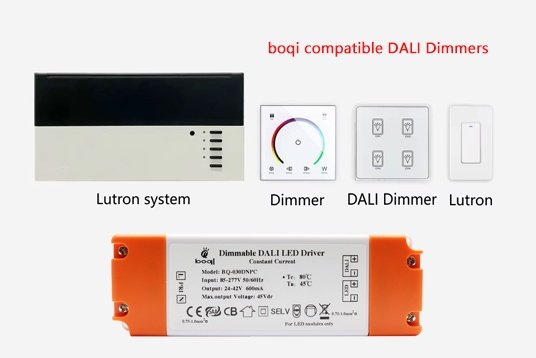
This article explains what a constant current DALI driver is, how it works, and why it’s a must-have for centralized smart lighting systems.
What Is a Constant Current LED Driver?
Many LED lighting failures come from mismatched drivers. If the current isn’t stable, LEDs can flicker or fail fast.
A constant current LED driver supplies a fixed current to LED modules, ensuring consistent brightness and protecting the LEDs from overcurrent damage.
Why Current Matters in LED Systems
LEDs are current-driven devices. That means their brightness and lifespan depend heavily on the current being controlled precisely. Voltage can vary, but current must stay constant to avoid damaging the diodes.
Key Components and Operation
| Component | Function |
|---|---|
| Constant Current Circuit | Maintains stable current output |
| Rectifier | Converts AC to DC |
| Regulator | Adjusts voltage to match LED requirements |
| Protections | Prevents overvoltage and short circuits |
When I first began working with LED systems, I didn’t understand how sensitive LEDs were to current fluctuation. After a few burnouts, I learned the hard way why constant current drivers are so essential.
What Is DALI? Understanding the Digital Addressable Lighting Interface
Traditional dimming can’t do much more than raise or lower brightness. For smart control, we need something smarter.
DALI stands for Digital Addressable Lighting Interface, a two-way communication protocol used to digitally control and monitor lighting systems.
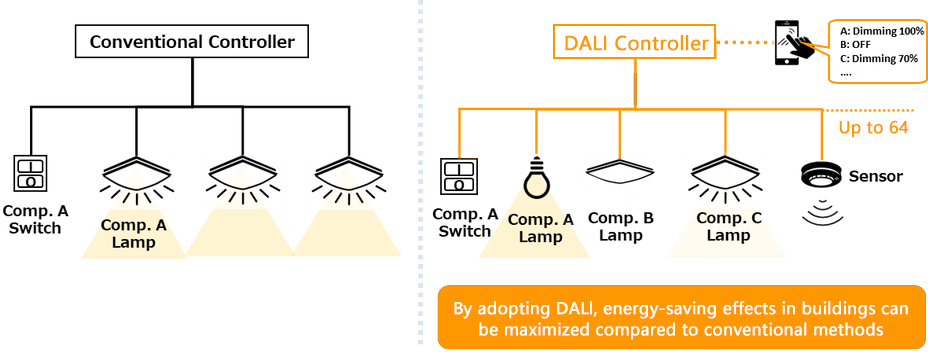
DALI at a Glance
DALI allows lighting fixtures and drivers to communicate individually with a central controller. That means you can dim lights individually, assign addresses, group them, and get feedback—all over two simple wires.
Key Features of DALI
| Fitur | Keterangan |
|---|---|
| Digital Addressing | Control each device independently |
| Two-Way Communication | Send commands and receive feedback |
| Scene Control | Create and store multiple lighting scenes |
| Open Standard | Interoperable across manufacturers |
Back in 2016, when I integrated DALI into a hotel renovation project, the flexibility it gave us over hallway lighting was a game changer. We could adjust scenes per time of day and even track fixture failures remotely.
How a Constant Current DALI Dimmable Driver Works
At first glance, it just looks like another LED driver—but it’s doing much more behind the scenes.
A constant current DALI dimmable driver powers LEDs with a steady current and communicates digitally with a central controller to adjust brightness and report status.
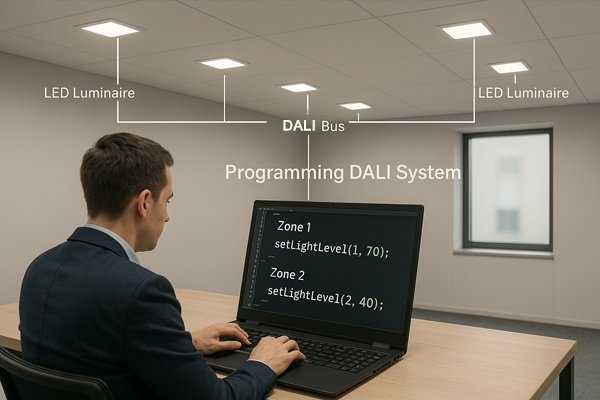
Internal Structure and Flow
These drivers contain both power regulation and a DALI interface chip. Here’s how it works:
- Power Circuit – Converts AC to a controlled DC current.
- DALI Interface – Receives dimming commands (0-100%) and executes them.
- Microcontroller – Assigns address, stores configuration, and provides status feedback.
Example: How a Scene Works
Say you’re programming a workspace. You assign each desk lamp a DALI address. Using a DALI controller, you group them into “Zone 1” and set a morning scene with 80% brightness. The driver handles the dimming and reports if one fixture fails.
| Function | DALI Role |
|---|---|
| Tingkat Peredupan | 0–100% digital command |
| Fault Detection | Status reply to controller |
| Group Control | Scene or broadcast command |
This level of control isn’t possible with analog protocols. It’s like comparing dial-up to fiber internet.
Key Electrical Specs: Current Ranges, Output Voltage, Power Factor
It’s not just about smart features. You still need to match the driver’s electrical specs with your LEDs.
Constant current DALI drivers typically offer adjustable current ranges, wide voltage outputs, and high power factor to meet varied lighting needs.
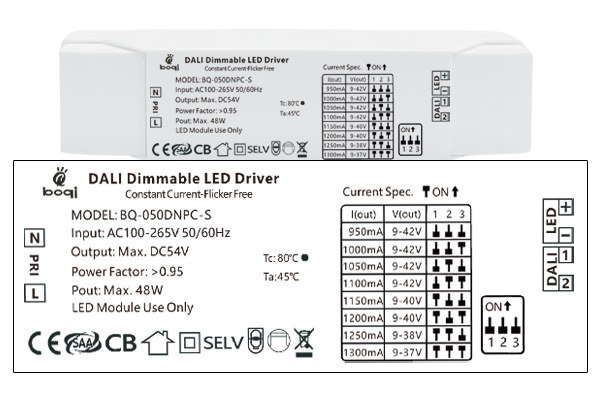
Key Specs to Review
| Parameter | Typical Value | Importance |
|---|---|---|
| Keluaran Saat Ini | 150mA – 1500mA (adjustable) | Must match LED module requirements |
| Tegangan Keluaran | 9V – 54V (varies by model) | Based on total LED voltage drop |
| Faktor kekuatan | ≥ 0.9 | Reduces energy waste |
| Efisiensi | ≥ 88% | Higher means less heat and lower cost |
| THD | < 15% | Cleaner power, important in large systems |
Many of our clients don’t know they can adjust output current via DIP switches or software on DALI drivers. That flexibility saves a lot of time and inventory space.
Features That Set DALI Apart: Addressability, Feedback, Precision
Why not just use 0–10V or TRIAC? That’s what many clients ask when we first talk.
DALI stands out because it offers digital addressability, real-time feedback, and precise dimming control over a simple two-wire bus.
What Makes DALI Smart
| Fitur | DALI | 0–10V/TRIAC |
|---|---|---|
| Individual Address | Yes | No |
| Dimming Precision | Digital steps (0.1% possible) | Analog or waveform control |
| Feedback Function | Yes (status reports) | No |
| Wiring Simplicity | 2 wires for control | Varies |
DALI’s digital nature lets us do things that analog dimming can’t—like controlling 64 lights individually on a single bus.
Where to Use Constant Current DALI Drivers: Ideal Applications
Not every project needs DALI. But when flexibility, efficiency, and control matter, it shines.
Constant current DALI drivers are ideal for commercial buildings, offices, hospitals, schools, and any smart lighting application where energy control and zoning are priorities.
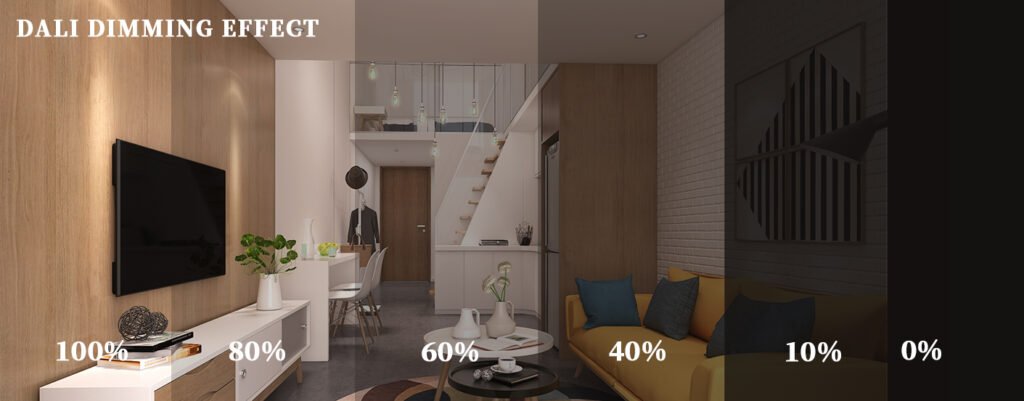
Best-Fit Projects
| Aplikasi | Why DALI Fits |
|---|---|
| Office Buildings | Zoning and daylight harvesting |
| Hotels | Scene setting and energy monitoring |
| Hospitals | Low-glare dimming for patient comfort |
| Classrooms | Adjust lighting per teaching needs |
| Airports/Malls | Centralized control for large areas |
When we worked on a large office retrofit, DALI let us group and automate hundreds of fixtures. The client saved 20% in energy bills in the first year.
System Compatibility: DALI Controllers, Sensors, and LED Fixtures
DALI isn’t just about drivers—you need the whole ecosystem to make it work.
DALI drivers integrate with DALI-certified controllers, sensors, and LED modules, creating a complete and interoperable smart lighting system.
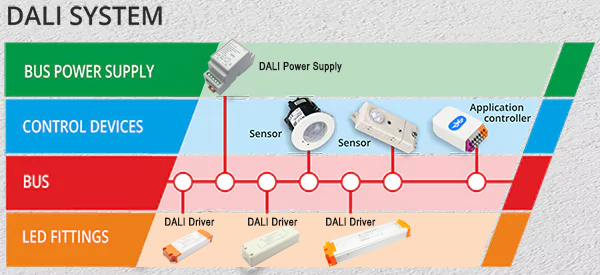
DALI Ecosystem Breakdown
| Component | Role in System |
|---|---|
| Pengontrol DALI | Sends commands and stores scenes |
| Motion Sensors | Trigger lighting based on presence |
| Light Sensors | Adjust brightness by ambient light |
| LED Fixtures | Must match current and voltage specs |
Always check compatibility. Once, a client mixed a DALI controller with a non-DALI sensor and couldn’t figure out why the scene wasn’t triggering. The system only works when every part speaks the same language.
Benefits of Using Constant Current DALI Dimmable Drivers
Still wondering if the extra cost is worth it?
Constant current DALI drivers improve energy savings, control accuracy, maintenance tracking, and user comfort in advanced lighting systems.
Real-World Advantages
- Energy Savings: Reduce power use with precise dimming and automation.
- Pemeliharaan: Get alerts on failed or disconnected fixtures.
- User Comfort: Set scenes based on task, mood, or time.
- Future-Proofing: Easily reprogram layout without rewiring.
Installation and Wiring Tips for DALI Systems
DALI wiring is simple, but a few mistakes can ruin your whole setup.
Use polarity-free 2-wire DALI bus wiring, follow limits for devices per bus, and avoid voltage drops to ensure smooth operation.
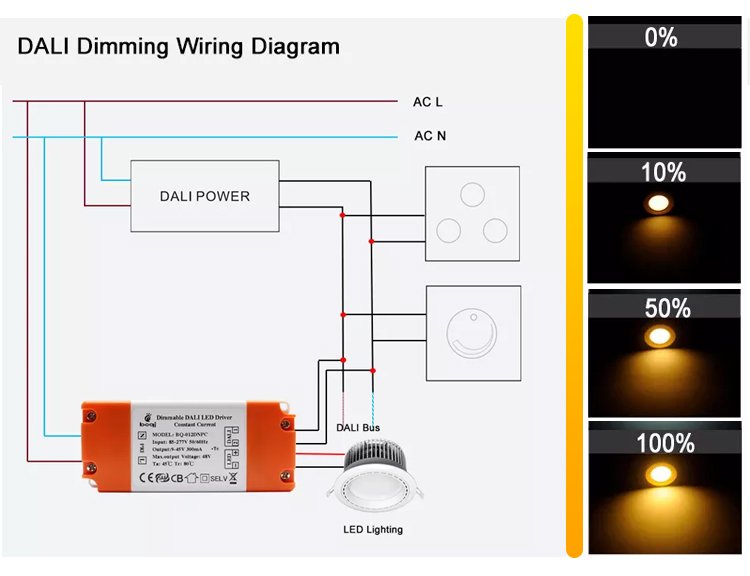
Wiring Guidelines
| Aspect | Tip |
|---|---|
| DALI Bus | Use 2 x 1.5mm² cables, polarity doesn’t matter |
| Max Devices per Bus | 64 addresses (not including groups/scenes) |
| Bus Voltage | 16V typical from DALI controller |
| Cable Length | Up to 300m recommended |
I’ve seen jobs fail because someone ran DALI wires next to power lines—leading to interference. Always isolate signal and power lines.
DALI vs. 0–10V vs. TRIAC: Which Is Right for Your Project?
All dimming protocols have their place. The key is choosing the right one for your goals.
DALI offers the most advanced control, while 0–10V is simple and analog. TRIAC is best for retrofits using AC phase-cut dimming.
| Fitur | DALI | 0–10V | TRIAC |
|---|---|---|---|
| Control Type | Digital | Analog | AC phase cut |
| Dimming Precision | High | Medium | Low |
| Feedback | Yes | No | No |
| Addressable | Yes | No | No |
| Wiring Complexity | Medium | Low | Low |
| Use Case | New smart builds | Simple projects | Retrofits |
Why Choose boqi DALI Drivers: Smart, Reliable, and Certified Solutions
It’s not just about features—it’s about trust and consistency.
boqi DALI drivers are reliable, efficient, and certified to global standards, offering smart control with long-term support.
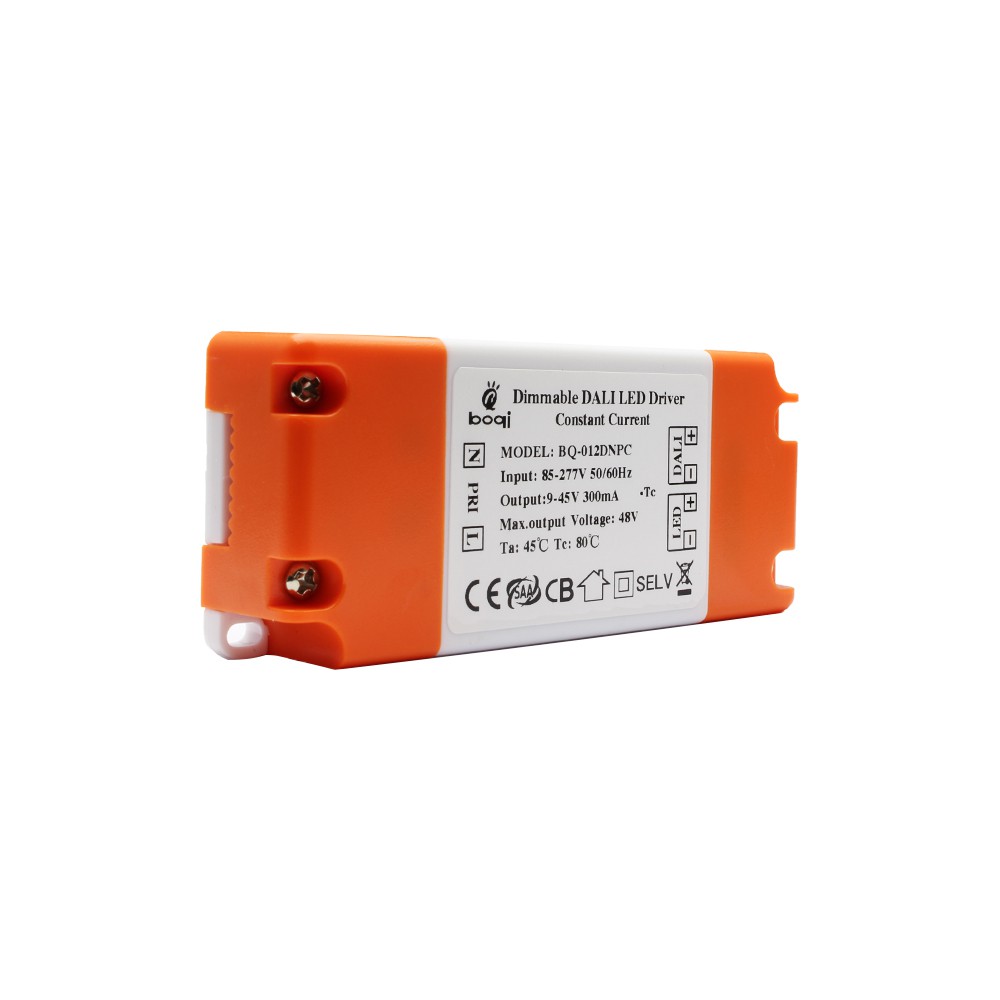
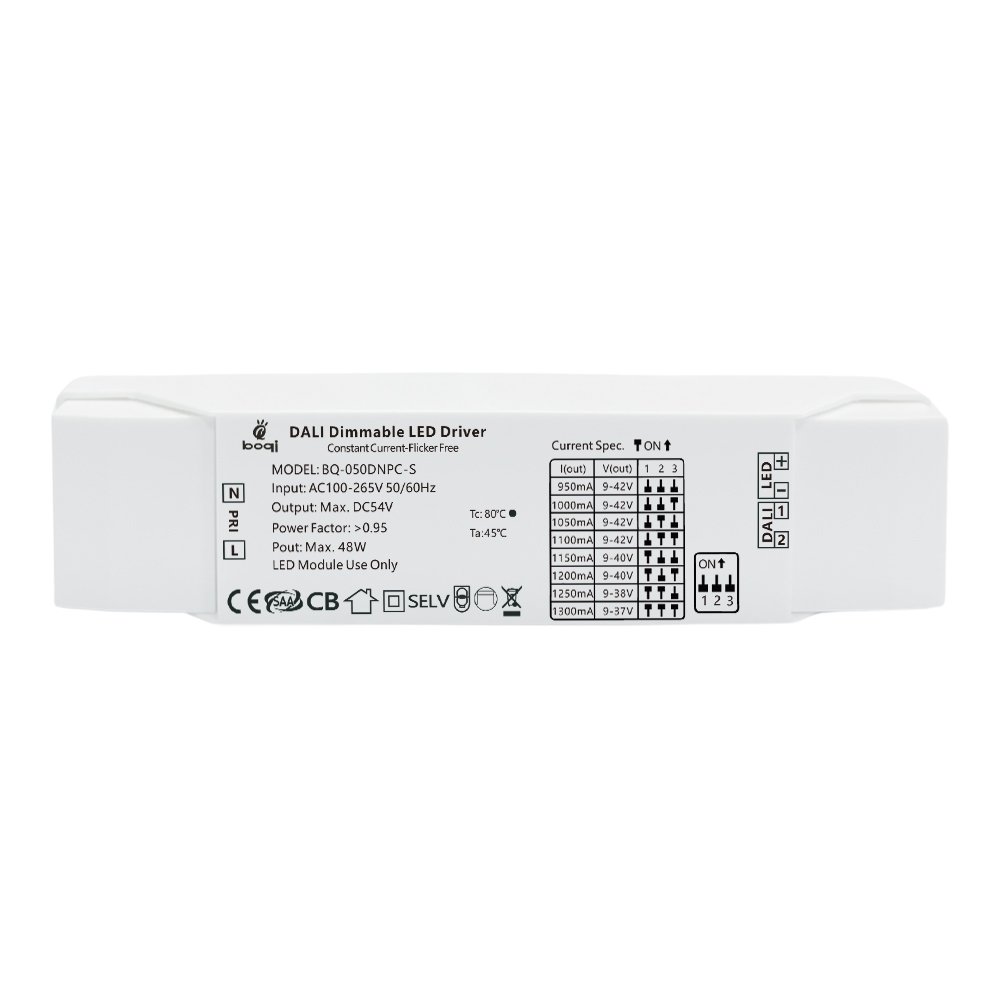
I started boqi because I saw too many inconsistent drivers fail under real-world conditions. Our drivers are tested for harsh environments, high accuracy, and long life. Many of our customers have used the same models for over 5 years without a single fault.
FAQs: Common Questions About DALI Constant Current Drivers
Q: Can I use DALI drivers with a non-DALI controller?
A: No, DALI drivers need a DALI-compatible controller to work properly.
Q: What if I don’t need feedback or scene control?
A: You might save money using 0–10V instead. But DALI is better for future upgrades.
Q: Can I change current settings on a DALI driver?
A: Yes, most offer DIP switch or software-based current tuning.
Q: Are DALI systems expensive?
A: Upfront cost is higher, but energy savings and control flexibility often make up for it in 1–2 years.
Kesimpulan
Constant current DALI drivers are the backbone of smart, reliable, and energy-efficient LED lighting systems for commercial and architectural use.