










Finding the right TRIAC dimmer for the UK can feel like a maze. Too many fail due to flickering, buzzing, or poor compatibility.
Choose a trailing edge TRIAC dimmer that matches your LED load range, supports low minimum wattage, complies with BS EN 60669-2-1, and fits UK wiring.
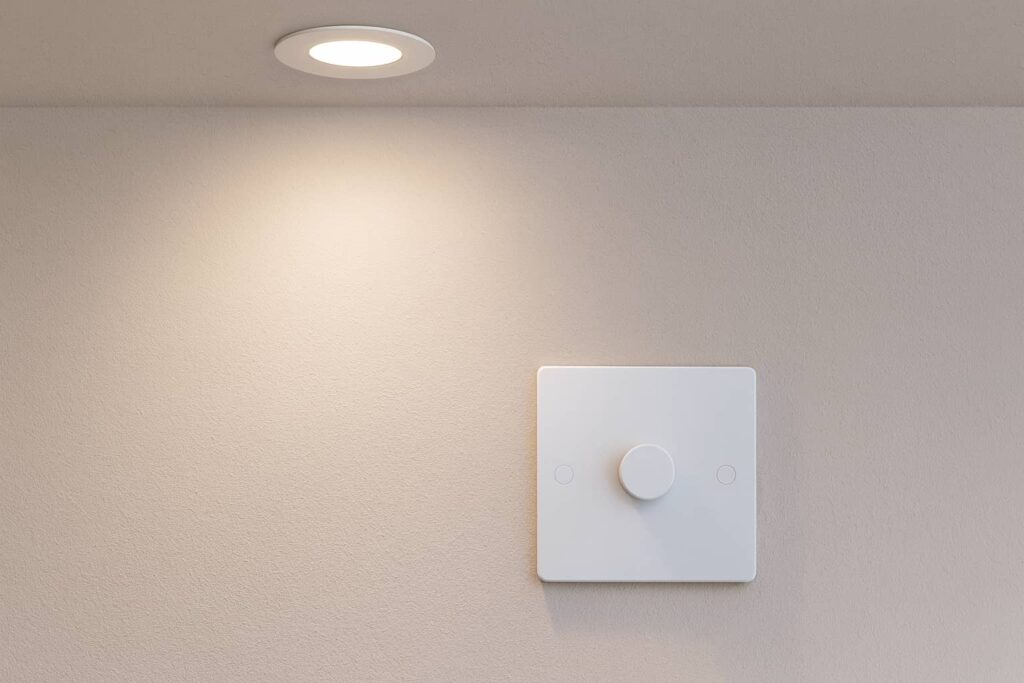
It’s not just about dimming. It’s about smooth, flicker-free performance that fits UK standards and satisfies your end users. Let’s explore what to check before buying.
Know the Basics: What is a TRIAC Dimmer?
If you’ve ever dealt with flickering lights or unstable dimming, chances are the wrong TRIAC dimmer was used.
A TRIAC dimmer controls AC power by switching on and off quickly during each cycle. It suits leading-edge and some trailing-edge dimming LED drivers.
How TRIAC Dimming Works
TRIAC (Triode for Alternating Current) is a semiconductor device. It regulates power by chopping parts of the AC waveform, reducing the voltage sent to the lamp. This is known as phase-cut dimming.
There are two types:
- Leading-edge (forward phase): Cuts the front of the waveform.
- Trailing-edge (reverse phase): Cuts the end of the waveform.
Suitable LED Drivers
TRIAC dimmers require phase-cut dimmable LED drivers. These are usually AC phase dimmable or TRIAC dimmable drivers, commonly used in retrofits and residential projects.
| Dimming Type | Compatible Driver Type | Common Applications |
|---|---|---|
| Leading-edge | TRIAC/AC phase dimmable | Incandescent, basic LEDs |
| Trailing-edge | TRIAC/AC phase dimmable | Dimmable LEDs, silent operation |
Pros and Cons of TRIAC Dimming
| Pros | Cons |
|---|---|
| No extra signal wires needed | Sensitive to driver compatibility |
| Works with 2-wire systems | Can flicker or buzz if mismatched |
| Affordable and easy to install | Limited dimming range on some loads |
Understand UK Mains Voltage and Wiring Systems?
Even the best TRIAC dimmer won’t work if it doesn’t match UK power specs.
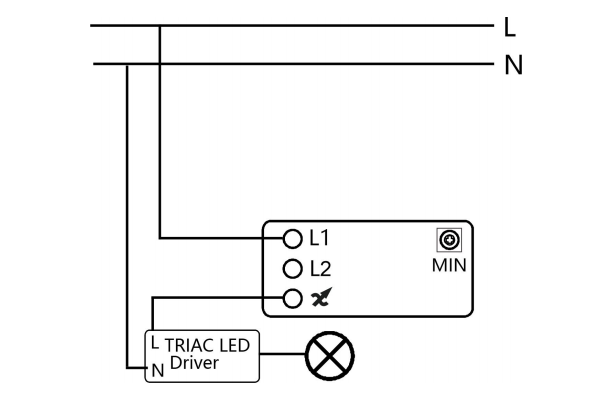
UK mains supply is 230V/50Hz with a 2-wire live-return system. Most homes lack a neutral at the switch. Dimmers must suit this setup.
UK Wiring: What You Need to Know
- Voltage: 230V ±10%
- Frequency: 50Hz
- Wiring: Most UK homes use a 2-wire system (live and switched live). Neutral is often not present at the wall switch.
This matters because:
- Some dimmers require a neutral to power their own circuit.
- Others, like well-designed TRIAC dimmers, work without a neutral, drawing power through the load.
86 Box Compatibility
The UK uses the 86-type back box (also called UK standard box). This limits internal space, especially if a dimmer needs extra components like relays or filters.
Check Compatibility with Dimmable LED Drivers?
The biggest headache in dimmer projects is poor compatibility—leading to flicker, dropout, or failure to start.
Always confirm that your TRIAC dimmer is tested and compatible with the LED driver used. Mismatched types can cause issues.

Why Compatibility Matters
LEDs work differently from traditional bulbs. They need a constant current or constant voltage driver to operate. A dimmer modifies the input waveform, and if the driver doesn’t accept this change correctly, problems occur.
Common problems include:
- Flickering at low brightness
- Light staying off until higher brightness
- Buzzing sounds
- Overheating of the dimmer or driver
How to Match Them
Look for:
- Drivers marked “TRIAC dimmable”, “phase-cut dimmable”, or “AC dimmable”
- Test reports from the dimmer supplier showing compatibility with your LED brand
- Drivers with wide input voltage ranges and low minimum load
| Checklist Item | What to Look For |
|---|---|
| Dimmable driver type | TRIAC or phase-cut dimmable |
| Minimum load | ≤3W recommended for LED |
| Max load | Should cover total LED wattage |
| Startup voltage | Low enough to light LED at dim setting |
| Flicker-free performance | Certified or tested by supplier |
Select the Right Dimming Curve and Load Type?
Not all TRIAC dimmers behave the same. The dimming curve makes a big difference in user experience.
Leading-edge dimmers cut the wave early and suit resistive loads; trailing-edge dimmers cut later and suit capacitive LED drivers.

Dimming Curves Explained
| Type | Cut Position | Load Type | Behavior |
|---|---|---|---|
| Leading-edge | Front | Resistive, inductive | Harsh startup, buzz with LEDs |
| Trailing-edge | End | Capacitive | Smooth dimming, quiet operation |
UK Market Preference
In the UK, most modern dimmable LED drivers are capacitive. This makes trailing-edge dimmers the safer choice.
Also, trailing-edge dimmers:
- Offer quieter operation
- Support lower minimum wattage
- Are gentler on drivers, reducing premature failure
Verify Certifications: CE, RoHS, UKCA?
Certifications are not just for paperwork—they’re for safety and market access.
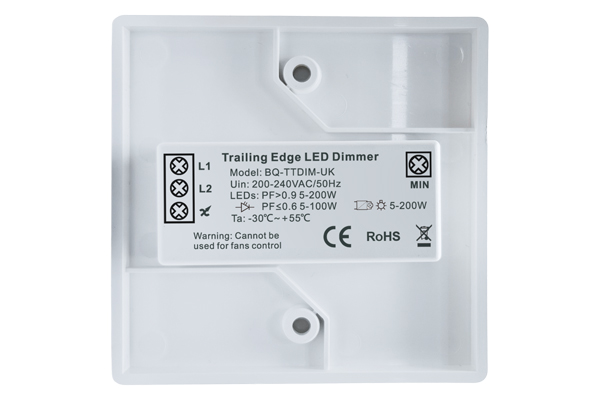
Make sure the TRIAC dimmer is CE, RoHS, and UKCA certified. This ensures electrical safety, EMI control, and compliance with UK law.
What Each Certification Means
| Mark | Stands For | Covers |
|---|---|---|
| CE | Conformité Européenne | EU safety, EMC, LVD |
| RoHS | Restriction of Hazardous Substances | No lead, mercury, etc. |
| UKCA | UK Conformity Assessed | Post-Brexit UK compliance |
These are usually required for:
- Retail distribution
- Projects involving electrical inspections
- Meeting customer procurement standards
Practical Tip
Ask your supplier for the Declaration of Conformity (DoC) and test reports. If they hesitate, it’s a red flag.
Consider Dimmer Design and Installation Form Factor?
Even if it works perfectly, a dimmer that doesn’t fit UK switch boxes or looks outdated won’t sell.
UK dimmers should match 86 box size, offer popular switch styles (knob or push), and suit retrofit installation.
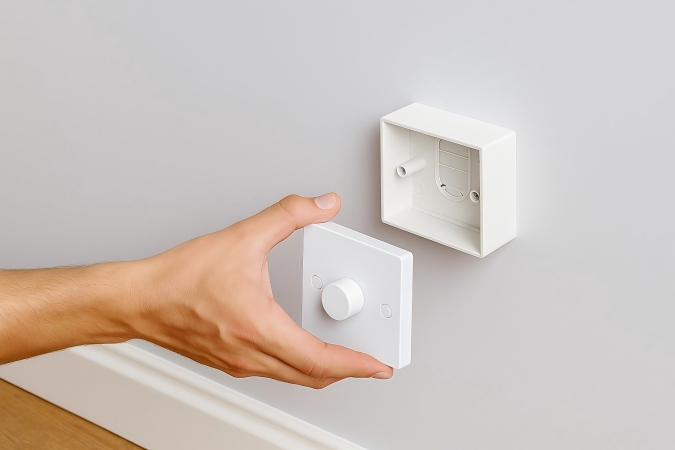
Physical Design Details
| Feature | UK Market Standard |
|---|---|
| Faceplate size | 86 x 86 mm |
| Box depth | Compatible with 35mm back box |
| Switch types | Rotary knob, push-button, combo |
| Installation | Screw-in for wall mount |
Design Features That Help
- Slim depth to fit crowded wall boxes
- Modular design to match different faceplates
- Soft-start function to extend LED lifespan
- Indicator LED for locating in the dark
Evaluate Performance: Flicker, Min. Load, and Stability?
A dimmer is only as good as its real-world performance.
Look for flicker-free dimming, low minimum load support (≤3W), and stable brightness with no pop-on or drop-out.
What to Test
- Flicker-free performance: Use a flicker meter or high-speed camera
- Minimum load: Make sure the dimmer turns on even with just one 3W LED
- Smooth curve: Avoid jumpy transitions at low brightness
- Startup behavior: No delayed or noisy startup
- EMI noise: Check if it causes radio interference
| Performance Metric | Ideal Value |
|---|---|
| Flicker Index | <0.1 (or <10% modulation) |
| Minimum Load | ≤3W |
| Startup Time | <0.5 seconds |
| Buzzing Noise | <25 dB (inaudible in room) |
| Dimming Smoothness | Full range, no jump or drop |
Choose a Reliable Supplier with Technical Support?
Even the best product can fail without good support. That’s why the supplier matters.
Choose a supplier that provides compatibility lists, customization, and local UK support. Avoid resellers with no engineering backup.

What to Look for in a Supplier
| Support Area | What to Expect |
|---|---|
| Technical documentation | Wiring diagrams, load charts, compatibility |
| Sample testing | Free or low-cost sample testing options |
| Certification support | All needed files ready |
| OEM/ODM ability | Logo, packaging, firmware customization |
| After-sales support | Email/WhatsApp/phone with engineer access |
At BOQI, we go beyond just selling dimmers. We test each model with popular UK LED brands and support our partners through every stage—from selection to installation. That’s why many of our customers stick with us long term.
Conclusion
Choosing the right TRIAC dimmer for the UK means balancing performance, safety, and compatibility—especially for 230V, no-neutral systems.