













Les drivers DALI CC reviennent sans cesse dans mes appels clients pour une raison. Sur notre ligne de production à Shenzhen, j'ai vu des projets de luminaires échouer simplement parce que le mauvais driver avait été installé. Les LED grillaient prématurément, le gradateur scintillait et les acheteurs perdaient des contrats. Cette douleur est évitable, et la solution se trouve à l'intérieur du luminaire lui-même.
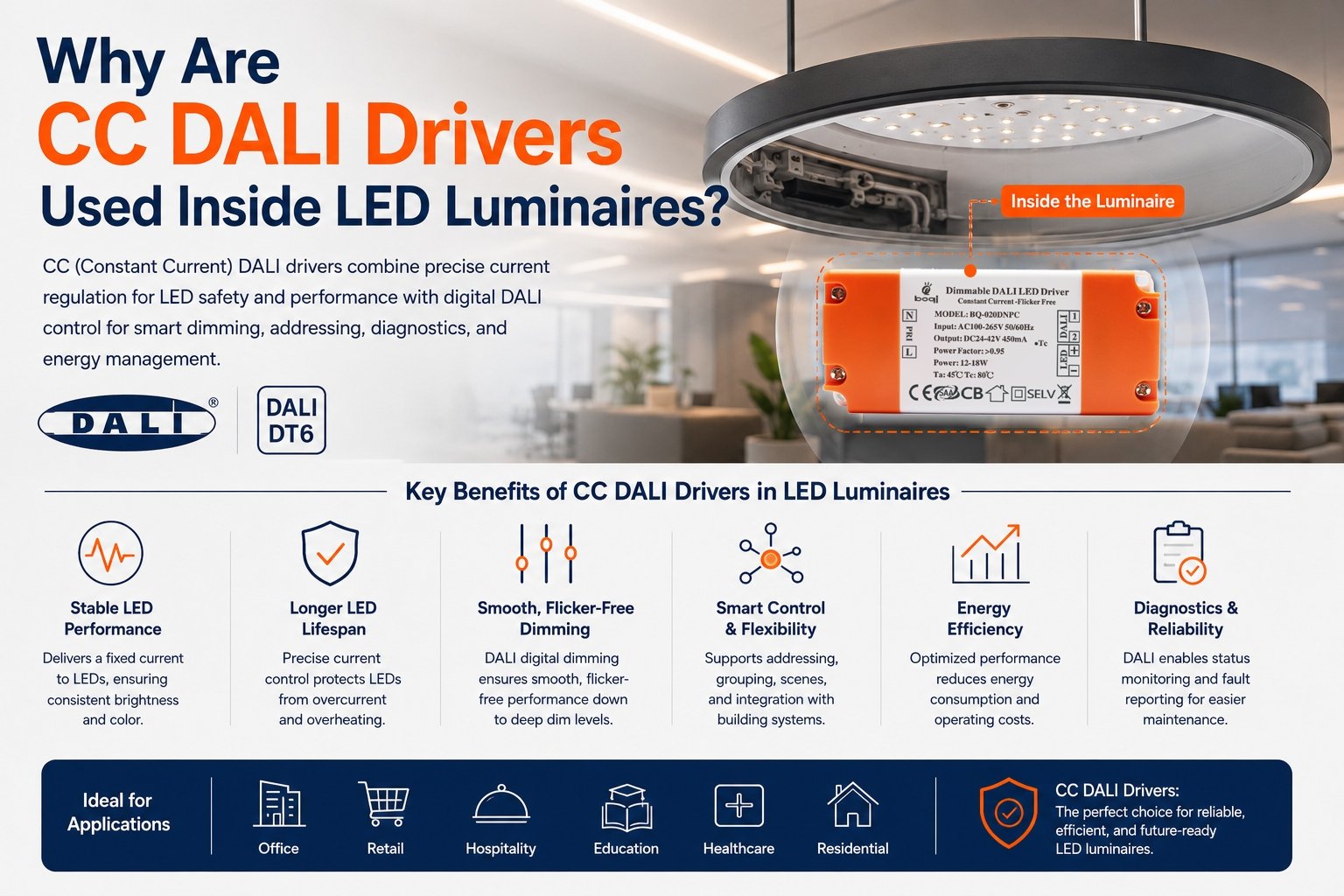
Les drivers DALI CC sont utilisés à l'intérieur des luminaires LED car ils fournissent un courant fixe et régulé qui protège les LED et stabilise la luminosité, tandis que l'interface DALI ajoute un gradateur numérique adressable, le contrôle de scènes, le diagnostic et l'intégration à l'automatisation des bâtiments — combinant une alimentation sûre et un contrôle intelligent dans un seul composant interne compact.
Voilà la réponse courte. Mais le tableau complet couvre le comportement électrique, la conception du système, les spécifications d'approvisionnement et le contrôle qualité. Laissez-moi vous guider à travers chaque partie, étape par étape.
Comment les drivers DALI CC améliorent-ils les performances à l'intérieur de mes luminaires LED ?
L'année dernière, nos ingénieurs ont démonté un downlight retourné d'un client en Italie. La carte LED était intacte. L'alimentation bon marché pilotée en tension à l'intérieur l'avait cuite. Cette démolition dit tout.
Les drivers DALI CC améliorent les performances des luminaires en maintenant un courant de sortie stable quelles que soient les fluctuations de tension, empêchant l'emballement thermique et la surcharge. Cette régulation de courant constant stabilise la luminosité et la couleur, prolonge la durée de vie des LED et permet un gradateur numérique fluide et sans scintillement sur toute la plage DALI.
Les LED sont des dispositifs pilotés par courantce 1s. Leur tension directe varie avec la température. Si vous leur fournissez une tension fixe, le courant augmente à mesure que la diode chauffe. Plus de courant crée plus de chaleur. Plus de chaleur attire plus de courant. Cette boucle est emballement thermique 2, et elle tue les cartes LED rapidement.
La régulation de courant constant 3 brise cette boucle. Le driver verrouille la sortie à une valeur fixe, telle que 350 mA, 500 mA, 700 mA ou 1050 mA. La tension flotte alors automatiquement pour correspondre à la charge LED. Le résultat est une sortie lumineuse stable, une couleur stable et une durée de vie prévisible.
Pourquoi le placement interne est important
Placer le driver à l'intérieur du luminaire n'est pas seulement une question de commodité. Des câbles de sortie DC courts réduisent les interférences électromagnétiques 4. Dans nos pré-tests CEM, les luminaires avec drivers internes passent les contrôles de conformité plus facilement que les luminaires avec de longs câbles externes. Le driver et la carte LED partagent également une seule conception thermique, de sorte que les fonctions de protection comme le repli thermique répondent aux conditions réelles du luminaire.
L'avantage du gradateur
DALI ajoute un gradateur numérique avec 254 niveaux définis sur une courbe standardisée. Comparé au contrôle analogique 0-10V, cela offre des performances sans scintillement et des résultats reproductibles sur chaque luminaire d'un projet. Voici comment les facteurs de performance se comparent :
| Facteur de performance | Alimentation CV de base | Driver DALI CC à l'intérieur du luminaire |
|---|---|---|
| Contrôle du courant | Aucun (tension uniquement) | Sortie fixe et régulée |
| Risque d'emballement thermique | Élevé | Éliminé par conception |
| Qualité du gradateur | Scintille souvent | Fluide, numérique, sans scintillement |
| CEM sur les câbles de sortie | Plus élevée (longues distances) | Minimisée (câbles courts) |
| Uniformité de la luminosité | Dérive avec la chaleur | Stable sur la durée de vie |
| Retour de défaut | Aucun | Communication bidirectionnelle |
Certains modèles avancés prennent même en charge la programmation du maintien du flux lumineux (Constant Light Output). Le driver augmente progressivement le courant au fil des années pour compenser la dépréciation naturelle des lumens, de sorte que le luminaire a le même aspect au jour 3 000 qu'au premier jour.
Qu'est-ce qui rend les drivers DALI CC mieux adaptés que d'autres types de drivers pour mes luminaires ?
Un responsable des achats de Singapour m'a un jour posé une question directe sur WhatsApp : pourquoi ne pas simplement utiliser des drivers 0-10 V moins chers pour toute sa gamme de downlights ? Ma réponse a tenu en un tableau comparatif.
Les drivers DALI à courant constant surpassent les autres types de drivers en combinant une régulation précise du courant avec un contrôle d'éclairage adressable. Contrairement aux drivers 0-10 V ou TRIAC, chaque unité DALI peut être adressée, groupée et surveillée individuellement, rendant les luminaires prêts pour l'automatisation de l'éclairage commercial sans recâblage supplémentaire.
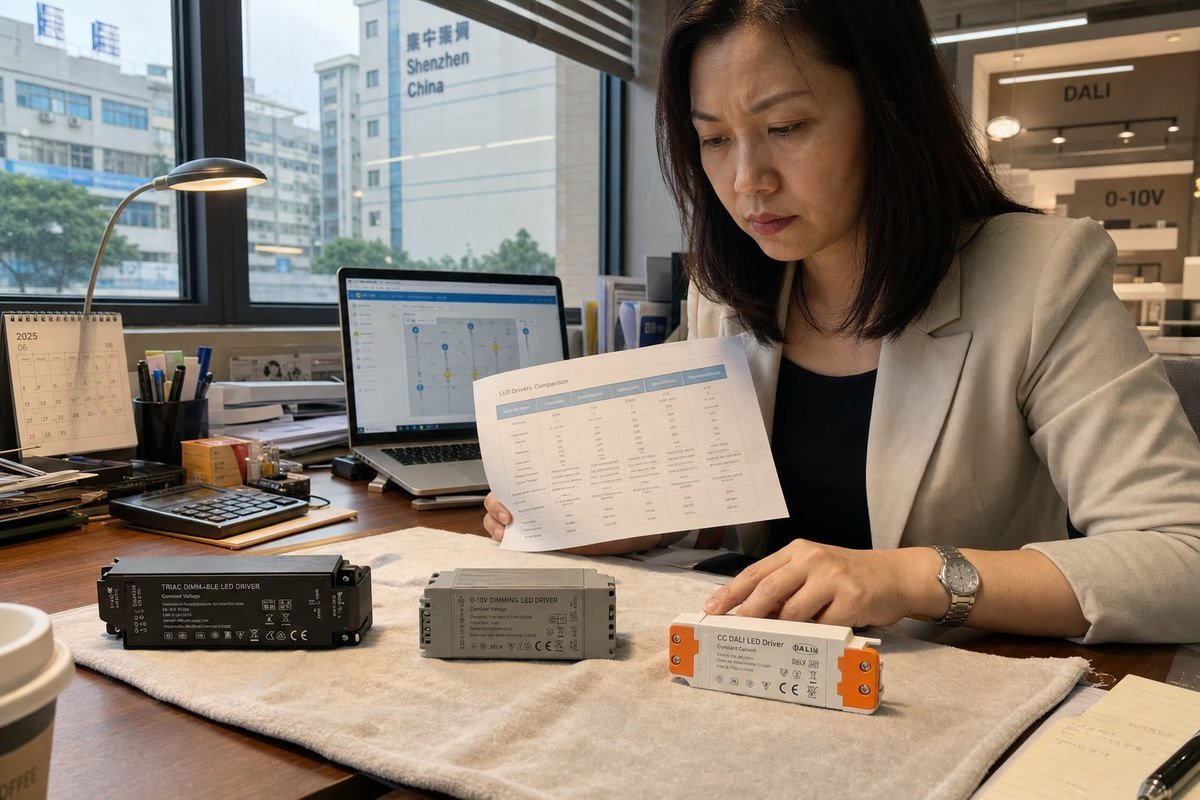
Commençons par la comparaison directe. Voici ce que je partage avec les acheteurs qui évaluent les types de drivers pour une nouvelle gamme de luminaires :
| Caractéristique | Circuit de commande de TRIAC | Circuit d'attaque 0-10 V | Driver DALI à courant constant |
|---|---|---|---|
| Type de contrôle | Analogique, coupure de phase secteur | Signal de tension analogique | Protocole numérique (norme IEC 62386 6) |
| Adressage individuel | Non | Non | Oui, par luminaire |
| Regroupement des luminaires | Recâblage nécessaire | Recâblage nécessaire | Logiciel uniquement |
| Retour d'information au contrôleur | Aucun | Aucun | Communication bidirectionnelle |
| Précision de la gradation | Varie selon le gradateur | Modéré | 254 niveaux standardisés |
| Câblage | Basé sur le secteur | Paire séparée sensible à la polarité | Bus 2 fils sans polarité |
| Intégration bâtiment intelligent | Faible | Limitée | Natif (KNX 7, BACnet, IoT) |
L'histoire du câblage
DALI utilise un bus à deux fils indépendant de la polarité. Les installateurs peuvent le faire passer dans le même conduit que l'alimentation secteur. Il n'y a pas de polarité à respecter et aucun conduit de contrôle séparé à budgétiser. Sur les grands projets, cela réduit à lui seul les coûts d'installation et les erreurs.
Logiciel au lieu de tournevis
Avec les systèmes analogiques, modifier les luminaires qui se gradent ensemble implique un recâblage physique. Avec le contrôle d'éclairage adressable, un intégrateur regroupe les luminaires depuis un ordinateur portable. Les bureaux sont reconfigurés. Les présentoirs de vente au détail changent selon les saisons. Les luminaires DALI s'adaptent sans toucher un seul fil.
Comportement d'appel de courant et de démarrage
Il y a un autre point que les acheteurs négligent souvent. Les drivers DALI de qualité prennent en charge des vitesses de fondu programmables et un démarrage progressif échelonné. Lorsqu'un étage entier de bureaux se met sous tension à 8 h, des centaines de drivers qui commutent en même temps peuvent provoquer une pointe de courant d'appel et faire sauter les disjoncteurs. Le comportement de démarrage progressif répartit cette charge. Pour les bureaux d'ingénierie qui spécifient de grands bâtiments, c'est un véritable argument de vente, pas une note de bas de page.
Pour les downlights, les spots, les luminaires linéaires et les produits à blanc réglable, la combinaison DALI à courant constant est simplement le meilleur choix au niveau du système.
Quelles spécifications techniques dois-je vérifier avant de choisir un fournisseur de drivers DALI CC ?
Les fiches techniques peuvent cacher autant qu'elles révèlent. Notre équipe examine chaque semaine les fiches techniques des concurrents, et les écarts que nous trouvons entre les performances annoncées et testées me surprennent encore après des années dans ce métier.
Avant de choisir un fournisseur, vérifiez la plage et la précision du courant de sortie, la fenêtre de tension de sortie, la conformité DALI-2, la profondeur de gradation, les performances de scintillement, les fonctions de protection, le rendement, la température nominale du boîtier, les marques de sécurité comme CE et SELV, ainsi que les dimensions physiques pour l'installation dans le luminaire.
Laissez-moi décomposer la liste de contrôle en couches, car toutes les spécifications n'ont pas le même poids.
Fondamentaux électriques
Vérifiez d'abord les options de courant de sortie. Les valeurs courantes sont 350 mA, 500 mA, 700 mA et 1050 mA. Les meilleurs drivers offrent un courant sélectionnable ou programmable par NFC par pas fins. Cette programmabilité permet à une seule référence de couvrir plusieurs modèles de luminaires, ce qui simplifie votre inventaire. Confirmez ensuite que la fenêtre de tension de sortie correspond à votre chaîne de LED. Une inadéquation ici signifie que le luminaire ne quittera jamais le laboratoire.
Qualité du contrôle et du gradateur
La conformité DALI-2 est non négociable pour les projets sérieux. Elle prouve la conformité à la norme IEC 62386 et garantit l'interopérabilité avec les capteurs et contrôleurs d'autres marques. Examinez ensuite la plage de gradation numérique. Les drivers haut de gamme gradent en douceur jusqu'à 1 % ou même 0,1 %. Demandez des données sur le scintillement, pas seulement le mot “ sans scintillement ”.”
Protection et conformité
Voici le tableau des priorités que je partage avec les nouveaux clients B2B :
| spécification | Ce qu'il faut vérifier | Pourquoi c'est important |
|---|---|---|
| Conformité DALI-2 | Confirmer avec le fournisseur | Garantit l’interopérabilité entre marques |
| Profondeur de gradation | Mesuré, non revendiqué | Confort visuel dans les hôtels, bureaux |
| Ensemble de protections | OVP, SCP, OTP, surcharge | Le luminaire survit aux défauts de terrain |
| Température de boîtier (tc) | Point nominal et valeur maximale | Détermine la durée de vie dans les boîtiers chauds |
| Marques de sécurité | CE, CB, SAA, SELV selon les besoins | Accès légal au marché par région |
| Dimensions | Largeur, longueur, pattes de montage | Doit s’intégrer dans les luminaires compacts |
| Efficacité | À pleine charge et en gradation | Pilote les résultats de monitoring énergétique |
La taille physique compte plus que ce que l’on pense. Les drivers pour luminaires compacts peuvent être aussi fins qu’environ 30 mm de large. Si votre boîtier de downlight est peu profond, cette dimension décide de toute la conception. Demandez également le support D4i si votre feuille de route inclut le monitoring énergétique, le reporting de défauts ou des luminaires intelligents prêts pour capteurs. Les drivers compatibles D4i intègrent une alimentation de bus et des modèles de données qui transforment chaque luminaire en nœud de reporting.
Comment puis-je garantir la qualité et la conformité lors de l'approvisionnement en drivers DALI CC pour ma gamme de luminaires ?
Une leçon difficile de nos débuts à l’export : un driver qui passe seul la CEM peut encore échouer dans un boîtier métallique. Nous avons appris à tester le luminaire complet assemblé, et nous conseillons désormais à chaque client de faire de même.
Garantir la qualité en auditant le processus de contrôle qualité du fournisseur, en exigeant les marques DALI-2 et les marques de sécurité régionales, en testant le luminaire complet pour la CEM comme un seul assemblage, en réalisant des tests thermiques au point tc du driver, et en validant la gradation, le reporting de défauts et l’interopérabilité avant la production en série.

La conformité est un processus, pas un certificat. Voici la séquence que nous suivons avec les partenaires OEM, et celle que je recommande à tout acheteur construisant une gamme de luminaires en marque privée.
Un processus d'approvisionnement pratique en cinq étapes
- Vérifiez les certifications à la source. N’acceptez pas un simple PDF. Vérifiez et confirmez que les rapports CE, CB ou SAA proviennent de laboratoires reconnus. Faites correspondre le numéro de modèle du rapport au produit réel.
- Testez le luminaire assemblé, pas seulement le driver. Lorsqu’un driver est installé dans un luminaire, la CEM de l’ensemble doit être testée comme une seule unité. Les boîtiers métalliques, les longueurs de câblage et les cartes LED modifient tous le résultat.
- Réalisez la validation thermique au point tc. Mesurez la température de boîtier du driver dans votre luminaire réel à pleine charge dans une chambre chauffée. Chaque tranche de dix degrés au-dessus du tc nominal peut réduire considérablement la durée de vie du driver.
- Validez la couche de contrôle. Connectez le driver à au moins deux contrôleurs DALI-2 différents. Confirmez l’adressage, le regroupement, le rappel de scènes, les taux de fondu et la communication bidirectionnelle. Vérifiez que le reporting de défauts et les données de monitoring énergétique se lisent correctement si vous utilisez les fonctions D4i.
- Figez l’échantillon de référence. Approuvez une unité de référence testée, puis maintenez la production contre celle-ci avec des inspections à réception, des contrôles en ligne et un vieillissement de rodage avant expédition.
Ce à quoi ressemble un bon contrôle qualité à l'usine
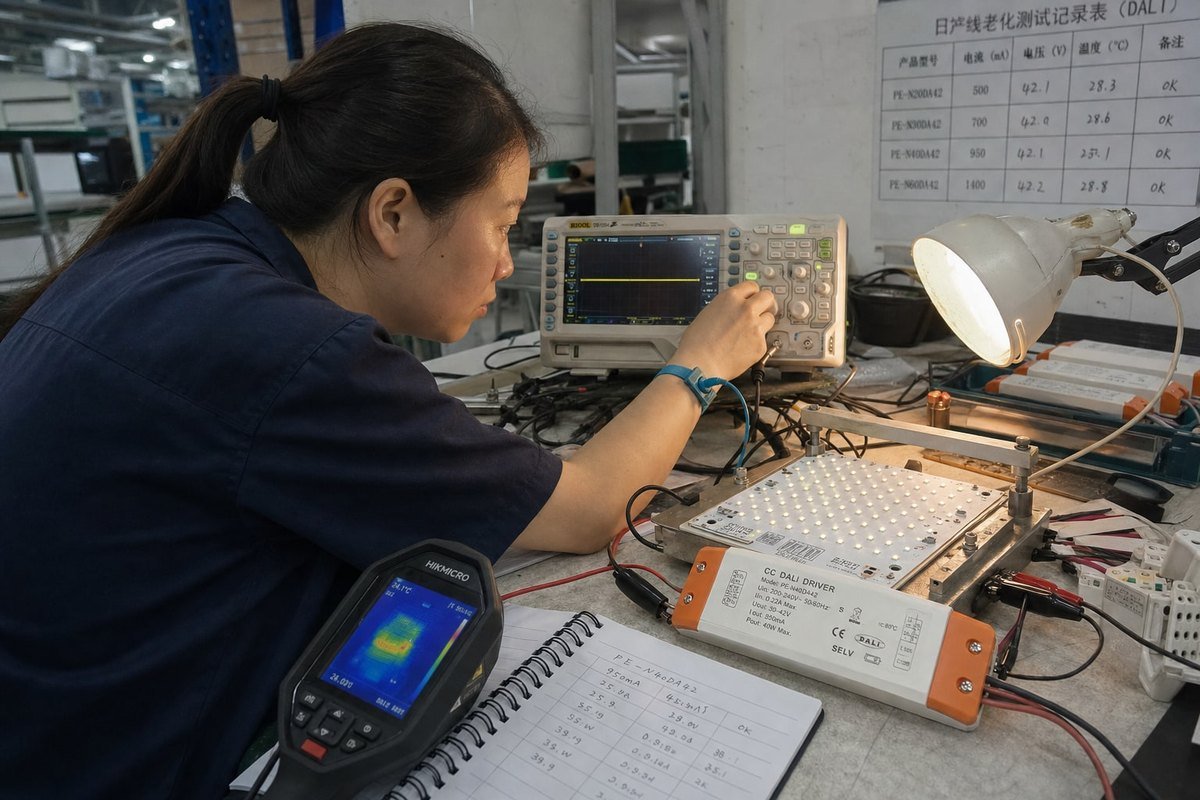
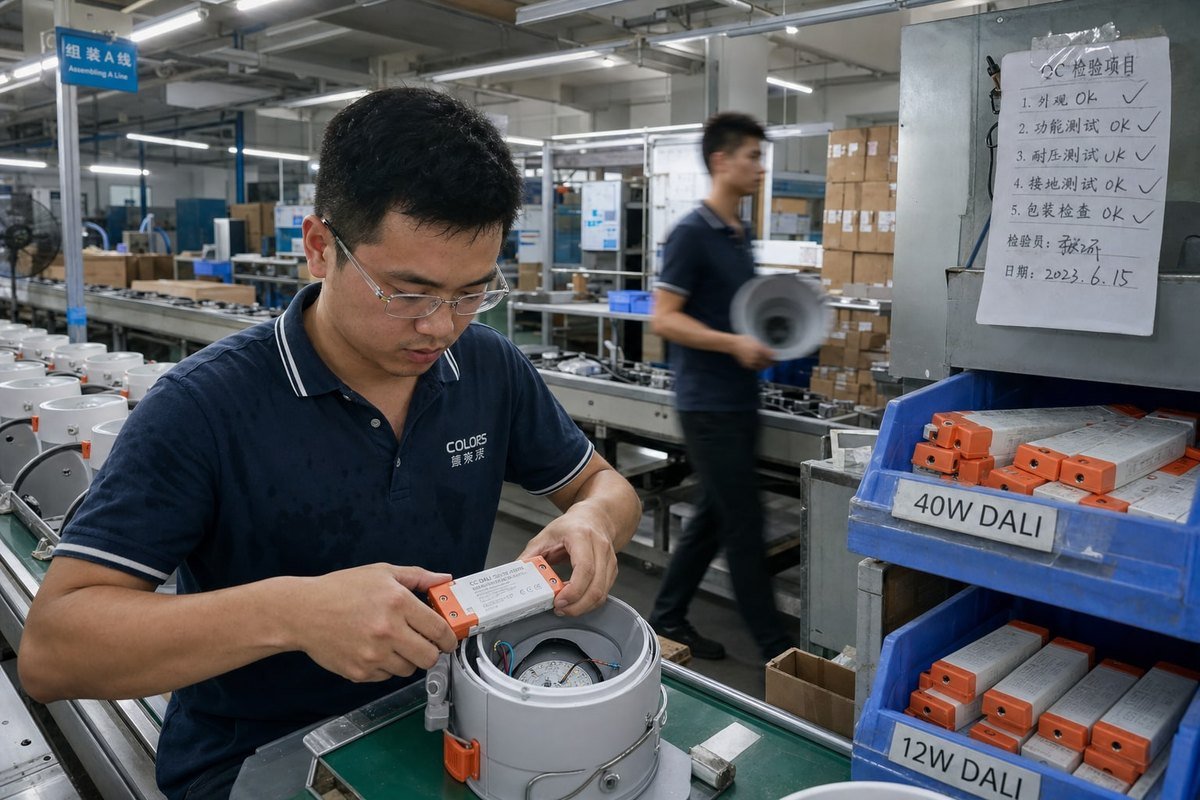
Dans notre installation de Shenzhen, chaque lot de drivers gradables passe par des tests de vieillissement avant l’emballage. Nous enregistrons les courbes de gradation et vérifions le scintillement sur des unités échantillons. Pour les clients sous délais de projet serrés, cette discipline compte. Un conteneur de drivers défectueux ne coûte pas seulement de l’argent. Il coûte la fenêtre d’installation, et les projets d’automatisation d’éclairage commercial pardonnent rarement les retards. Demandez à votre fournisseur de montrer ses racks de vieillissement et ses enregistrements de test. Un partenaire sérieux accueillera la question favorablement. Un partenaire faible changera de sujet.
Conclusion
Les drivers CC DALI gagnent leur place dans les luminaires LED en résolvant deux problèmes à la fois : protéger les LED grâce à la régulation de courant constant et permettre un contrôle intelligent et adressable. Choisissez les spécifications avec soin, testez l’assemblage complet et associez-vous à un fournisseur dont vous pouvez vérifier le contrôle qualité.
Notes de bas de page
Source officielle de l’UE expliquant la marque de sécurité CE que les acheteurs doivent vérifier sur les drivers. ↩︎
Concept de fond expliquant le mécanisme de défaillance des LED auquel l’article fait référence à plusieurs reprises. ↩︎
Explique le principe électrique sous-jacent à la régulation de courant des drivers LED abordée dans l’article. ↩︎
Clarifie le phénomène d’EMI pertinent pour le placement interne du driver et les tests CEM. ↩︎
Référence de fond sur le comportement de tension des semi-conducteurs affectant les performances thermiques des LED. ↩︎
Référence à la norme internationale régissant le protocole de contrôle d’éclairage numérique DALI. ↩︎
Site officiel de l’Association KNX expliquant la norme mondiale pour l’automatisation des bâtiments. ↩︎