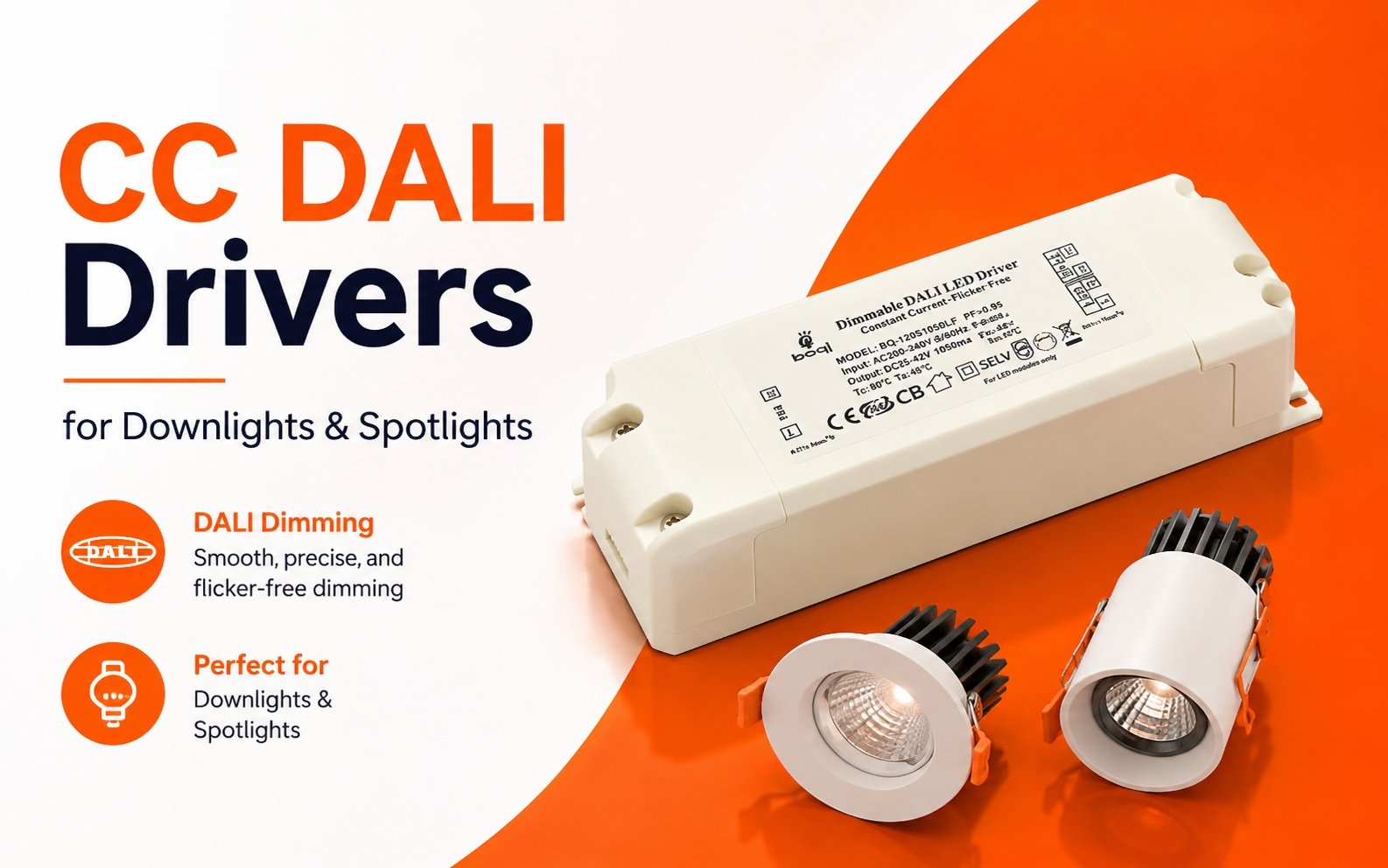















Multi-zone regeling met [CV DALI-drivers](https://boqiled.com/?p=17832) klinkt eenvoudig—tot de inbedrijfstelling op locatie vastloopt. Op onze productielijn in Shenzhen herleiden we de meeste mislukte projecten tot één vermijdbare planningsfout.
Multi-zone regeling met CV DALI-drivers laat elke LED-verlichtingszone onafhankelijke helderheids- of kleurcommando's ontvangen via DALI-adressen, groepen en scènes. DT6-drivers verzorgen enkelkanaals dimmen, terwijl DT8-drivers tunable-white of RGBW-kanalen onder één adres coördineren, wat de inbedrijfstelling in grote installaties vereenvoudigt.
Dat korte antwoord verbergt verschillende valkuilen. In dit artikel loop ik door hoe het systeem werkt, wat je moet controleren vóór de inkoop, waar de kostenbesparingen echt vandaan komen, en hoe je drivers op maat maakt zonder compliance-hoofdpijn.
Hoe maken CV DALI-drivers naadloze multi-zone regeling mogelijk in grootschalige verlichtingsprojecten?
Een distributeur in Duitsland bestelde ooit onze 4-kanaals RGBW-drivers in de verwachting vier onafhankelijke ruimtezones te krijgen. Die misvatting leerde ons de architectuur uit te leggen voordat we een project offreren.
CV DALI-drivers maken multi-zonebediening mogelijk door constant-voltage LED-voeding te combineren met digitale adressering op een tweedraadsbus. Elke driver heeft zijn eigen DALI-adres, kan deelnemen aan maximaal 16 groepen en reageert op scène-opdrachten, zodat elke zone onafhankelijk dimt zonder afzonderlijke dimmercircuits.

Het kernconcept is scheiding. DALI is een digitaal regelnetwerk 1 gedefinieerd onder IEC 62386. De belastingszijde blijft constante spanning 2—typisch 12V, 24V, 36V of 48V DC—die LED-tape of modules in parallelle bedrading voedt. Adresseerbare lichtregeling komt volledig van de bus, niet van de voedingsbedrading. Een enkele DALI-lijn ondersteunt tot 64 individuele adressen, die je kunt organiseren in 16 groepen voor gesynchroniseerd dimmen en scèneterugroepen across verlichtingszones en groepen.
DT6 vs DT8: Welk apparaattype past bij jouw zones?
| Voorzien zijn van | DT6-driver | DT8-driver |
|---|---|---|
| Kanalen | Enkelkanaals dimmen | Multichannel: DT8 tunable white, RGB, RGBW |
| Adresverbruik | Eén adres per kanaal | Eén adres voor de hele kleureenheid |
| Beste gebruik | Onafhankelijke enkelkleurige zones | Gecoördineerde kleur- of CCT-regeling |
| Inbedrijfstellingsinspanning | Eenvoudig, één zone per adres | Minder adressen, gecoördineerde kanalen |
Een multichannel-driver is geen multi-zone systeem
Hier is het grootste misverstand dat ik zie. Multichannel LED-drivers, zoals een 4-kanaals RGBW DT8-eenheid, hebben vier fysieke uitgangen. Maar die kanalen zijn ontworpen om samen te werken als één kleurgeregelde zone. Als jouw project Zone A voor de receptie nodig heeft, Zone B voor een gang, Zone C voor uitstalrekken en Zone D voor plafondverlichting, dan heb je onafhankelijk adresseerbare drivers nodig—niet één RGBW-eenheid.
De juiste ontwerpvolgorde is: verlichtingszones → regelvereisten → DALI-adresseringsstrategie → DT6 of DT8 selectie → driverkanalen → vermogensberekening. Veel teams doen het omgekeerde. Ze kiezen eerst een driver en forceren dan zones rond de uitgangen ervan. Onthoud ook: DT8 bespaart adressen, geen drivers. Eén tunable-white armatuur werkt onder één DT8-adres, maar vier afzonderlijke ruimtes hebben nog steeds afzonderlijke drivers of adressen nodig.
Waar moet ik op letten voordat ik CV DALI-drivers inkoop voor commerciële installaties met meerdere zones?
Vorig jaar stuurde een inkoopmanager in Singapore ons een specificatie van één regel: DALI CV-driver, 24V, vier zones. Onze ingenieurs antwoordden met twaalf vragen voordat we iets zouden offreren.
Verifieer vóór sourcing de IEC 62386-compliance en DALI-2-certificering, bevestig echte kanaalonafhankelijkheid, stem de uitgangsspanning af op uw LED-belasting, controleer de PWM-dimmingkwaliteit en low-end prestaties, beoordeel de busvoedingsvereisten en vraag gedocumenteerde QC-records plus CE-, CB- en SELV-certificering.

Die twaalf vragen bestaan omdat een specificatieblad zelden het volledige verhaal vertelt. Hier is de checklist die we kopers doorlopen voordat de productie start.
De verificatietabel vóór inkoop
| Check Point | Wat moet je controleren? | Waarom dit belangrijk is |
|---|---|---|
| IEC 62386-naleving | Echte DALI-2 testrapporten, niet alleen “DALI compatible” claims | Garandeert interoperabiliteit met sensoren, schakelaars en controllers |
| Uitgangsspanning | 12V, 24V, 36V of 48V afgestemd op jouw strips; 24V DC constante spanning is het meest voorkomend | Verkeerde spanning beschadigt LED's of stuurt ze onvoldoende aan |
| Kanaalonafhankelijkheid | Echte onafhankelijke kanalen versus eenvoudige parallelle uitgangen | Parallelle uitgangen kunnen geen afzonderlijke zones vormen |
| Dimkwaliteit | Pulse Width Modulation dimfrequentie, logaritmische dimcurves, low-end diepte—sommige ontwerpen bereiken ongeveer 0,1% | Voorkomt zichtbare flikkering in hospitality- en architecturale ruimtes |
| Busvoeding | Of het systeem een externe DALI-busvoeding nodig heeft en de busstroomopname van elke driver | Een overbelaste bus veroorzaakt weggevallen commando's en dode zones |
| Certificeringen | CE-, CB- en SELV-markeringen op de behuizing | Vereist voor markttoegang in de EU en Azië-Pacific |
Twee van deze punten verdienen extra aandacht. Ten eerste, kanaalonafhankelijkheid. Sommige “multi-output” producten splitsen simpelweg één dimkanaal over meerdere terminals. Op papier lijken het multi-channel LED drivers, maar elke uitgang dimt samen. Vraag de leverancier direct: kan elk kanaal zijn eigen DALI-commando ontvangen? Ten tweede, dimgedrag. Logaritmische dimcurves komen overeen met hoe het menselijk oog helderheid waarneemt, dus een curveverschil tussen drivers uit verschillende batches wordt direct zichtbaar in een hotellobby. We raden ook aan te vragen of de driver TouchDIM ondersteunt of 0/1-10V fallback-ingangen, omdat retrofit-projecten die flexibiliteit vaak nodig hebben. Controleer ten slotte de fysieke labeling. Op onze eigen units worden het bedradingsschema, de input/output-specificaties en de certificeringsiconen direct op het aluminium behuizing gedrukt, wat installateurs echte tijd bespaart op locatie.
Kunnen multi-zone CV DALI-systemen mij helpen om de bedradingskosten te verlagen en de projectlogistiek te vereenvoudigen?
Elke offerte die we opstellen weegt dezelfde afweging: DALI-hardware kost meer per driver dan 0-10V, toch valt de totale installatiekosten vaak lager uit. Dit is waarom.
Ja. Eén tweedraads DALI-bus vervangt home-run bedrading naar elke zone, softwarematige groepering maakt herbedrading na indelingswijzigingen overbodig, en het consolideren van drivers van één leverancier vermindert de verzendcomplexiteit. Samen verlagen deze factoren de kosten voor kabels, arbeid en logistiek bij commerciële projecten met meerdere zones.

Begin met de eerlijke vergelijking, want kopers vragen er constant naar:
| Factor | DALI CV-drivers | 0-10V / 1-10V | RF / alleen PWM-controllers |
|---|---|---|---|
| Zone-adressering | Individuele adressen, groepen, scènes | Meestal zone-niveau, één besturingspaar per zone | Afhankelijk van merk-ecosysteem |
| Feedback en status | Ondersteund in DALI-2 systemen | Geen | Meestal geen |
| Bedrading | Eén gedeelde tweedraadsbus | Aparte besturingskabel naar elke zone | Draadloos, maar propriëtair |
| Later herindelen | Softwarematige groepering, geen herbedrading | Fysieke herbedrading vereist | App-gebaseerd, merkvast |
| Beste match | Multi-zone, integratie-intensieve projecten | Basisdimming, legacy-upgrades | Kleine of single-brand systemen |
Waar de besparingen daadwerkelijk vandaan komen
Bij analoge besturing heeft elke zone zijn eigen besturingskabel terug naar een dimmer nodig. Met het DALI-2-protocol 3, één tweedraadsbus daisy-chains door alle 64 adressen. Op een winkelvloer met een dozijn zones verwijdert dat verschil alleen al een aanzienlijke hoeveelheid koper en arbeid. Dan komt flexibiliteit: wanneer een huurder de vloerindeling wijzigt, herconfigureert softwarematige groepering de lichtzones zonder één kabel aan te raken. Voor zeer lange stripruns werkt een gedecentraliseerde aanpak goed—compacte DC-to-DC DALI dimmers dicht bij de strips, gevoed door een hoogcapacitatieve centrale voeding—wat spanningsval over grote installaties minimaliseert.
Nu het bezwaar dat ik van kleinere kopers hoor: DALI is overkill voor een winkel met twee zones, en een eenvoudige RF-kit installeert sneller. Voor die schaal ben ik het eens. Maar zodra een project meerdere zones overschrijdt, scène-recall nodig heeft, of later mogelijk verbinding maakt met een gebouwbeheersysteem, kantelt de kostencurve richting DALI. En hybride paden bestaan: DALI-naar-draadloze bridges kunnen een bekabelde backbone uitbreiden naar app-gestuurde of Matter-gebaseerde mesh-zones. Aan de logistieke kant consolideren onze exportklanten in Singapore, Vietnam en heel Europa drivers, dimmers en accessoires in één zending met één QC-rapport, wat krappe projecttijdlijnen verkort.
Hoe zorg ik voor kwaliteit en naleving bij het aanpassen van CV DALI-drivers voor multi-zone toepassingen?
Voordat een aangepaste batch onze Shenzhen-faciliteit verlaat, verblijft deze in een burn-in ruimte op volledige belasting. Die gewoonte komt voort uit één pijnlijke vroege les met een gehaaste OEM-order.
Zorg voor kwaliteit door zonevereisten te definiëren vóór maatwerk, DALI-2-testgegevens op te vragen volgens IEC 62386, monsters te valideren op uw eigen besturingssysteem, CE-, CB- en SELV-certificering te bevestigen en met uw leverancier afspraken te maken over verouderingstests, dimcurvecontroles en inspectie vóór verzending.

Maatwerk gaat mis wanneer de elektrische specificatie wordt vastgelegd voordat het besturingsontwerp klaar is. Daarom doorlopen we elk OEM/ODM-project via dezelfde sequentie, en ik raad kopers aan iets vergelijkbaars te eisen van elke leverancier.
Het zevenstappenpad voor maatwerk en QC
- Leg eerst de zonekaart vast. Volg de sequentie: zones → besturingsvereisten → adresseringsstrategie → DT6 of DT8 → kanalen → vermogensberekening. Draai het nooit om.
- Definieer de elektrische specificatie. Uitgangsspanning, kanaalaantal, wattage per zone, en load headroom zodat geen enkele driver op zijn maximum draait.
- Vraag protocolbewijs op. Vraag om DALI-2 testgegevens volgens IEC 62386, niet een vage “DALI supported” regel op een datasheet.
- Valideer golden samples op je echte systeem. Sluit het sample aan op de daadwerkelijke controllers, sensoren en wandpanelen die je project gebruikt. Test scènes, groepen, fade-tijden en de logaritmische dimcurve op lage niveaus, waar flicker zich verbergt.
- Spreek QC-gates schriftelijk af. Inkomende componentinspectie, in-line elektrische tests, 100% burn-in op volledige belasting, en third-party of klant pre-shipment inspectie.
- Bevestig labeling en certificering. CE, CB en SELV iconen plus bedradingsschema's moeten op de behuizing zelf worden gedrukt, naast je eigen logo als het project private-label is.
- Plan voor diagnostiek. Geavanceerde DALI-2 CV-drivers rapporteren gegevens per zone, zoals energieverbruik 4 en lampstoringsstatus, wat voorspellend onderhoud en integratie met gebouwbeheersystemen later ondersteunt.
Thermisch ontwerp is ook belangrijk. Onze slanke aluminium behuizingen gebruiken geribbelde koelgroeven langs het bovenoppervlak, omdat een driver die koel blijft in een krappe plafondholte jarenlang consistent dimt. Wanneer we een aangepaste unit met een klant ontwikkelen, is thermische marge een van de eerste toleranties die we afspreken—vóór productiegereedheid, niet na klachten.
Conclusie
Multi-zonebesturing met CV DALI-drivers beloont planning: breng zones eerst in kaart, verifieer DALI-2-conformiteit, bevestig kanaalonafhankelijkheid en werk samen met een leverancier die test vóór verzending. Doe dat goed, en inbedrijfstelling blijft pijnloos.
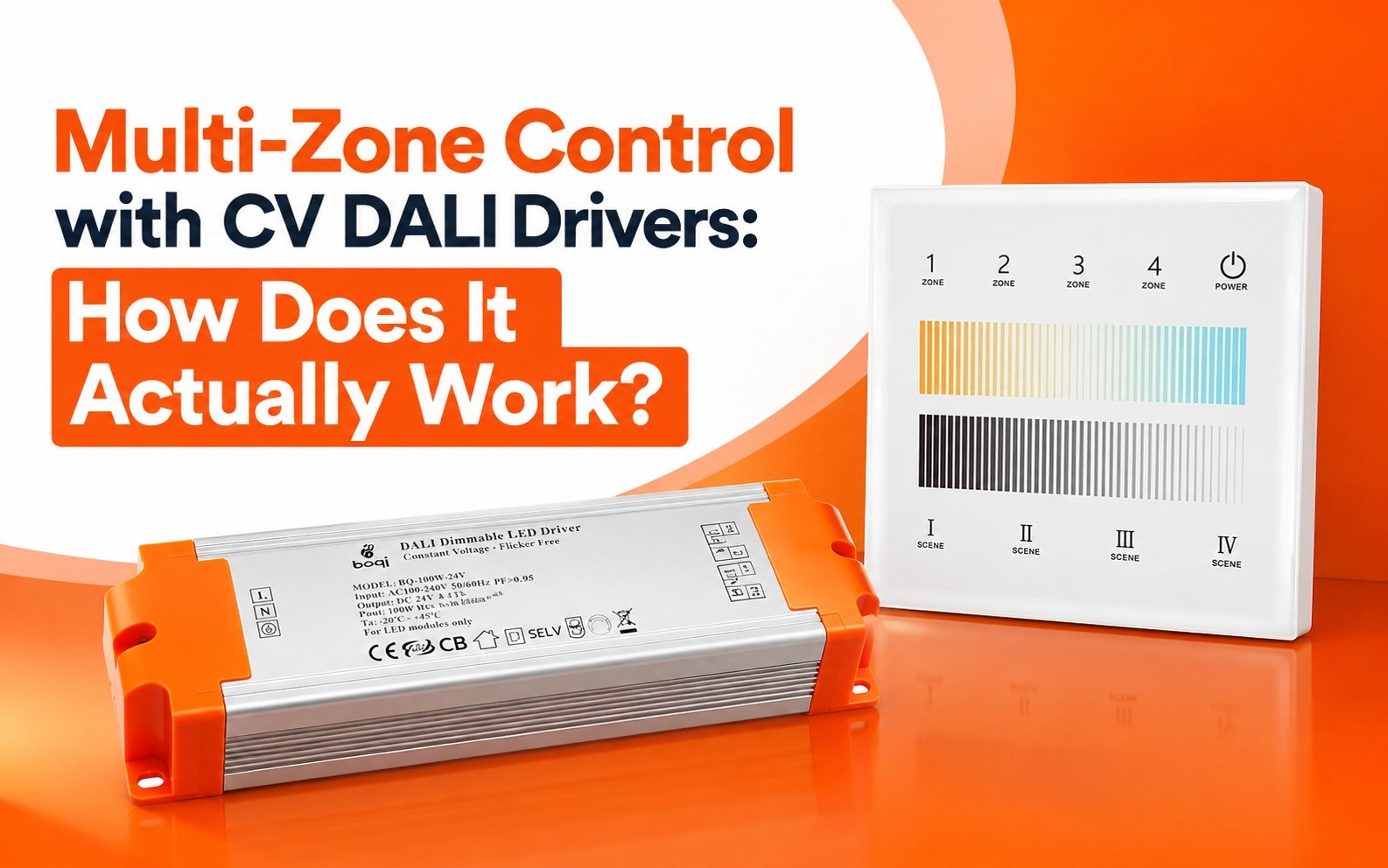
Geïnteresseerd in het inkopen van de producten die in dit artikel worden genoemd? Bekijk de details en vraag hier een offerte aan:
Voetnoten
Officiële site van de IEC, die internationale normen ontwikkelt voor alle elektrische en elektronische technologieën. ↩︎
Technische referentie voor LED-drivers, met betrekking tot constante spanning en constante stroom voedingsmodi. ↩︎
De DALI Alliance is de wereldwijde brancheorganisatie die het DALI-2-protocol voor lichtregeling definieert. ↩︎
Biedt een overzicht van elektrisch energieverbruik, een diagnostische metriek geleverd door geavanceerde DALI-2 lichtcontrollers. ↩︎