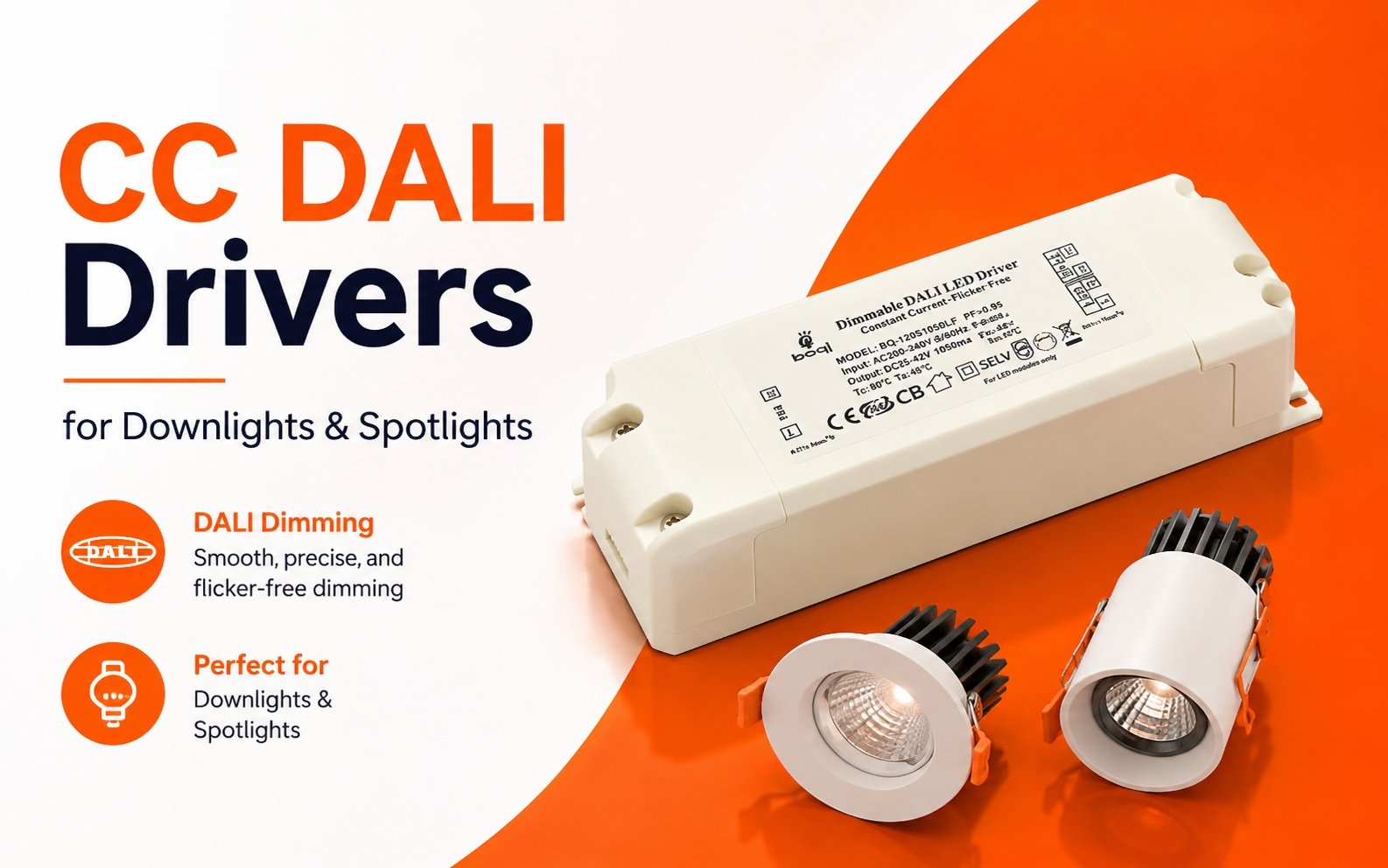















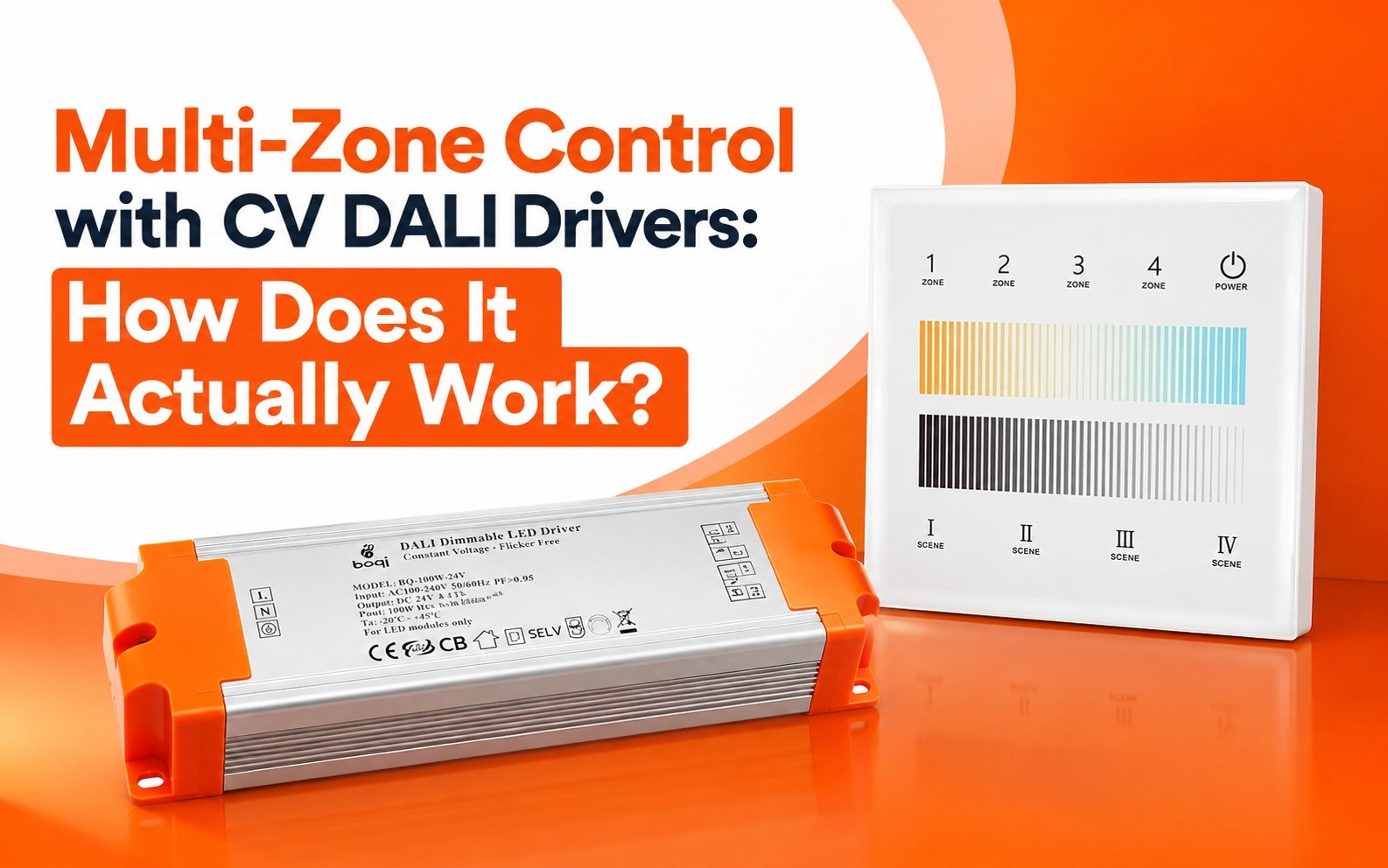
Multi-zone control with [CV DALI drivers](https://boqiled.com/?p=17832) sounds simple—until commissioning stalls on site. On our Shenzhen production line, we trace most failed projects back to one avoidable planning mistake.
Multi-zone control with CV DALI drivers lets each LED lighting zone receive independent brightness or color commands through DALI addresses, groups, and scenes. DT6 drivers handle single-channel dimming, while DT8 drivers coordinate tunable-white or RGBW channels under one address, simplifying commissioning in large installations.
That short answer hides several traps. In this article, I will walk through how the system works, what to check before sourcing, where the cost savings really come from, and how to customize drivers without compliance headaches.
How do CV DALI drivers enable seamless multi-zone control in large-scale lighting projects?
A distributor in Germany once ordered our 4-channel RGBW drivers expecting four independent room zones. That misunderstanding taught us to explain the architecture before quoting any project.
CV DALI drivers enable multi-zone control by combining constant-voltage LED power with digital addressing on a two-wire bus. Each driver holds its own DALI address, joins up to 16 groups, and responds to scene commands, so every zone dims independently without separate dimmer circuits.

The key concept is separation. DALI is a digital control network 1 defined under IEC 62386. The load side stays constant voltage 2—typically 12V, 24V, 36V, or 48V DC—feeding LED tape or modules wired in parallel. Addressable lighting control comes entirely from the bus, not from the power wiring. A single DALI line supports up to 64 individual addresses, which you can organize into 16 groups for synchronized dimming and scene recall across lighting zones and groups.
DT6 vs DT8: Which Device Type Fits Your Zones?
| Feature | DT6 Driver | DT8 Driver |
|---|---|---|
| Channels | Single-channel dimming | Multi-channel: DT8 tunable white, RGB, RGBW |
| Address consumption | One address per channel | One address for the whole color unit |
| Best use | Independent single-color zones | Coordinated color or CCT control |
| Commissioning effort | Simple, one zone per address | Fewer addresses, coordinated channels |
A Multi-Channel Driver Is Not a Multi-Zone System
Here is the biggest misunderstanding I see. Multi-channel LED drivers, such as a 4-channel RGBW DT8 unit, have four physical outputs. But those channels are designed to work together as one color-controlled zone. If your project needs Zone A for reception, Zone B for a corridor, Zone C for display shelves, and Zone D for ceiling lighting, you need independently addressable drivers—not one RGBW unit.
The correct design sequence is: lighting zones → control requirements → DALI addressing strategy → DT6 or DT8 selection → driver channels → power calculation. Many teams do the opposite. They pick a driver first, then force zones around its outputs. Also remember: DT8 saves addresses, not drivers. One tunable-white fixture works under one DT8 address, but four separate rooms still need separate drivers or addresses.
What should I check before sourcing CV DALI drivers for multi-zone commercial installations?
Last year, a procurement manager in Singapore sent us a one-line spec: DALI CV driver, 24V, four zones. Our engineers replied with twelve questions before we would quote anything.
Before sourcing, verify IEC 62386 compliance and DALI-2 certification, confirm true channel independence, match output voltage to your LED load, check PWM dimming quality and low-end performance, review bus power requirements, and demand documented QC records plus CE, CB, and SELV certification.

Those twelve questions exist because a spec sheet rarely tells the full story. Here is the checklist we walk buyers through before production starts.
The Pre-Sourcing Verification Table
| Check Point | What to Verify | Why It Matters |
|---|---|---|
| IEC 62386 compliance | Real DALI-2 test reports, not just “DALI compatible” claims | Guarantees interoperability with sensors, switches, and controllers |
| Output voltage | 12V, 24V, 36V, or 48V matched to your strips; 24V DC constant voltage is the most common | Wrong voltage destroys LEDs or underdrives them |
| Channel independence | True independent channels versus simple parallel outputs | Parallel outputs cannot form separate zones |
| Dimming quality | Pulse Width Modulation dimming frequency, logarithmic dimming curves, low-end depth—some designs reach around 0.1% | Prevents visible flicker in hospitality and architectural spaces |
| Bus power | Whether the system needs an external DALI bus power supply and each driver’s bus current draw | An overloaded bus causes dropped commands and dead zones |
| Certifications | CE, CB, and SELV markings printed on the housing | Required for market access in the EU and Asia-Pacific |
Two of these points deserve extra attention. First, channel independence. Some “multi-output” products simply split one dimming channel across several terminals. They look like multi-channel LED drivers on paper, but every output dims together. Ask the supplier directly: can each channel receive its own DALI command? Second, dimming behavior. Logarithmic dimming curves match how human eyes perceive brightness, so a curve mismatch between drivers from different batches becomes instantly visible in a hotel lobby. We also recommend asking whether the driver supports TouchDIM or 0/1-10V fallback inputs, because retrofit projects often need that flexibility. Finally, check the physical labeling. On our own units, the wiring diagram, input/output ratings, and certification icons are printed directly on the aluminum body, which saves installers real time on site.
Can multi-zone CV DALI systems help me lower wiring costs and simplify project logistics?
Every quotation we prepare weighs the same trade-off: DALI hardware costs more per driver than 0-10V, yet the total installed cost often lands lower. Here is why.
Yes. A single two-wire DALI bus replaces home-run wiring to every zone, software grouping removes rewiring after layout changes, and consolidating drivers from one supplier reduces shipment complexity. Together these cut cable, labor, and logistics costs on multi-zone commercial projects.

Start with the honest comparison, because buyers ask me for it constantly:
| Factor | DALI CV Drivers | 0-10V / 1-10V | RF / PWM-only Controllers |
|---|---|---|---|
| Zone addressing | Individual addresses, groups, scenes | Mostly zone-level, one control pair per zone | Depends on brand ecosystem |
| Feedback and status | Supported in DALI-2 systems | None | Usually none |
| Wiring | One shared two-wire bus | Separate control run to each zone | Wireless, but proprietary |
| Rezoning later | Software-based grouping, no rewiring | Physical rewiring required | App-based, brand-locked |
| Best fit | Multi-zone, integration-heavy projects | Basic dimming, legacy upgrades | Small or single-brand systems |
Where the Savings Actually Come From
With analog control, every zone needs its own control run back to a dimmer. With the DALI-2 protocol 3, one two-wire bus daisy-chains through all 64 addresses. On a retail floor with a dozen zones, that difference alone removes a significant amount of copper and labor. Then comes flexibility: when a tenant changes the floor layout, software-based grouping reconfigures the lighting zones without touching a single cable. For very long strip runs, a decentralized approach works well—compact DC-to-DC DALI dimmers placed near the strips, fed by a high-capacity central power supply—which minimizes voltage drop across large installations.
Now the objection I hear from smaller buyers: DALI is overkill for a two-zone shop, and a simple RF kit installs faster. For that scale, I agree. But once a project crosses several zones, needs scene recall, or may connect to a building system later, the cost curve flips toward DALI. And hybrid paths exist: DALI-to-wireless bridges can extend a wired backbone into app-controlled or Matter-based mesh zones. On the logistics side, our export clients in Singapore, Vietnam, and across Europe consolidate drivers, dimmers, and accessories into one shipment with one QC report, which shortens tight project timelines.
How do I ensure quality and compliance when customizing CV DALI drivers for multi-zone applications?
Before any customized batch leaves our Shenzhen facility, it spends time in a burn-in room running at full load. That habit came from one painful early lesson with a rushed OEM order.
Ensure quality by defining zone requirements before customization, requesting DALI-2 test data against IEC 62386, validating samples on your actual control system, confirming CE, CB, and SELV certification, and agreeing on aging tests, dimming-curve checks, and pre-shipment inspection with your supplier.

Customization goes wrong when the electrical spec gets locked before the control design. So we run every OEM/ODM project through the same sequence, and I recommend buyers demand something similar from any supplier.
The Seven-Step Customization and QC Path
- Lock the zone map first. Follow the sequence: zones → control requirements → addressing strategy → DT6 or DT8 → channels → power calculation. Never reverse it.
- Define the electrical spec. Output voltage, channel count, wattage per zone, and load headroom so no driver runs at its ceiling.
- Request protocol evidence. Ask for DALI-2 test data against IEC 62386, not a vague “DALI supported” line on a datasheet.
- Validate golden samples on your real system. Connect the sample to the actual controllers, sensors, and wall panels your project uses. Test scenes, groups, fade times, and the logarithmic dimming curve at low levels, where flicker hides.
- Agree on QC gates in writing. Incoming component inspection, in-line electrical testing, 100% burn-in at full load, and third-party or client pre-shipment inspection.
- Confirm labeling and certification. CE, CB, and SELV icons plus wiring diagrams should be printed on the housing itself, alongside your custom logo if the project is private-label.
- Plan for diagnostics. Advanced DALI-2 CV drivers report per-zone data such as power consumption 4 and lamp failure status, which supports predictive maintenance and building management system integration later.
Thermal design matters too. Our slim aluminum housings use ridged heat-sink grooves along the top surface because a driver running cool in a tight ceiling void dims consistently for years. When we develop a custom unit with a client, thermal margin is one of the first tolerances we agree on—before tooling, not after complaints.
Conclusion
Multi-zone control with CV DALI drivers rewards planning: map zones first, verify DALI-2 compliance, confirm channel independence, and partner with a supplier who tests before shipping. Get that right, and commissioning stays painless.
Interested in sourcing the products mentioned in this article? See details and request a quote here:
Footnotes
1. Official site of the IEC, which develops international standards for all electrical and electronic technologies. ↩︎
2. Technical reference for LED drivers, covering constant voltage and constant current power supply modes. ↩︎
3. The DALI Alliance is the global industry organization that defines the DALI-2 protocol for lighting control. ↩︎
4. Provides an overview of electrical power consumption, a diagnostic metric provided by advanced DALI-2 lighting controllers. ↩︎