














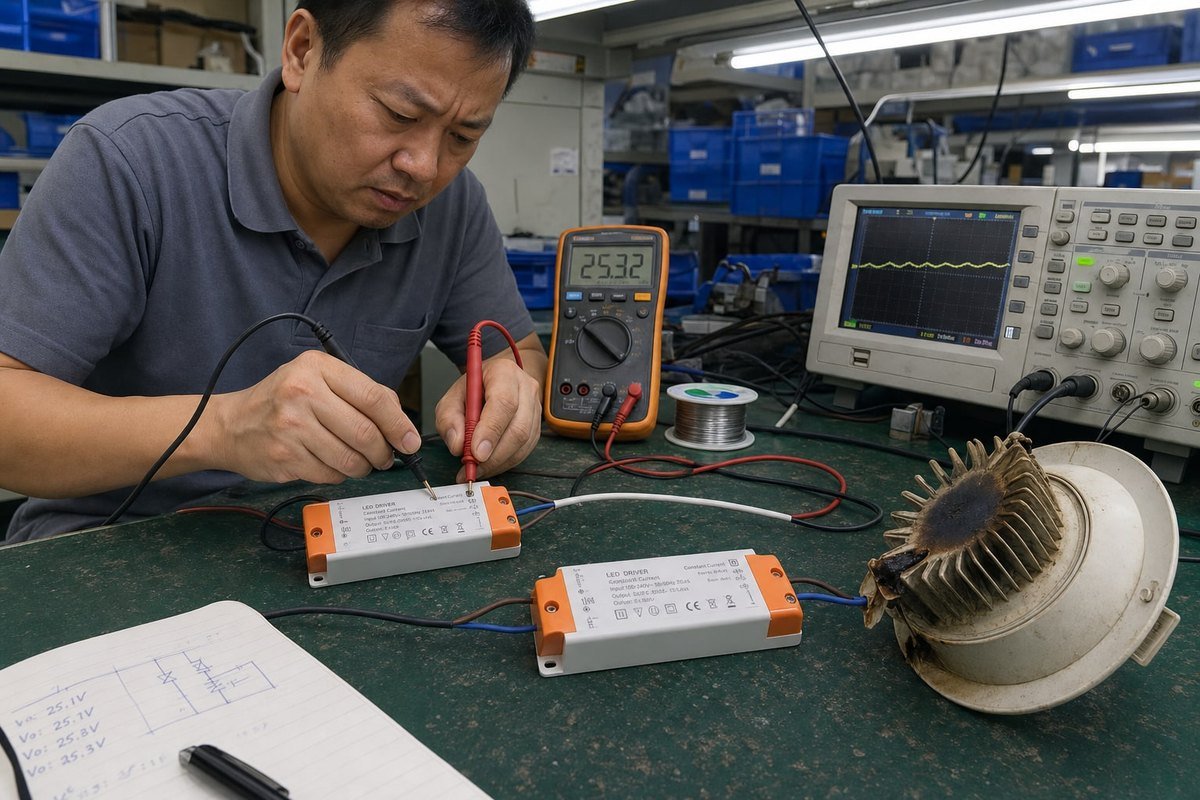
Elegir entre controladores TRIAC de corriente constante y voltaje constante confunde a muchos compradores. He visto selecciones incorrectas quemar luminarias LED en nuestro banco de pruebas, costando a los clientes lotes completos de producción.
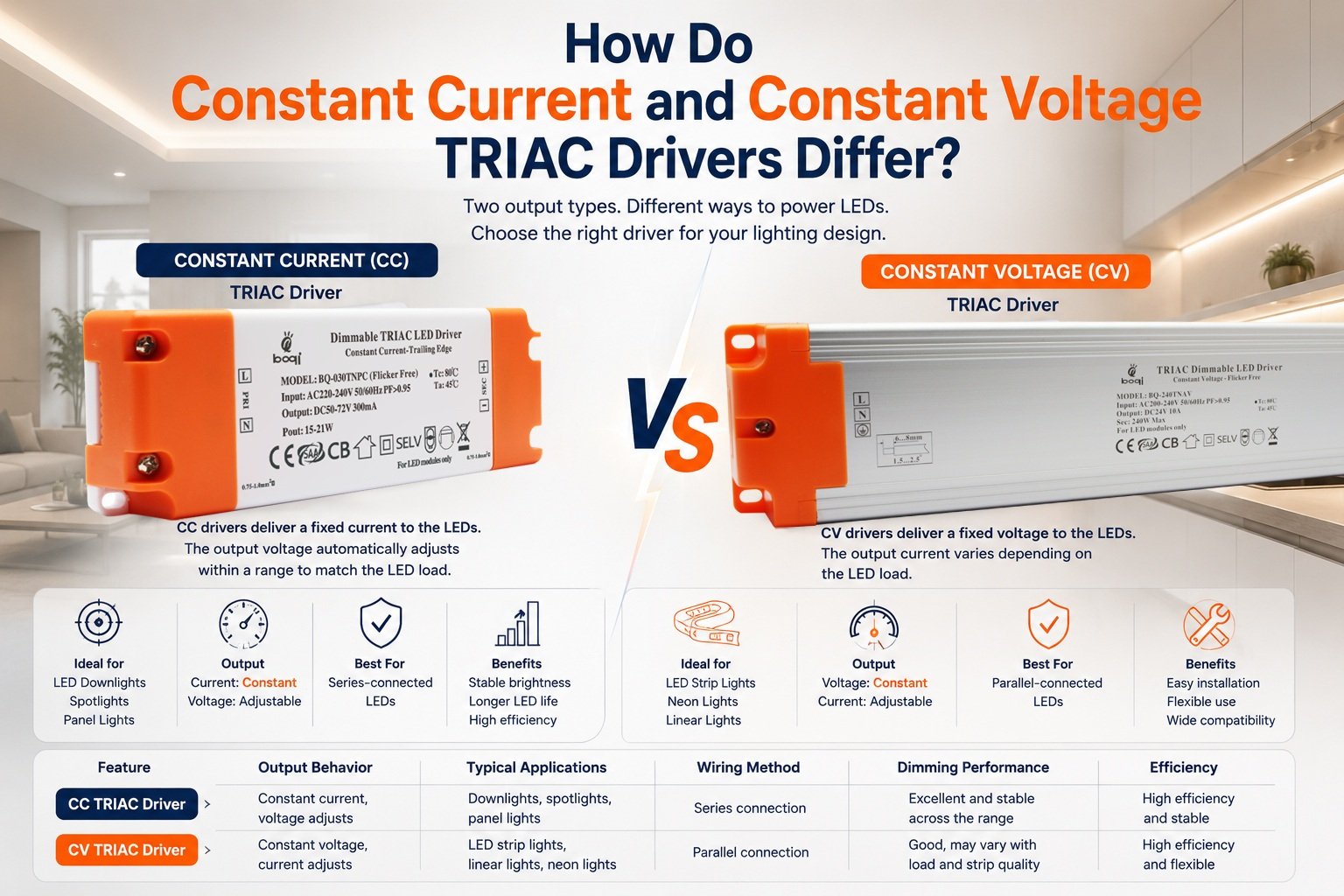
Los controladores TRIAC de corriente constante entregan una corriente de salida fija, como 350mA o 700mA, mientras que el voltaje varía con la carga LED. Los controladores TRIAC de voltaje constante mantienen un voltaje fijo, generalmente 12V o 24V, mientras que la corriente varía. Ambos aceptan señales de atenuación por corte de fase provenientes de atenuadores de pared.
Esa es la respuesta breve. Pero las diferencias van más allá de una sola línea. Permítame guiarlo a través del diseño de circuito, la adecuación de la aplicación, el comportamiento de atenuación y el costo, para que pueda especificar el controlador correcto desde el primer momento.
¿Cómo difieren los controladores TRIAC de corriente constante y voltaje constante en el diseño de circuito y la regulación de salida?
El año pasado, nuestros ingenieros rediseñaron una plataforma de controlador TRIAC de 40W en versiones CC y CV. En un gabinete diferente, las dos placas internas se veían sorprendentemente distintas. Aquí está el porqué.
Un controlador TRIAC de corriente constante utiliza un bucle de retroalimentación de detección de corriente que ajusta el voltaje de salida para mantener fijo el amperaje. Un controlador TRIAC de voltaje constante utiliza un bucle de regulación de voltaje que mantiene estable la salida, a menudo añadiendo capacitores de filtro más grandes, mientras que la carga conectada determina cuánta corriente fluye.
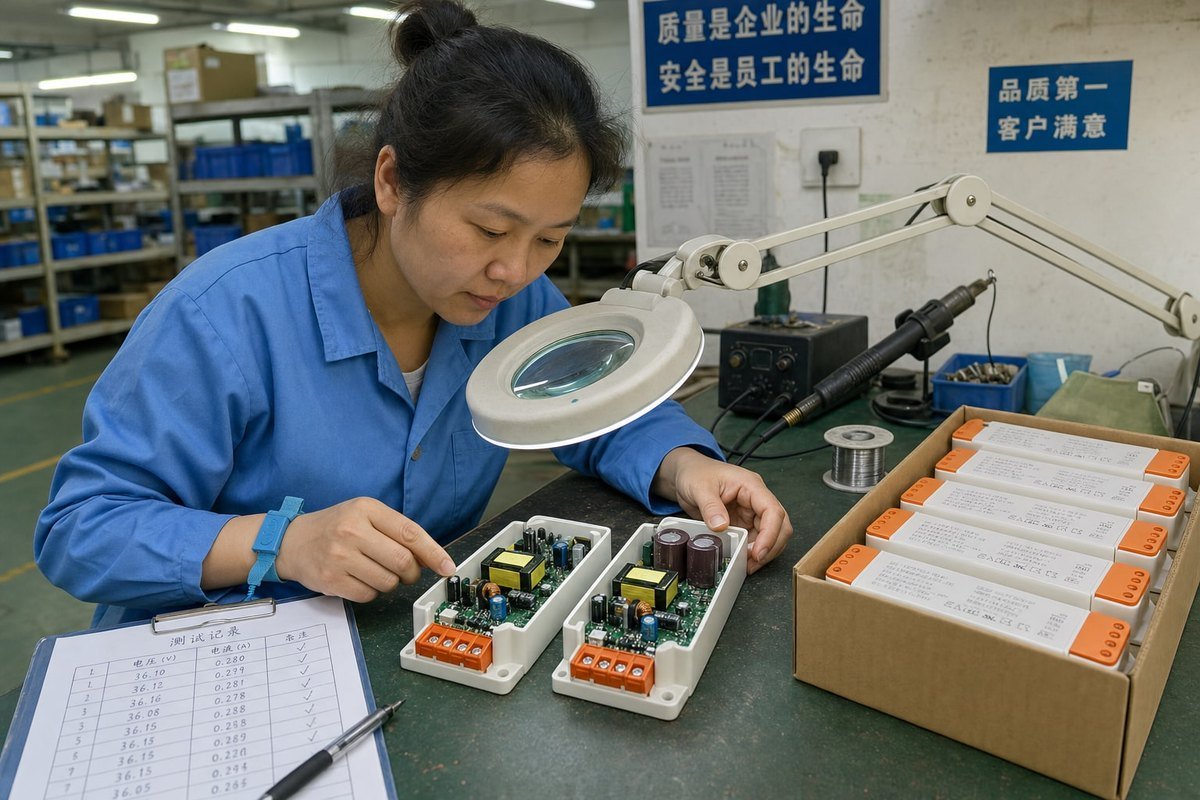
Ambos tipos de controladores comienzan con el mismo front-end. Un atenuador TRIAC en la pared recorta la forma de onda de CA utilizando control de fase directa 1. El controlador debe leer esa entrada recortada, mantener el TRIAC conduciendo y aún así producir energía de CC limpia en la salida. Esto es lo que hace complicada la compatibilidad con la atenuación por corte de fase. Los atenuadores de borde ascendente necesitan una corriente de mantenimiento mínima para permanecer enclavados, por lo que tanto los controladores TRIAC CC como CV incluyen circuitos de sangrado para satisfacer ese requisito de carga mínima.
La división real ocurre en la etapa de salida.
El bucle de retroalimentación cuenta la historia
Un diseño de corriente constante mide la corriente que fluye a través de los LED, generalmente a través de una resistencia de detección. Si la corriente se desvía hacia arriba porque los LED se calientan, el IC de control reduce el voltaje de salida. La corriente permanece bloqueada. Por ejemplo, un controlador CC de 700mA podría oscilar entre 15V y 42V dependiendo de cuántos LED estén en la cadena.
Un diseño de voltaje constante hace lo contrario. Monitorea el voltaje de salida y lo mantiene exactamente en 12V o 24V. Cualquier carga que conecte consume su propia corriente, hasta el máximo nominal del controlador. La carga de regulación se traslada al producto LED en sí, que debe incluir resistencias o control de corriente integrado.
Comparación eléctrica lado a lado
| Aspecto | Corriente Constante (CC) | Voltaje Constante (CV) |
|---|---|---|
| Parámetro regulado | Corriente de salida (mA) | Voltaje de salida (V) |
| Parámetro variable | Voltaje (dentro de un rango) | Corriente (hasta el máximo nominal) |
| Clasificaciones típicas | 350mA, 500mA, 700mA | 12V, 24V |
| Método de retroalimentación | Bucle de resistencia de detección de corriente | Bucle de divisor de voltaje |
| Cableado de carga | Cadena en serie | Segmentos en paralelo |
| Capacitancia de salida | Moderado | Mayor, corriente de irrupción más alta |
Una nota práctica de nuestra línea de control de calidad: los controladores CV con capacitores de filtro grandes pueden producir una corriente de irrupción más alta al encenderse. Con el tiempo, esa irrupción puede estresar los contactos dentro de un atenuador TRIAC. Los buenos diseños añaden circuitos de arranque suave para controlarla. Además, los controladores por encima de ciertos niveles de potencia requieren corrección del factor de potencia 2 etapas, y ese requisito se aplica igualmente a las topologías CC y CV.
¿Qué tipo de controlador TRIAC debo elegir para mi aplicación específica de iluminación LED?
Un comprador de Lyon nos envió una vez una hoja de especificaciones solicitando un “driver TRIAC de 24V, 700mA” para downlights. Esa contradicción me indicó que la etiqueta de su luminaria necesitaba una revisión más detallada primero.
Revise la etiqueta de la luminaria. Si especifica una corriente, como 350mA o 700mA, elija un driver TRIAC de corriente constante. Si especifica un voltaje, como 12V o 24V, elija un driver TRIAC de voltaje constante. El diseño eléctrico del producto LED decide, no el atenuador.

La regla de la etiqueta resuelve la mayoría de los casos en segundos. Pero ayuda entender por qué cada categoría de producto se inclina hacia un lado.
Dónde encajan los controladores TRIAC de corriente constante
Los drivers de CC son adecuados para luminarias construidas alrededor de paquetes de LED desnudos o módulos COB sin limitación de corriente interna. Estos incluyen:
- Downlights empotrados y focos
- Cabezales de iluminación de riel
- Luminarias colgantes con motores COB
- Paneles de luz y fuentes puntuales arquitectónicas
Los LED son dispositivos controlados por corriente. Su brillo y vida útil dependen de la corriente, no del voltaje. Alimentar un módulo COB desnudo con un voltaje fijo invita a fuga térmica 3: el LED se calienta, consume más corriente, se calienta más y falla. Un driver de CC bloquea ese ciclo limitando la corriente sin importar lo que haga la temperatura de unión.
Dónde encajan los controladores TRIAC de voltaje constante
Los drivers de CV dominan la iluminación de tiras LED y los sistemas modulares:
- Tira flexible y barras lineales rígidas
- Señalización y letras de canal
- Coves y recorridos bajo gabinete
- Sistemas de retrofit de bajo voltaje magnético que esperan una fuente de 12V o 24V
Estos productos ya contienen resistencias limitadoras de corriente o reguladores integrados en cada segmento. Solo necesitan un voltaje de riel estable. También puede cortar, extender o agregar segmentos de tira sin cambiar el driver, siempre que la corriente total se mantenga bajo el límite del driver.
Tabla de decisión rápida
| Su producto LED | La etiqueta dice | Driver TRIAC correcto |
|---|---|---|
| Módulo downlight COB | 700mA, 27–42V | Corriente constante |
| Rollo de tira LED de 5 metros | 24V CC, 60W | Voltaje constante |
| Foco de riel | 350mA | Corriente constante |
| Cadena de módulos de señalización | 12V CC | Voltaje constante |
Una advertencia de nuestra experiencia de exportación: nunca sobredimensione la corriente de un driver de CC. Un driver de 700mA en un módulo de 500mA sobrecargará y acortará la vida del LED, incluso si la ventana de voltaje coincide.
¿Cómo se comparan el rendimiento de atenuación y la compatibilidad entre los controladores TRIAC de corriente constante y voltaje constante?
Las curvas de atenuación se prueban obsesivamente en nuestras instalaciones. Ejecutamos cada nuevo diseño de driver contra una estantería de atenuadores de borde líder populares europeos y americanos, porque las especificaciones en papel nunca cuentan la historia completa de compatibilidad.
Los drivers TRIAC de corriente constante generalmente atenúan reduciendo la corriente de salida, ofreciendo un rendimiento suave y sin parpadeo hasta niveles bajos. Los drivers TRIAC de voltaje constante típicamente traducen la señal de corte de fase en una salida de modulación por ancho de pulso, que funciona bien pero es más sensible a la corriente de mantenimiento y a la caída de voltaje en recorridos largos.
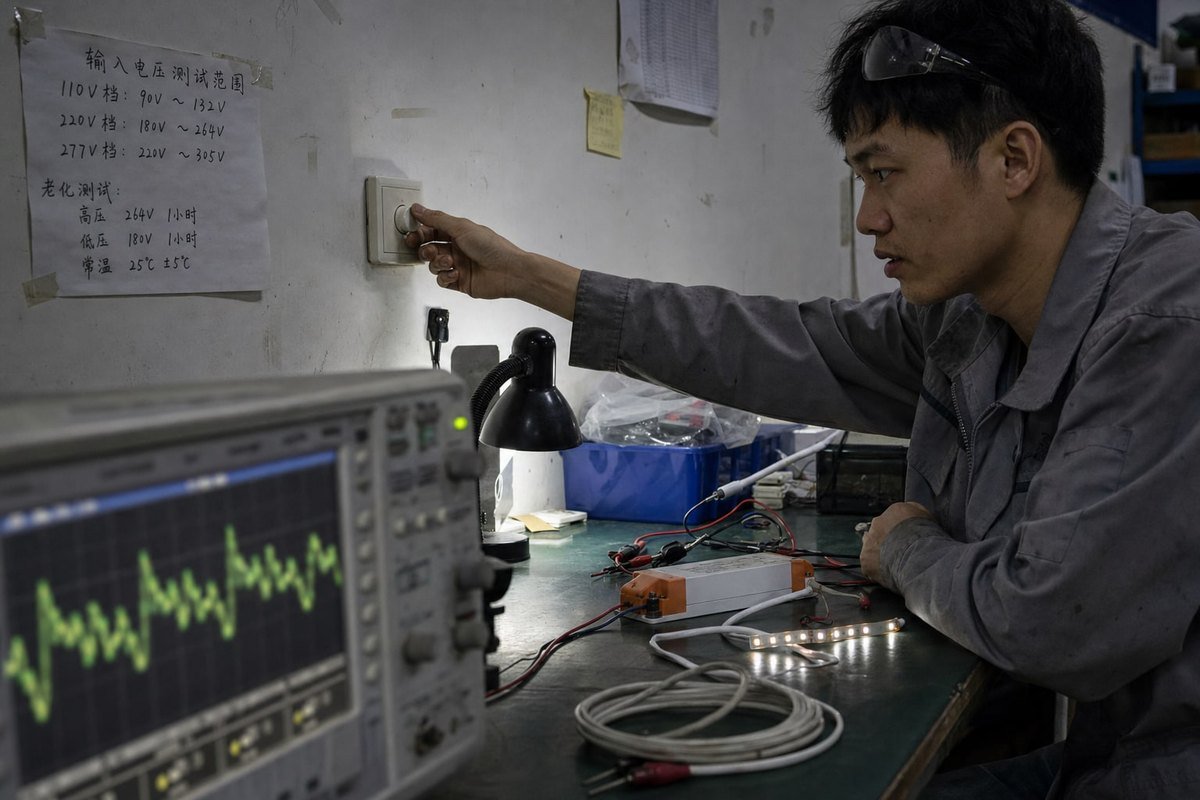
El método de atenuación es donde las dos arquitecturas divergen más visiblemente para el usuario final.
Cómo interpreta cada tipo el corte de fase
Un driver de CC mide el ángulo de conducción del atenuador de pared y lo mapea a un nivel de corriente. Esto se llama Reducción de Corriente Constante, o CCR. En la posición de atenuador al 50%, el driver podría emitir 350mA en lugar de 700mA. Debido a que los cambios de corriente son suaves y continuos, CCR ofrece un rendimiento genuinamente sin parpadeo sin artefactos de alta frecuencia. Los diseños avanzados de CC ahora añaden atenuación híbrida, mezclando CCR con PWM en el extremo inferior del rango, para eliminar el efecto de “encendido repentino” donde las luces saltan de apagado a un brillo mínimo visible.
Un driver de CV no puede simplemente bajar su voltaje, porque una tira de 24V atenuada a 12V se comportaría de manera impredecible y cambiaría el color. En su lugar, la mayoría de los drivers TRIAC de CV convierten la entrada de corte de fase en una Modulación por ancho de pulso 4 salida a voltaje completo. La tira parpadea encendida y apagada más rápido de lo que el ojo puede ver. Bien hecho, PWM atenúa profundamente y de manera uniforme. Mal hecho, a bajas frecuencias, puede aparecer en cámara como bandas.
Puntos críticos de compatibilidad
Los sistemas de CV enfrentan dos desafíos adicionales. Primero, el requisito de carga mínima impacta más: atenúe un segmento pequeño de tira al 5%, y la potencia total puede caer por debajo de lo que el atenuador de borde líder necesita para mantener su TRIAC enclavado, causando parpadeo o caída. Segundo, la caída de voltaje en recorridos largos de cable atenúa el extremo lejano de una tira. Los drivers de CC evitan ambos problemas; empujan el voltaje hacia arriba para superar la resistencia del cable, manteniendo el brillo uniforme a lo largo de una cadena en serie.
La combinación del atenuador sigue siendo importante para ambos. Siempre aconsejamos a los compradores solicitar una lista de compatibilidad de atenuadores probados en lugar de asumir que cualquier atenuador TRIAC funcionará.
¿Qué factores de costo y eficiencia debo considerar al seleccionar entre estos dos tipos de controladores TRIAC para producción en masa?
Las negociaciones de costos me enseñaron una lección difícil al inicio de mi carrera comercial: el driver más barato en la hoja de cotización rara vez produce la luminaria terminada más barata. El costo del conjunto completo es lo que importa.
Los drivers TRIAC de corriente constante cuestan ligeramente más por unidad pero alcanzan mayor eficiencia, a menudo 90% o más, y simplifican la luminaria al eliminar componentes limitadores de corriente. Los drivers TRIAC de voltaje constante cuestan menos individualmente pero trasladan las pérdidas de resistencia y la gestión de corriente al propio producto LED.

Para un comprador como usted, que planifica pedidos de volumen y objetivos de BOM ajustados Iluminación LED 5, la decisión requiere una visión a nivel de sistema, no solo a nivel de driver.
Eficiencia a nivel de sistema
Un driver de CC alimenta corriente directamente a la cadena de LED. Casi nada se desperdicia entre el driver y el diodo. Un sistema de CV, por el contrario, consume energía en las resistencias limitadoras de corriente integradas en cada segmento de tira. Esas pérdidas por resistencias nunca aparecen en la hoja de datos del driver, pero aumentan el consumo energético real y el calor. Cuando calcula los lúmenes por vatio 6 para todo el producto, las arquitecturas de CC suelen ganar.
Comparación de costo del conjunto completo
| Factor de costo | Sistema TRIAC de CC | Sistema TRIAC de CV |
|---|---|---|
| Precio unitario del driver | Moderado a más alto | Más bajo |
| Complejidad del módulo LED | Más simple, sin necesidad de resistencias | Resistencias o reguladores en la placa |
| Eficiencia del sistema | Frecuentemente 90%+ | Menor debido a pérdidas por resistencias |
| Flexibilidad de inventario | Un driver por especificación de corriente | Un driver de 24V cubre muchas tiras |
| Mano de obra de cableado | Cadena en serie, emparejamiento cuidadoso | Paralelo, instalación más rápida |
| Riesgo de fallo en campo | Menor, la corriente está protegida | Mayor si la carga excede la clasificación |
Consideraciones de producción y abastecimiento
Los drivers de CV ofrecen una ventaja real de inventario. Un solo driver TRIAC de 24V y 100W puede servir a docenas de SKU de tiras, reduciendo la complejidad de compra. Los drivers de CC requieren un emparejamiento más estricto: cada familia de luminarias necesita un driver con la ventana de corriente y voltaje correcta, lo que multiplica los números de pieza.
Sin embargo, considere las devoluciones y la exposición a garantía. En nuestra experiencia enviando a clientes europeos, las luminarias con driver de CC generan menos quejas en campo porque el daño por sobrecorriente está diseñado fuera del sistema. También evalúe las implicaciones del circuito en serie vs. paralelo en su línea de ensamblaje: las cadenas de CC en serie deben cablearse completamente antes del encendido, mientras que los segmentos de CV en paralelo toleran carga parcial durante las pruebas. Finalmente, confirme que el nivel de potencia elegido incluya una corrección del factor de potencia adecuada, ya que las regulaciones de la UE 7 aplican umbrales independientemente de la topología de CC o CV.
Conclusión
Coincida con la etiqueta: las clasificaciones de corriente necesitan drivers TRIAC de corriente constante, las clasificaciones de voltaje necesitan voltaje constante. TRIAC define la entrada de regulación; el tipo de regulación define todo lo demás. Verifique la compatibilidad antes de la producción en masa.
Notas al pie
Explica los fundamentos de la regulación TRIAC referenciados en la discusión de diseño de circuitos. ↩︎
Aclara el concepto técnico mencionado respecto a los requisitos regulatorios de los drivers. ↩︎
Información sobre el fenómeno de fuga térmica que afecta la fiabilidad y fallo de los LED. ↩︎
Define la técnica de regulación PWM utilizada por los drivers de voltaje constante. ↩︎
Concepto de fondo sobre la tecnología de lámparas LED que subyace a todo el artículo. ↩︎
Fuente gubernamental autorizada que define la eficacia LED y las métricas de lúmenes por vatio. ↩︎
Fuente oficial de la UE sobre estándares regulatorios que afectan las reglas del factor de potencia de los drivers. ↩︎