









每个月,买家都会通过电子邮件向我们的深圳工厂咨询关于[CC DALI驱动器](https://boqiled.com/?p=17779)用于筒灯和射灯时出现闪烁、不匹配或早期失效的问题 IEC 62386合规性 1. 。一个错误的规格就可能毁掉整个项目。.
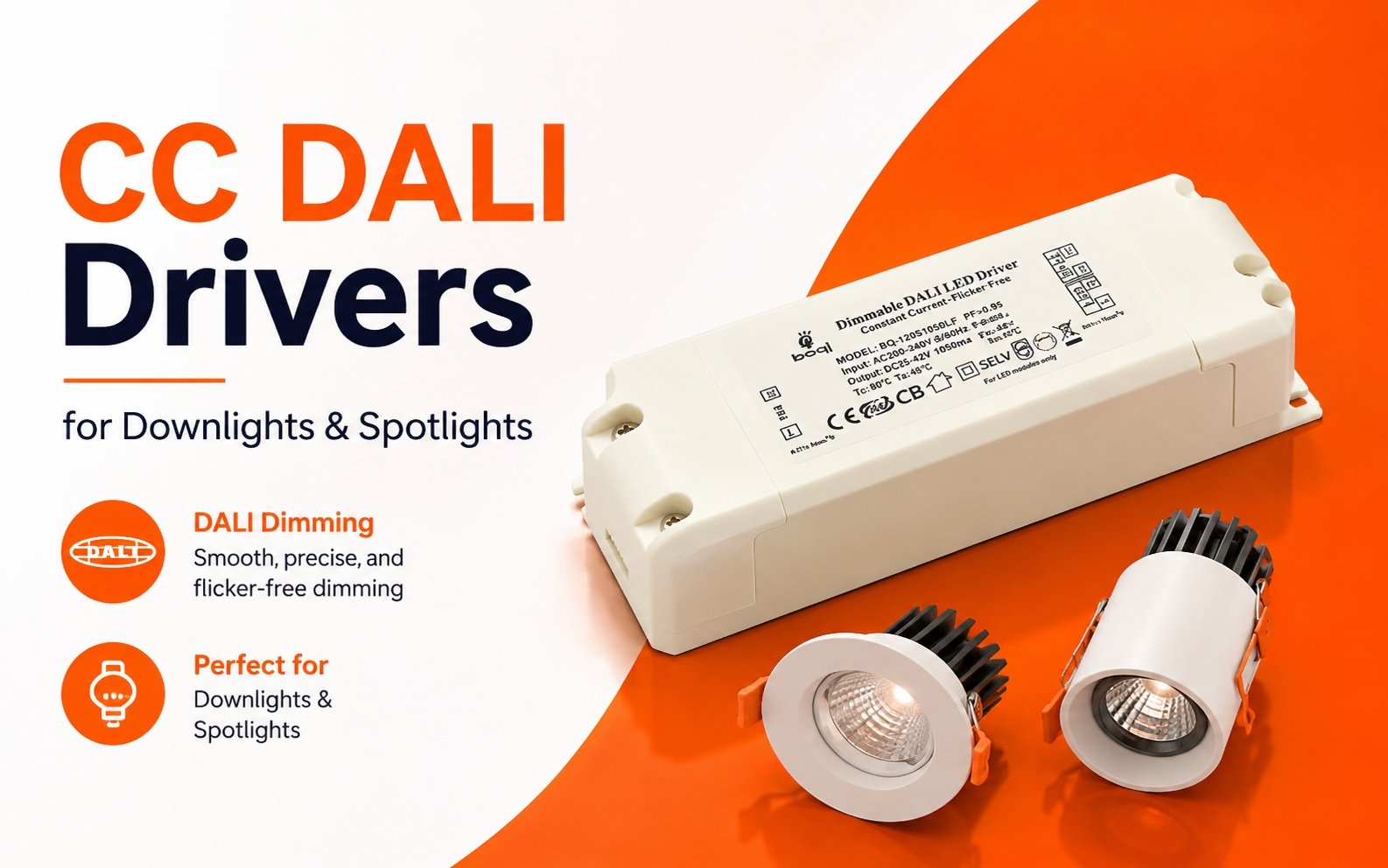
CC DALI驱动器是一种通过DALI数字调光协议控制的恒流LED驱动器。它向筒灯和射灯LED模组提供固定电流,如350 mA、500 mA或700 mA。选择时,先匹配LED电流,再匹配正向电压范围,最后匹配功率。.
这个简短的回答背后隐藏着大量细节。在本指南中,我将逐步讲解选型、定制、认证检查,以及如何在不过度支付的情况下满足紧迫的交期。让我们从选型逻辑开始,因为其他一切都取决于此。.
如何为我的筒灯和射灯项目选择合适的CC DALI驱动器?
新加坡的一位采购经理曾给我发来一份仅列出一个数字的规格书:20W。我们的工程师不得不暂停她的订单,以免酿成错误。.
选择CC DALI驱动器时,首先匹配LED模组的额定电流——350、500、700或1050 mA——然后确认驱动器的输出电压窗口覆盖LED的正向电压范围,最后检查功率、DALI-2功能、调光范围和热限制。.
选择 恒流驱动器 时最大的错误是这种想法:"我的筒灯是20W,所以我需要一个20W的驱动器。"这是不完整的。功率是电流×正向电压的结果,而不是起点。.
从LED模组反向推导
请遵循以下链条:所需LED电流→LED正向电压范围→工作功率→驱动器选型。例如,如果COB模组规格为500 mA,工作电压约为30–36V,则驱动器必须提供稳定的500 mA电流,同时其 输出电压窗口 2 覆盖该范围。仅标称20W的标签无法告诉你任何电气兼容性信息。这就是为什么LED COB兼容性始终归结于电流和电压,而不是包装上印刷的功率。.
大多数买家忽略的两个隐藏检查点
首先,检查实际稳压电流容差,而不仅仅是标称值。两个驱动器都可能标称500 mA,但电流调节的差异会影响 亮度一致性 3, 、结温、颜色匹配和寿命。当数十个灯具安装在同一天花板且必须看起来一致时,这一点最为重要。.
其次,检查最小输出电压。CC驱动器仅在其定义的窗口内进行调节,例如500 mA在20–40V范围内。LED正向电压也会随温度升高而下降。因此,重叠必须在实际工作温度下成立,而不仅仅是在室温数据表上。.
CC DALI与CV DALI概览
| 功能 | 恒流DALI驱动器 | CV DALI驱动器 |
|---|---|---|
| 输出 | 稳压电流 | 稳压电压 |
| 典型规格 | mA加电压范围 | 固定12V或24V |
| 典型负载 | COB、筒灯、射灯 | LED灯带、CV模组 |
| 主要匹配参数 | LED电流 | LED电压 |
| 主要选型错误 | 仅按功率选择 | 选择错误的电压 |
DT6还是DT8?
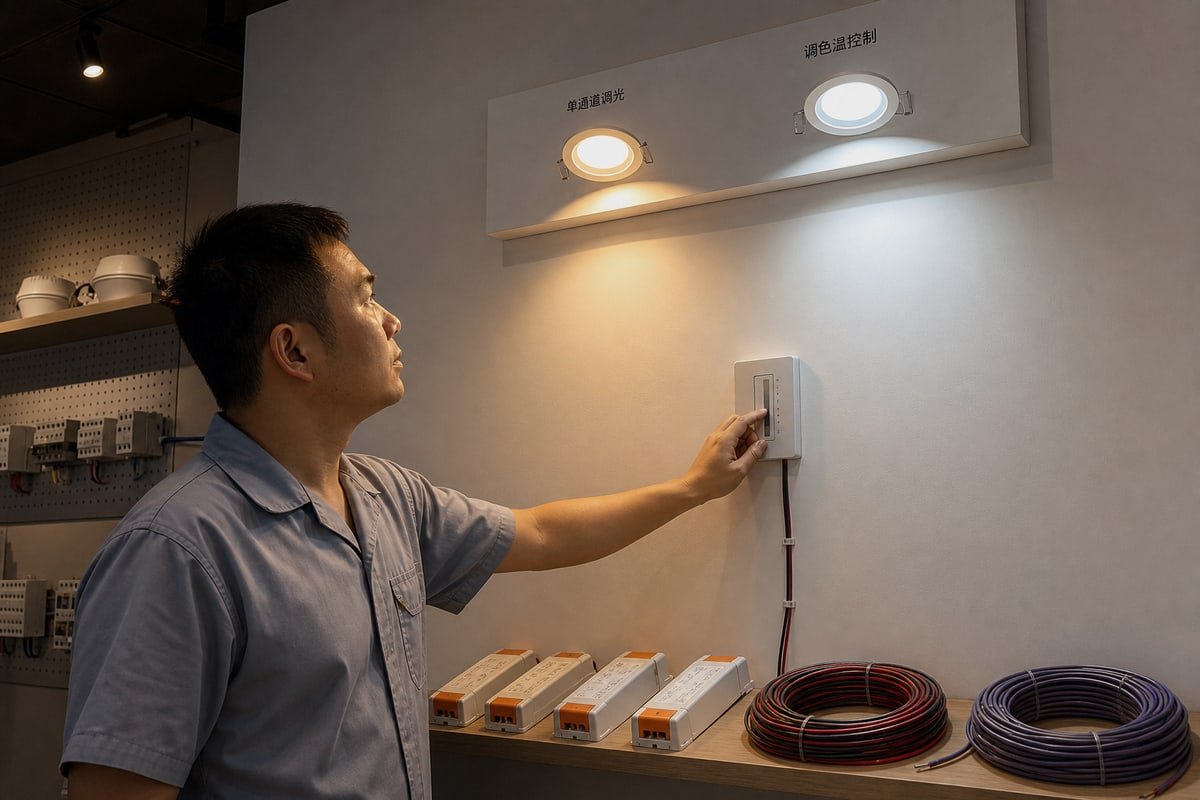
DT6控制装置 支持单通道强度调光,是大多数筒灯的基础配置。DT8支持单DALI地址上的可调白光技术或RGBW。一些买家担心必须在所有地方为DT8付费,其实不必。如果项目仅需要平滑的强度控制,DT6就足够了;仅在需要色温调节时才指定DT8。无论哪种方式,DALI都能提供无闪烁调光,具有匹配人眼的对数曲线,每条线路可寻址控制多达64个设备,以及极性无关的两线制总线,可与主电源电缆在同一导管中运行——非常适合与楼宇自动化系统集成。.
我可以定制带有我自己品牌标识和规格的CC DALI驱动器吗?
去年春天,我们的深圳生产线生产了一批带有橙色端盖和欧洲客户标志丝印在CE标记旁的贴牌批次。定制化对我们来说是日常工作。.
是的。大多数OEM/ODM供应商提供带有定制标志、私有品牌包装、定制输出电流、外壳颜色和调整规格的CC DALI驱动器。买家通常需要签署协议、达到最低起订量,并在批量生产开始前批准标签设计。.
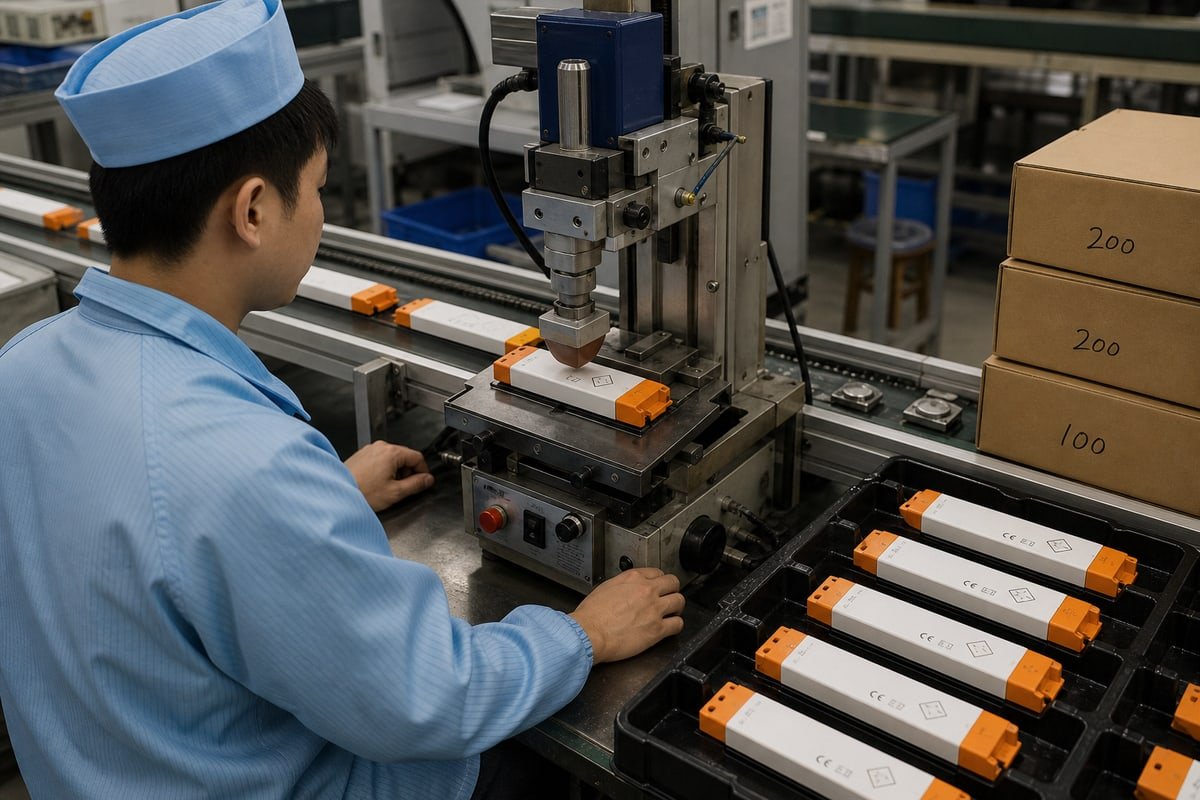
贴牌工作远不止印刷标志。在我们纤薄的驱动器外壳上——带有印刷规格标签的白色顶面板、主电源侧标有L、N、PRI的端子块以及输出侧标有LED和DALI的端子块——几乎所有可见和电气元件都可以根据客户的品牌标准进行调整。.
以下是我们为品牌所有者和批发商处理的典型定制范围:
| 定制领域 | 可更改内容 | Typical Notes |
|---|---|---|
| Branding | Logo, model naming, label layout, packaging | Artwork approved before tooling the print |
| Casing | End-cap color, housing color, marking style | Orange, cream, or brand-specific colors |
| Electrical | Output current presets, adjustable output current, voltage window | DIP switch or preset selection reduces SKUs |
| Control | DT6 or DT8, push-dim functionality as a dual mode | Match the client's control ecosystem |
| 合规 | Market-specific certification marks on the label | CE, CB, SAA, SELV shown as required |
Our process usually runs in five steps: you share the fixture specs and target market; our engineers propose the electrical spec and label design; we build branded samples; you test them in your actual luminaires; then we run the pilot batch and move to mass production. I always push clients to test samples inside the real fixture housing, because enclosed downlights create thermal conditions a bench test never shows.
For buyers who want the latest design technologies, this is also where trends enter the conversation. D4i-ready platforms turn downlights into IoT nodes with standardized sensor power and stored luminaire data. Matter-over-DALI bridging is emerging so professional DALI downlights can be controlled from consumer ecosystems like Apple Home. Some next-generation drivers even carry melanopic metadata to support circadian lighting. If your brand wants a roadmap toward these features, raise it during the ODM discussion—not after tooling is finished.
批量订购CC DALI驱动器前,应检查哪些质量认证?
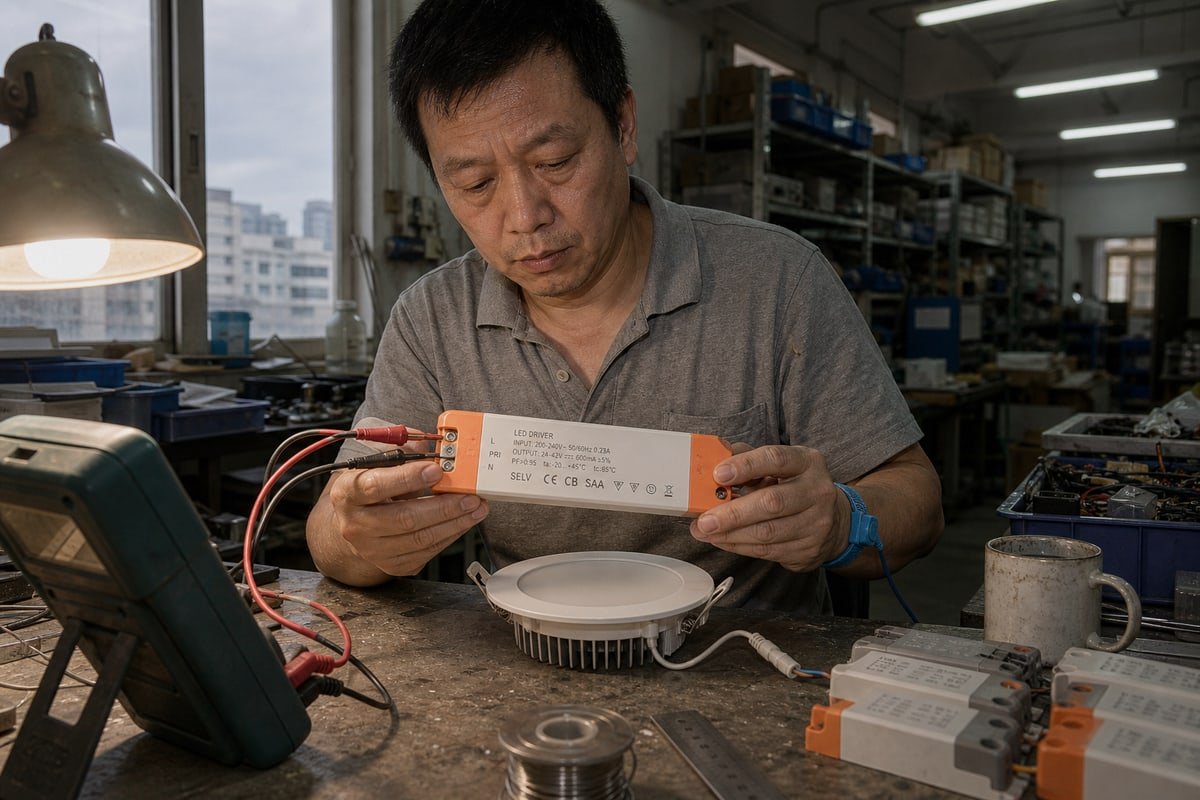
Early in our export business, I learned that a certificate PDF means little until you trace it to the exact model number. That lesson now shapes our whole QC process.
在批量订购前,请核实CE、CB和SAA安全认证、SELV输出分类、IEC 62386合规性以及DALI-2互操作性认证。同时,要求提供涵盖输出电流容差、纹波、闪烁性能、浪涌保护及满载热行为的测试报告。.
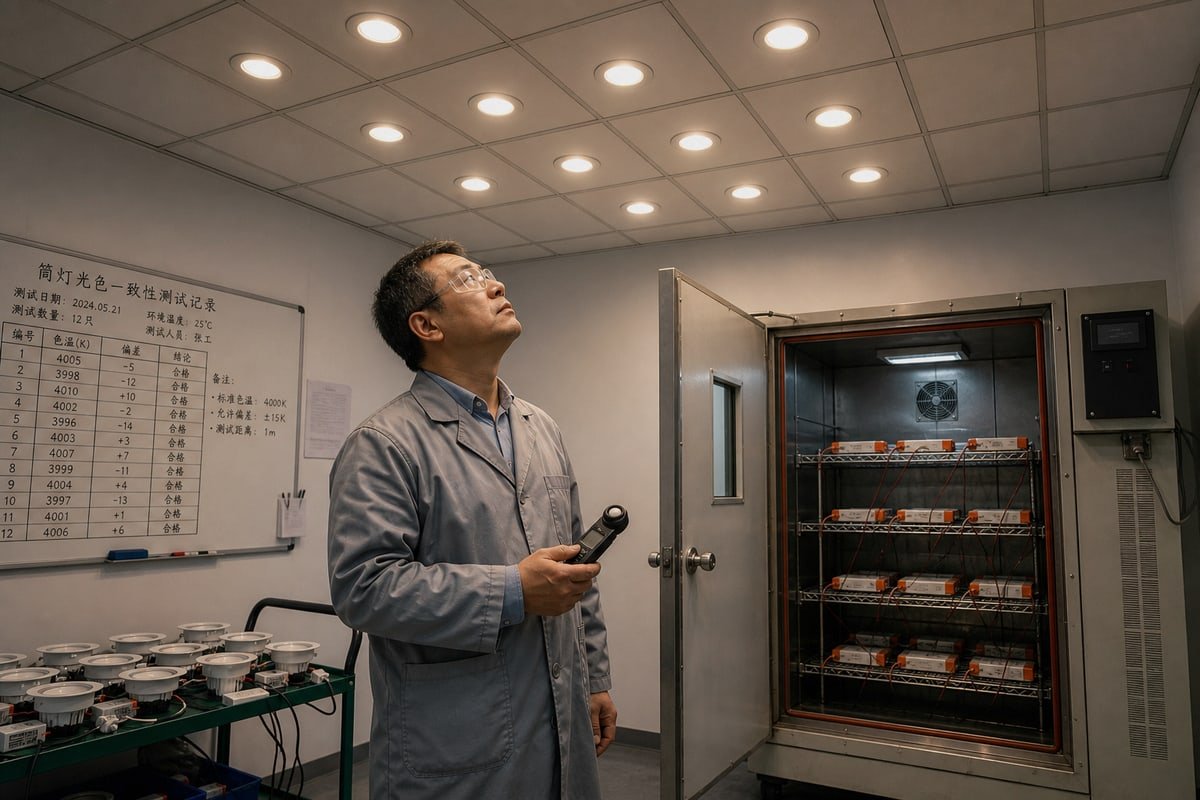
Certification checking has two layers: the paper layer and the product layer. Both matter when you order CC DALI drivers for downlights and spotlights in bulk, because one bad batch can damage a brand you spent years building.
文件层面
Start with the marks printed on the driver label and confirm each one maps to the exact model and current version you are buying. Here is the checklist I give procurement teams:
| Certification / Mark | What It Covers | Why It Matters for Bulk Orders |
|---|---|---|
| CE | EU safety and EMC conformity | Legal requirement for Europe |
| CB | International IECEE test scheme | Speeds up approvals in multiple markets |
| SAA | Australian electrical safety | Required for Australia and often checked in Asia-Pacific tenders |
| SELV output | Safety extra-low voltage output | Safe-touch output for Class III luminaire designs |
| IEC 62386 | The DALI standard itself | Confirms the digital interface follows the spec |
| DALI-2 certification 4 | Independent interoperability testing | Resolves the compatibility gaps of original DALI |
DALI-2 certification deserves special attention. It is verified through the DALI Alliance program and guarantees interoperability between drivers, sensors, and controllers from different manufacturers. A generic "DALI compatible" claim does not. And remember: DALI compatibility does not automatically mean identical DALI functionality. Check the exact supported device types, dimming range, failure behavior, and control-system compatibility for your project.
产品层面
Beyond certificates, ask for measured data. Request the actual output-current tolerance across a sample batch, since tight regulation drives brightness and color consistency. Ask for output ripple figures—below 3% is a strong benchmark for compact luminaire drivers. Confirm surge, short-circuit, overload, and thermal protection. Finally, ask how the supplier ages and samples each batch before shipment. In our own QC room, full-load burn-in inside a heated enclosure has caught issues that room-temperature tests missed completely.
在紧迫的期限内采购CC DALI驱动器时,如何平衡成本与交货时间?
Every quotation we prepare involves the same tension: faster delivery raises cost, while lower cost stretches the schedule. Balancing the two is a skill, not luck.
通过选择可调输出电流驱动器来减少SKU、确认标准型号库存、尽早锁定规格,并分批发货——紧急数量走空运,其余走海运,从而平衡成本与交期。尽早进行技术对齐可避免代价高昂的重新打样延误。.
Deadline pressure is where most sourcing mistakes happen. Buyers rush the spec, skip sample testing, and then lose more time fixing failures than they ever saved. From years of shipping to clients across Singapore, Australia, and Europe, here is the sequence that actually works:
- Lock the electrical spec first. Confirm LED current, forward-voltage window, and required DALI functions before asking for prices. Re-sampling because of a wrong current rating is the single biggest schedule killer I see.
- Prefer adjustable output current. A driver selectable across 350, 500, 700, and 1050 mA covers a 5W–25W fixture range with one SKU. Fewer SKUs mean faster stock availability, simpler forecasting, and lower inventory risk for your warehouse.
- Ask what is on a standard platform. A custom label on a proven platform ships weeks faster than a fully custom electrical design. Save deep customization for projects with real runway.
- Split the shipment. Air-freight the quantity needed for the first installation phase and send the balance by sea. You meet the site date without paying air rates on the whole order.
- Run steps in parallel. Certification document review, label artwork approval, and sample testing can all happen at the same time. We handle urgent approvals over WhatsApp with some clients because a two-day email loop is a two-day delay.
Two objections come up often. First: "DALI systems are complex to commission, so they slow projects down." Commissioning does need compatible controllers, but the two-wire, polarity-independent bus reduces wiring labor and rework on site, which usually gives time back. Second: "Adjustable-current drivers are flexible, so specification matters less." The opposite is true—flexibility widens the room for error, so the current, voltage, and thermal limits still need careful confirmation against each fixture.
结论
Match current first, voltage range second, wattage third. Then confirm DALI-2 functions, certifications, and customization terms early—so your CC DALI driver project ships on time, on budget, and flicker-free.
脚注
1. The IEC maintains the 62386 standard which defines the DALI protocol for digital lighting control. ↩︎
2. Explains the electrical requirements for driving LEDs, specifically the relationship between current and voltage. ↩︎
3. Technical overview of LED operation and the importance of current regulation for stable light output. ↩︎
4. Official organization for DALI standards, ensuring interoperability between lighting control products. ↩︎