












什么是前沿切相调光器?

了解前沿切相调光器的工作原理,从TRIAC触发到LED兼容性,并避免闪烁、电磁干扰和负载不匹配故障。.

Illustration explaining what a leading edge dimmer is and does (ID#1)

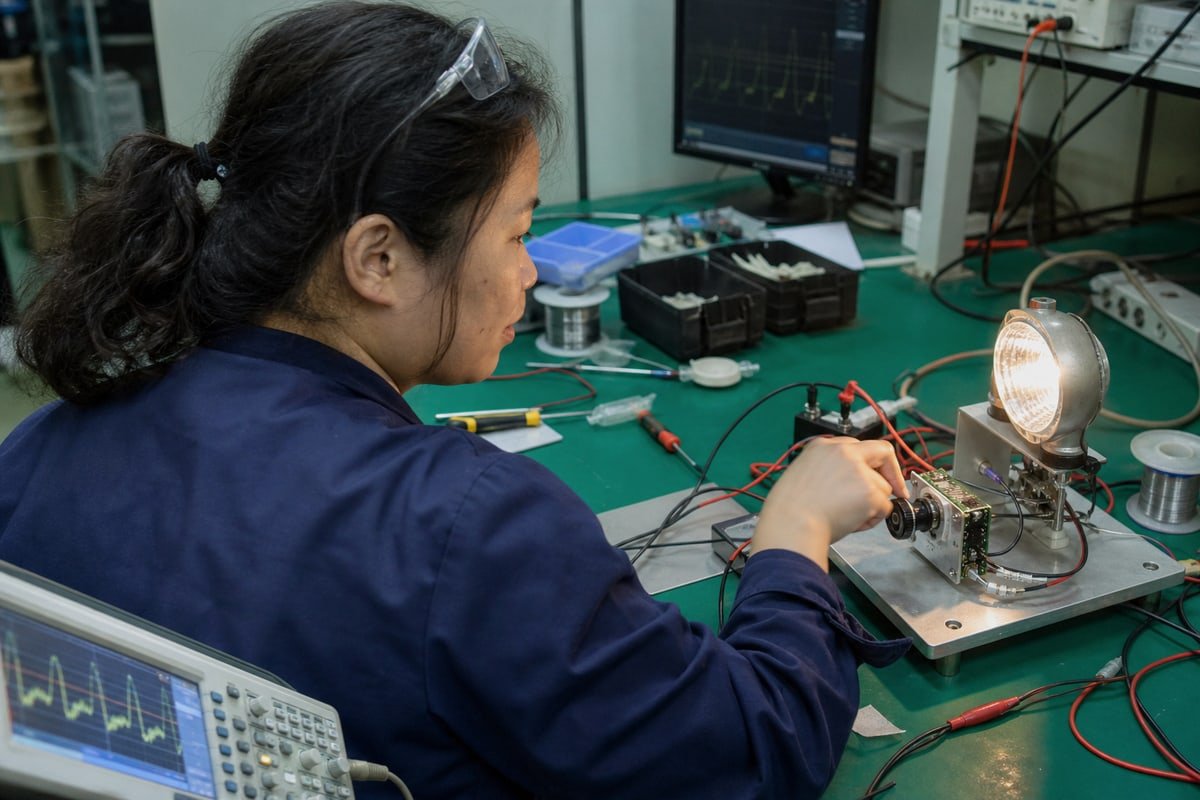
Every week, buyers email our Shenzhen lab about a leading edge dimmer 1 making LEDs flicker. Returns pile up, deadlines slip, and margins shrink. The fix starts with understanding the technology.

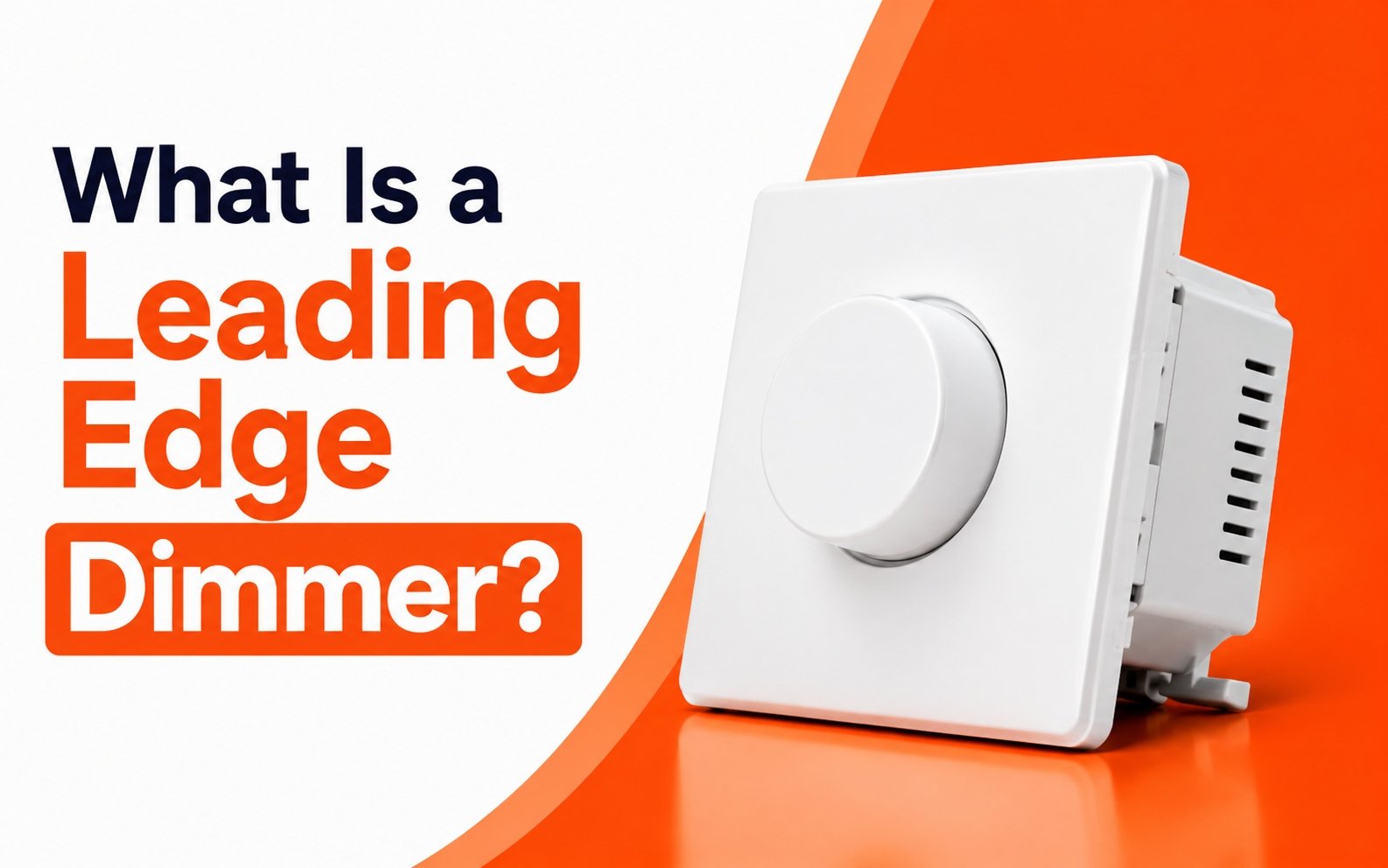
前沿切相调光器是一种交流相位切割调光器,通过切断每个交流电压半周期的起始部分来降低光输出。它基于TRIAC或晶闸管技术构建,主要设计用于白炽灯和卤素灯负载,仅适用于额定支持该技术的LED驱动器。.

That definition covers the basics. But the real engineering questions sit underneath it. How does the waveform chopping actually happen? How does it differ from trailing edge control? And which loads can you safely connect? I will walk through each question below, using what we see on our own test benches every day.

前缘调光器实际上是如何工作的?

On our test bench, we fire every dimmer sample across a full range of loads before it ships. That habit taught us exactly what happens inside each half-cycle.

A leading edge dimmer delays the TRIAC's turn-on point after each zero crossing of the AC sine wave. It blocks the front of each half-cycle, then conducts the remainder, which lowers the average power reaching the lamp and dims the light.

TRIAC dimmer delaying AC sine wave turn-on to dim light output (ID#2)

This is why the method is also called forward phase control. The dimmer trims the front edge of the waveform, so less energy reaches the lamp per cycle. Your eye reads that as lower brightness. Let me break the sequence down.

The firing sequence, step by step

  1. The AC sine wave crosses zero volts.
  2. The dimmer's control circuit waits for a set delay. Turning the knob changes this delay, known as the firing angle.
  3. A gate pulse triggers the TRIAC, or in some designs a Silicon Controlled Rectifier (SCR).
  4. The TRIAC conducts the rest of the half-cycle and delivers power to the load.
  5. Current drops below the TRIAC's holding threshold at the next zero crossing. The device switches off by itself, and the cycle repeats a hundred or more times per second.

What the sharp turn-on does downstream

That sudden mid-cycle turn-on is not gentle. The voltage jumps almost instantly, which creates a high dV/dt spike. In our EMI testing, we see those spikes generate 电气噪声 2, and in the field they can cause nuisance tripping in modern AFCI breakers. There is another aging problem worth knowing. When an older dimmer fires asymmetrically between half-cycles, it introduces a DC offset into the line, which can saturate and overheat transformers in nearby equipment. These are the hidden behaviors that a simple definition never mentions, and they matter when you specify TRIAC调光 at scale.

A TRIAC switches itself off at each zero crossing once current falls below its holding threshold True
The TRIAC cannot stay conductive without sufficient current, so it naturally turns off near zero crossing and must be re-triggered every half-cycle.
A leading edge dimmer works like a variable resistor that smoothly lowers voltage 错误
It does not reduce voltage continuously; it chops out the front of each half-cycle, so the lamp receives a truncated waveform, not a smaller sine wave.

What's the difference between leading edge and trailing edge dimmers?

Price pressure versus dimming smoothness is a trade-off I discuss with almost every distributor who orders from us. The two phase-cut families sit on opposite sides of it.

前沿切相调光器通过TRIAC或晶闸管开关切断每个交流半周期的起始部分,而后沿切相调光器则利用基于MOSFET的电子元件切断末端。后沿切相型号通常能更平滑、更安静地调光兼容的LED驱动器;前沿切相适用于电阻性和磁性感性负载。.

Comparison of leading edge TRIAC and trailing edge MOSFET dimmer switching methods (ID#3)

Here is the side-by-side view I share with procurement teams before they pick a standard for a project:

功能前切相后切相
WaveformCuts the beginning of each half-cycleCuts the end of each half-cycle
Common technologyTRIAC/thyristorOften MOSFET/electronic switching
Historical applicationIncandescent/halogenElectronic low-voltage and many modern loads
LED兼容性Driver-dependentOften advantageous for compatible LED drivers
Low-end LED performanceCan be challengingOften smoother, but driver-dependent
Key concernMinimum load, holding current, inrushDriver compatibility and electronic behavior

Is trailing edge simply better?

Many guides say yes, and buyers raise this objection to me constantly. My answer is no, not automatically. A trailing edge dimmer ramps voltage down gently at the end of each half-cycle, which reduces the flicker and buzzing that plague mismatched LED installs. But leading edge remains the correct choice for the loads it was designed for, including incandescent and halogen bulbs and magnetic transformers, which are inductive loads that tolerate the abrupt turn-on well.

The rule that actually matters

Both approaches are 相位切割调光. Neither label guarantees LED performance on its own. What decides the outcome is whether the LED driver's input stage was designed for that specific chopped waveform. When we develop driver-and-dimmer pairs for OEM clients, we match them as a system, not as two independent parts. That mindset prevents most field complaints before they happen.

哪些照明负载与前缘调光器兼容?

A procurement manager in Singapore once messaged me on WhatsApp with photos of glowing "off" downlights. Her fixtures were dimmable, yet the pairing still failed.

Leading edge dimmers suit resistive loads such as incandescent and halogen bulbs, plus magnetic low-voltage transformers. LEDs work only when the LED driver is specifically rated for TRIAC phase-cut dimming; unrated drivers can flicker, buzz, dim poorly, or stay partially lit when switched off.

Compatible loads for leading edge dimmers including incandescent, halogen, and rated LED drivers (ID#4)

That WhatsApp case captures the whole compatibility problem. Her lamps were labeled dimmable. The dimmer's wattage rating 3 covered the fixtures. The system still misbehaved. Here is the load-by-load picture first:

负载类型兼容性备注
Incandescent bulbs优秀Predictable resistive load; the classic match
Halogen bulbs优秀Also resistive; smooth full-range dimming
Magnetic LV transformers良好Inductive loads that leading edge handles well
TRIAC-rated LED driversConditionalMust be explicitly rated for leading-edge dimming
Generic "dimmable" LEDsRiskyDriver input stage may not tolerate the chopped waveform
Non-dimmable LEDs/CFLsIncompatibleExpect failure or damage

Inside a modern LED driver

An incandescent filament is a simple resistive load. An LED driver is not. It may contain a rectifier, bulk capacitor, switching converter, EMI filter, and control circuitry. A leading edge TRIAC dimmer interacts with that input capacitance 4 and with the TRIAC's holding-current requirement. When the match is wrong, we see flicker at low dimming levels, TRIAC mis-triggering or dropout, audible buzzing, a narrow usable dimming range, LEDs that stay partially lit when "off," and different behavior when multiple drivers share one dimmer. Phase-cut harmonic distortion can even confuse dim-to-warm drivers, causing inconsistent color shifts.

The minimum load trap

Traditional leading edge dimmers often carry a minimum load requirement of roughly 25W–60W. A small LED load draws far less current than the incandescent load the dimmer expected, so the combination turns unstable even within the wattage rating. My B2B rule: check whether the LED driver, not merely the lamp, is rated for leading-edge dimming, and verify minimum-load, maximum-load, and inrush-current requirements.

An LED fixture within a dimmer’s wattage rating can still dim unstably True
If the LED load falls below the dimmer’s minimum load requirement or the TRIAC’s holding current, the light can flicker or cut out even though the wattage math looks fine.
Any bulb labeled “dimmable” will work with any leading edge dimmer 错误
“Dimmable” only means the lamp supports some dimming method; the driver must be specifically compatible with TRIAC leading-edge phase-cut control to perform reliably.

Why would I choose a leading edge dimmer for my next bulk order?

Years of OEM projects taught me that dimmer sourcing decisions fail at the spec sheet, not the factory floor. Volume orders magnify every overlooked compatibility detail.

Choose a leading edge dimmer for bulk orders when your installed base runs incandescent, halogen, or TRIAC-rated LED drivers, when budgets are tight, or when replacing legacy wall dimmers. Verify minimum load, maximum load, inrush current, and true-OFF performance before committing to volume.

Bulk order considerations for choosing leading edge dimmers with legacy lighting loads (ID#5)

There are solid commercial reasons to standardize on leading edge for certain projects. These dimmers are generally more affordable and more widely available than trailing edge alternatives. They remain the legacy standard in millions of older buildings, so retrofit and replacement demand stays steady across the markets we ship to, from Singapore and Australia to Germany and the UK. For distributors serving halogen-heavy hospitality projects or landlords replacing like-for-like wall dimmers, leading edge is often the pragmatic pick.

The pre-order verification checklist

Before any client of ours confirms a volume order, we walk them through this list:

Check Item为何这很重要
Driver dimming ratingThe driver, not the lamp, must be rated for leading-edge/TRIAC control
最小负载Small LED loads below roughly 25W–60W can destabilize the TRIAC
Maximum load and inrushLED drivers create inrush spikes that stress undersized dimmers
调光范围Confirm usable low-end performance, not just the top end
True-OFF behaviorLeakage paths can leave LEDs glowing at "off"
Multi-driver behaviorSeveral drivers on one dimmer behave differently than one

How we de-risk it before shipment

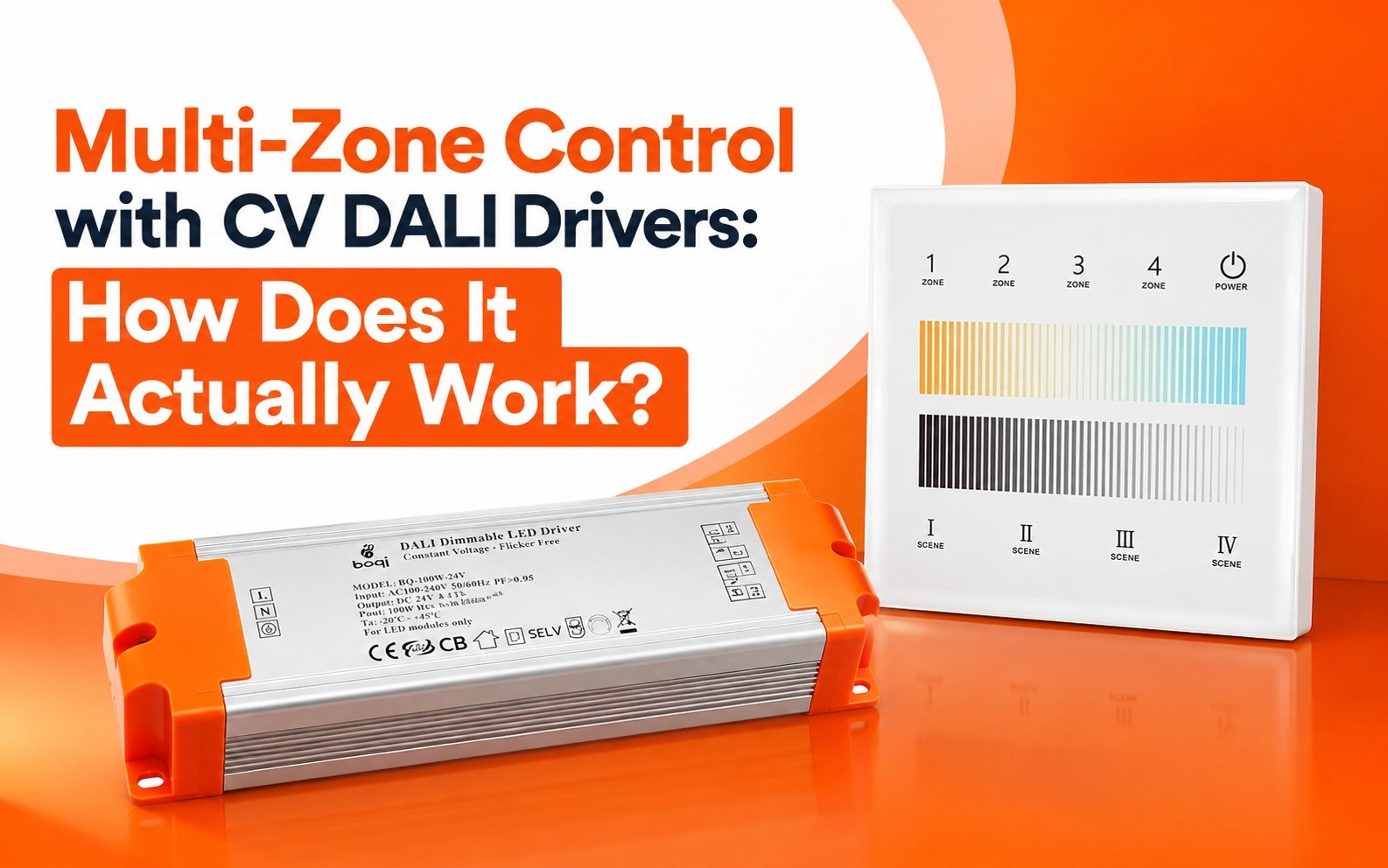
Our process is straightforward. We ask for the exact fixture or driver model, then run paired samples through full-range dimming, low-end flicker checks, and true-OFF tests before mass production. For private-label clients on tight deadlines, this one week of validation prevents months of warranty claims. We also co-develop matched dimmer-and-driver sets under the client's logo, which removes the compatibility gamble entirely.

Validating dimmer-driver pairs with samples before mass production reduces returns True
Bench-testing the exact combination exposes flicker, buzzing, and true-OFF failures before volume commitment, which is far cheaper than field replacements.
A dimmer’s wattage rating alone confirms it will handle an LED bulk order 错误
Wattage says nothing about holding current, inrush, or minimum load, and those three factors decide whether a leading edge dimmer works with LED drivers.

结论

A leading edge dimmer still earns its place when matched to the right load. Verify driver compatibility, minimum load, and inrush current, and your bulk orders will perform reliably.

脚注


1. Authoritative overview of dimming technologies and the history of phase-cut lighting controls. ↩︎


2. Federal resource explaining electromagnetic interference and the impact of electrical noise on circuits. ↩︎


3. Wikipedia’s Dimmer page provides a detailed technical explanation of power and wattage ratings for phase-cut dimming systems. ↩︎


4. Scientific encyclopedia entry explaining how capacitance affects electronic circuit behavior and power delivery. ↩︎

立即索取报价!

7×24小时服务,我们将始终尽快回复您,并在收到您的消息后12小时内给予答复。如有任何疑问,请随时联系我们。. 

了解更多专业指导课程——这些是你犯错之前很少有人会告诉你的。.

立即获取报价

我们将在1个工作日内与您联系,请留意后缀为 “@boqiled.com”