













Les acheteurs me demandent souvent ce que signifie « courant constant » dans le domaine de l'éclairage DALI. Une mauvaise compréhension de ce concept entraîne des retours de drivers, des luminaires qui clignotent et des retards de lancement. Notre équipe d'ingénieurs de Shenzhen apporte quotidiennement des éclaircissements sur cette question.
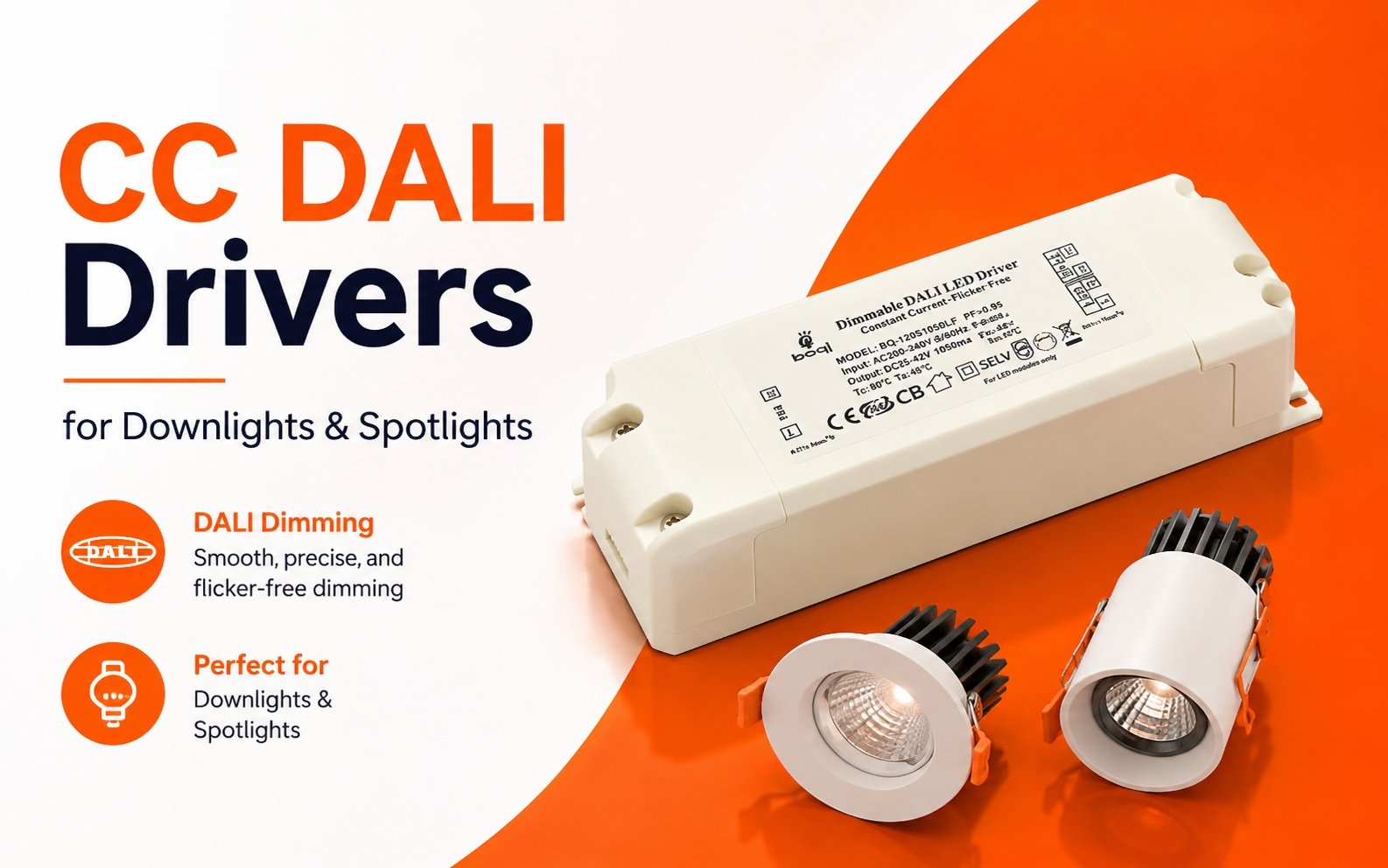
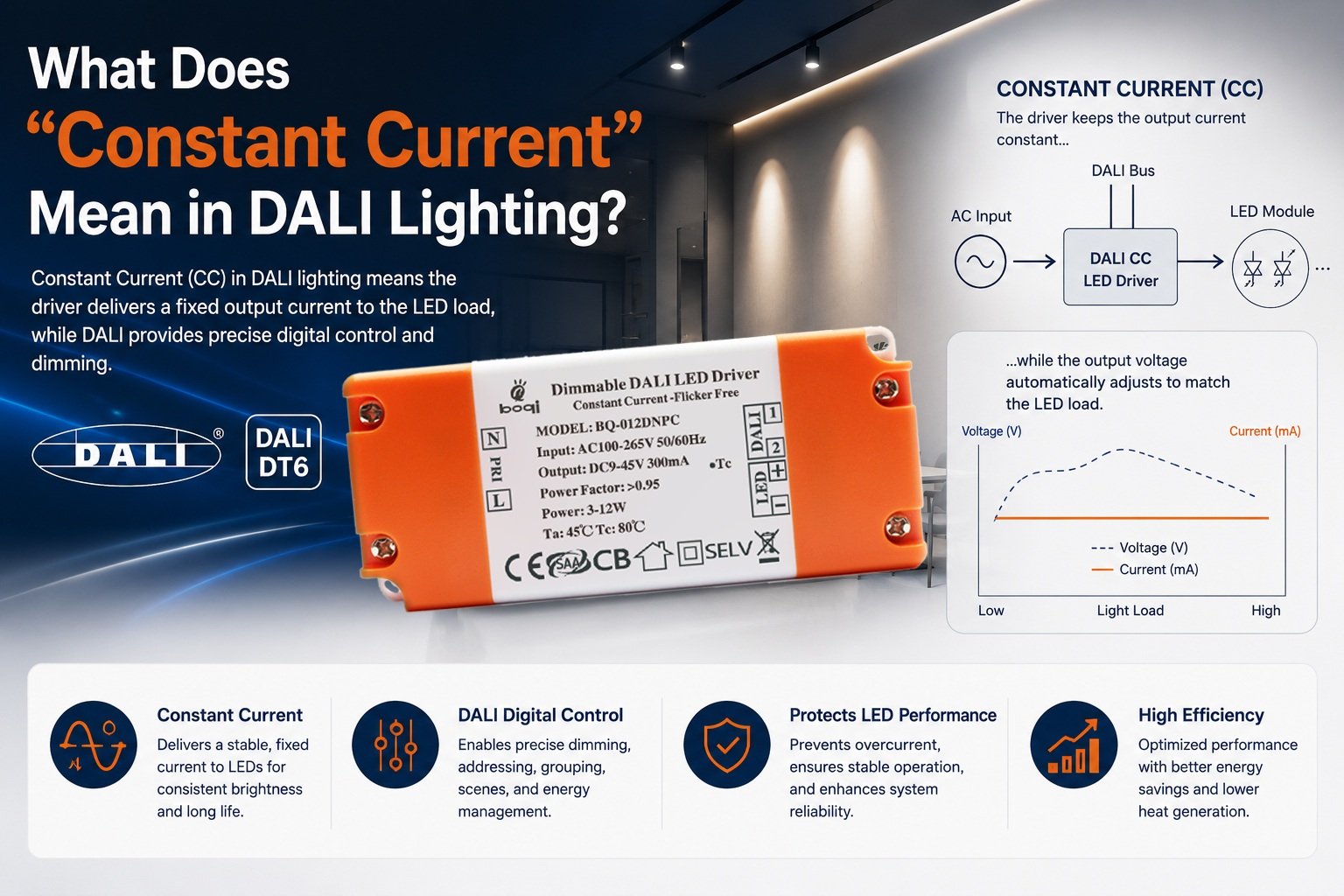
Dans un système d'éclairage DALI à courant constant, le driver LED fournit un courant de sortie fixe, exprimé en milliampères, au module LED, tandis que sa tension varie dans une plage de tension directe. Le protocole DALI ne concerne que la gradation numérique ; c'est le driver lui-même qui régule et stabilise le courant.
Cette définition semble simple. Mais ce sont les détails qui déterminent si vos luminaires s'atténuent en douceur ou tombent en panne prématurément. Laissez-moi vous expliquer ce qui compte vraiment lorsque vous achetez ou choisissez ces drivers.
Comment savoir si mes luminaires LED ont besoin d'un variateur DALI à courant constant ?
Au printemps dernier, un distributeur italien nous a envoyé un échantillon de spot encastré dont l'ampoule grillait sans cesse. Le problème venait d'un alimentateur à tension constante associé à un module COB à commande par courant.
Vos luminaires LED nécessitent un variateur DALI à courant constant si le module LED indique un courant nominal en milliampères, par exemple 350 mA ou 700 mA. Les COB nus, les modules pour spots encastrés et les modules haute puissance sont alimentés en courant constant ; les bandes LED dotées de résistances intégrées nécessitent généralement une alimentation en tension constante.
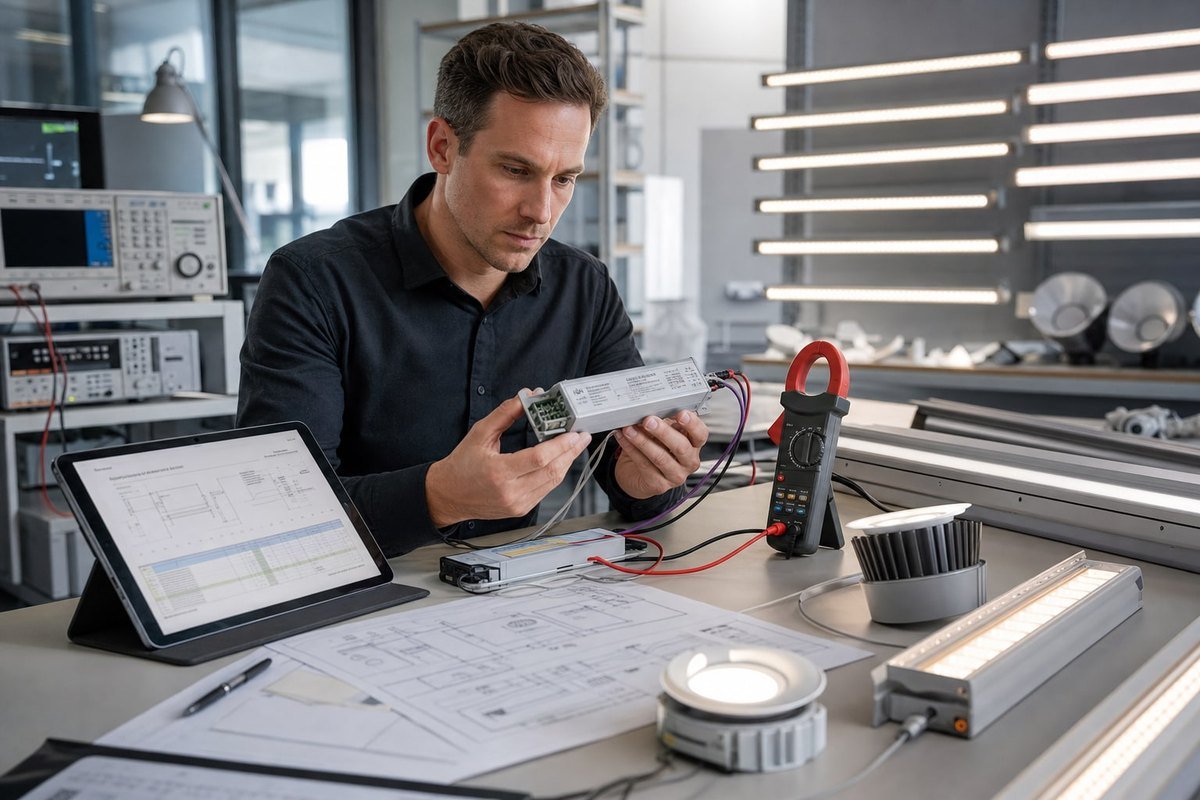
Le moyen le plus rapide de se décider est de consulter la fiche technique du module LED. Les LED sont des semi-conducteurs alimentés par le courant. Si on leur fournit trop de courant, la température augmente, la résistance…ce 1 chute, et la LED consomme encore plus de courant. Cette réaction en chaîne s'appelle emballement thermique 2, ce qui endommage la puce. Un circuit de commande à courant constant évite cela en maintenant le courant de sortie (en milliampères) à un niveau constant tout en ajustant automatiquement la tension.
Vérifiez d'abord ces trois points
Commencez par vérifier les caractéristiques techniques du module. Si celles-ci indiquent “ 700 mA, 24–42 V ”, cette plage de tension correspond à la tension directe 3 plage, et vous avez besoin d'un courant constant. Deuxièmement, examinez le câblage. Les systèmes à courant constant utilisent un montage en série, de sorte que le même courant traverse chaque LED de la chaîne. Troisièmement, examinez votre plan de commande. Si le projet nécessite un système d'éclairage adressable avec des scènes et des groupes, vous aurez besoin d'un équipement de commande DALI, et non d'une gradation analogique.
Voici la comparaison relative à la tension constante que nos ingénieurs présentent aux nouveaux clients :
| Facteur | Courant constant (CC) | Tension constante (CV) |
|---|---|---|
| Sortie régulée | Courant fixe (mA) | Tension fixe (V) |
| Charges typiques | COB, spots encastrés, panneaux, luminaires pour grandes hauteurs | Bandes LED, modules d'affichage |
| Câblage | Configuration du câblage en série | Parallèle |
| Risque de défaillance en cas d'incompatibilité | Surintensité, emballement thermique | Luminosité inégale, zones de surchauffe |
| Uniformité de la luminosité | Identique sur toute la chaîne | Chutes sur les longues distances |
Il y a un autre point qui échappe souvent aux gens. Le protocole DALI en lui-même ne garantit pas un système à courant constant. Le bus DALI ne transmet que des commandes numériques à environ 16 V CC, avec un faible budget de courant. Le côté sortie du pilote est un circuit distinct, qui peut fonctionner en mode CC (courant constant) ou CV (tension constante) selon le produit.
Quelle intensité de sortie dois-je préciser lorsque je recherche des variateurs à courant constant DALI pour mon projet ?
Le choix du courant de sortie est un compromis que nous évaluons en permanence avec nos clients : un courant plus élevé en milliampères se traduit par un flux lumineux plus important par module, mais aussi par une production de chaleur accrue et une durée de vie réduite des LED.
Indiquez le courant de sortie indiqué dans la fiche technique de votre module LED (généralement 350 mA, 500 mA, 700 mA ou 1 050 mA) et vérifiez que la plage de tension directe du driver couvre votre guirlande LED. Pour plus de flexibilité entre les différentes références, optez pour un driver multi-courant réglable via des commutateurs DIP ou par programmation.
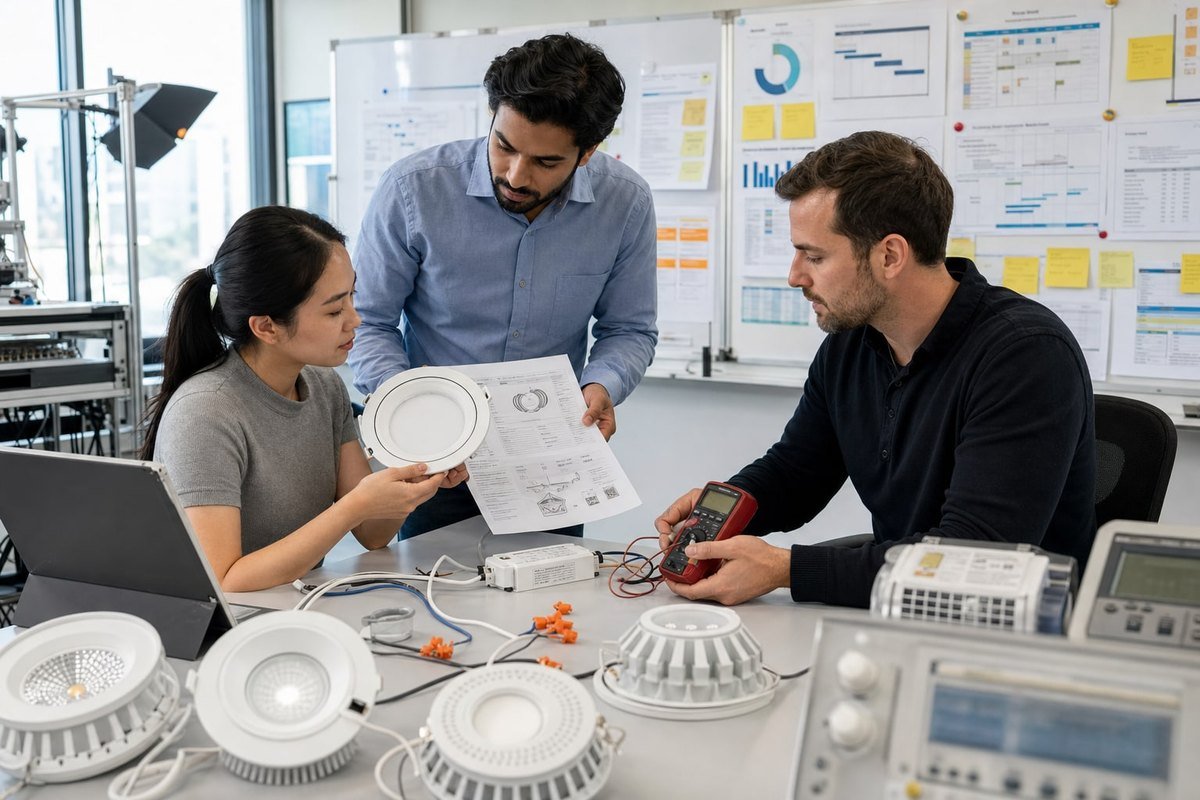
Déterminer correctement la valeur du courant n’est qu’une première étape. Vous devez également vérifier que la plage de tension du pilote correspond à celle de votre chaîne. Si votre chaîne nécessite une tension comprise entre 30 et 42 V à 700 mA, un pilote conçu pour une plage de 25 à 40 V sera saturé dans la partie haute de la plage, ce qui provoquera des coupures ou un scintillement. Dans nos projets OEM pour des marques européennes d’éclairage, cette incompatibilité de tension est l’erreur de spécification la plus courante que nous détectons lors de la revue de conception.
Adapter le courant à l'application
Les différentes classes de luminaires sont regroupées en fonction des courants d'alimentation typiques. Utilisez ces informations comme point de départ, puis vérifiez-les par rapport à votre module :
| Application | Courant de sortie typique | Plage de puissance typique |
|---|---|---|
| Petits projecteurs, têtes de rail | 350 à 500 mA | 5 à 15 W |
| Spots encastrés à usage commercial | 500 à 700 mA | 10 à 25 W |
| Panneaux lumineux, luminaires linéaires | 700 à 1 050 mA | 25 à 45 W |
| Entrepôts industriels à grande hauteur | 1 050 mA et plus | 60 W et plus |
Définissez également le comportement de la gradation
Le courant n'est pas la seule donnée indiquée dans la fiche technique. Renseignez-vous sur le mode de gradation du driver. Les meilleurs drivers LED DALI-2 utilisent une gradation hybride : réduction continue du courant à forte luminosité, puis haute fréquence modulation par largeur d'impulsion 4 à de faibles niveaux. Cette combinaison permet d’obtenir une gradation fluide et sans scintillement jusqu’à 1%, voire 0,1%. Précisez également le type d’appareil. Un contrôleur DALI DT6 gère la gradation monocanal standard, tandis que le DT8 équilibre deux canaux de courant pour le « tunable white » via une seule adresse. Si votre client souhaite disposer de données de retour d’information sur la consommation d’énergie et la température à des fins de gestion du bâtiment, ajoutez la prise en charge de la norme D4i à la liste des exigences.
Enfin, demandez un démarrage progressif et une limitation du courant d'appel. Lorsque des dizaines de pilotes se mettent sous tension simultanément sur un même disjoncteur, les pilotes bon marché le font sauter. Les pilotes de bonne qualité, eux, ne le font pas.
Comment puis-je vérifier la précision du courant constant lors du contrôle qualité de ma gamme d'éclairage en marque de distributeur ?
Une responsable des achats de Singapour m'a un jour demandé via WhatsApp quelles étaient exactement nos étapes de contrôle qualité avant de valider une commande sous marque de distributeur. Cette conversation a donné lieu à notre liste de contrôle standard.
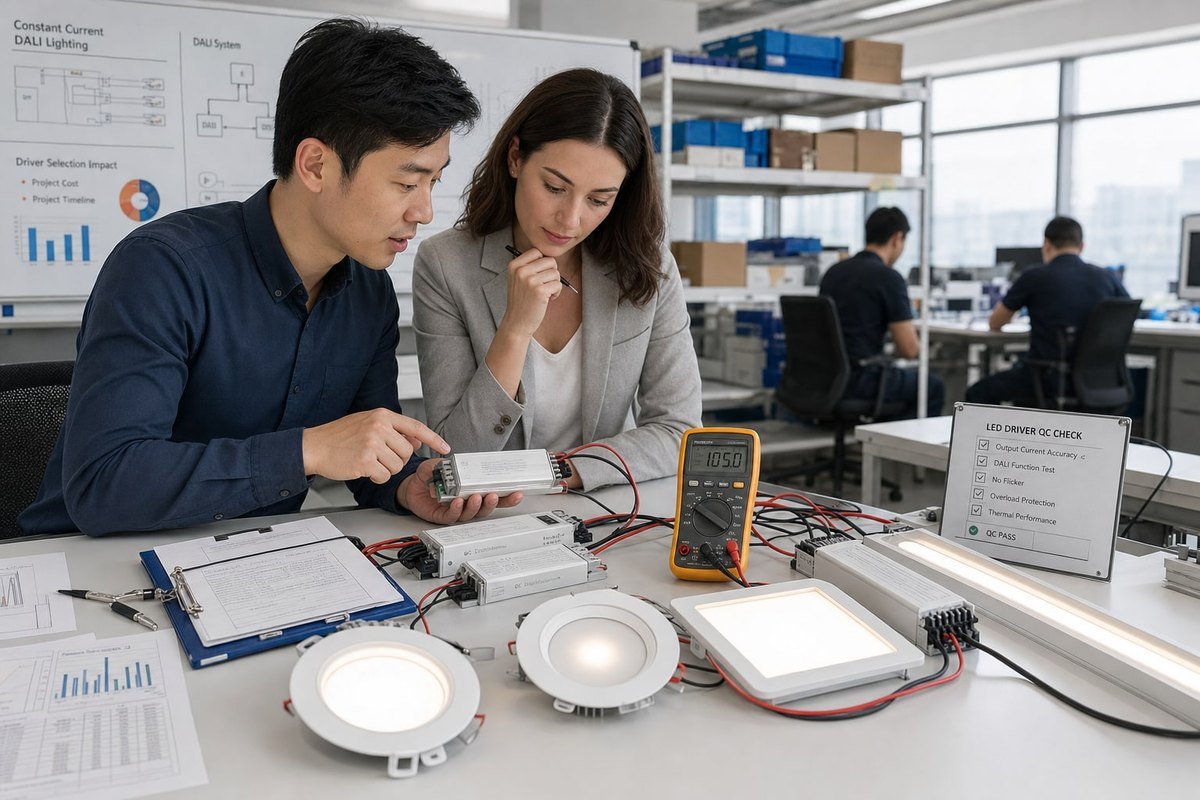
Vérifiez la précision du courant constant en mesurant le courant de sortie à l'aide d'un multimètre étalonné ou d'une charge électronique, à pleine luminosité et à plusieurs niveaux de gradation DALI, pour les tensions de charge minimales et maximales. Acceptez les appareils dont le courant ne s'écarte pas de plus de ±5% du courant nominal, et vérifiez les performances en matière de scintillement à l'aide d'un scintillomètre photométrique.

Le contrôle qualité des pilotes de marque de distributeur n'est pas compliqué, mais il doit être systématique. Sur notre chaîne de production à Shenzhen, chaque pilote est soumis à des tests automatisés avant que le logo ne soit apposé sur le boîtier. Je recommande aux propriétaires de marques de reproduire une version simplifiée de ce processus lors de l'inspection avant expédition, soit par leurs propres moyens, soit par l'intermédiaire d'un inspecteur tiers.
Une procédure pratique de contrôle qualité en cinq étapes
- Essai de courant statique. Connectez le pilote à une charge électronique réglée dans la plage de tension directe nominale. Mesurez le courant de sortie au niveau de luminosité 100%. Il doit se situer à ±5% de la valeur indiquée sur la plaque signalétique.
- Balayage de charge. Répétez la mesure aux tensions minimale et maximale de la vitre du conducteur. Un étage à courant constant de bonne qualité maintient la même valeur en milliampères sur toute la plage de mesure.
- Linéarité de la gradation DALI. Envoyez des commandes DALI aux codes 100%, 50%, 10% et 1%. Vérifiez que l'intensité lumineuse suit la courbe de gradation logarithmique de manière fluide, sans à-coups ni sauts. Cela permet de vérifier que le protocole de gradation numérique et l'étage de régulation du courant fonctionnent correctement ensemble.
- Mesure du scintillement. À de faibles niveaux de luminosité, les pilotes passant en modulation de largeur d'impulsion doivent fonctionner à une fréquence suffisamment élevée pour rester invisibles. Testez avec un mesureur de scintillement 6 à 10% et 1%.
- Échantillonnage thermique et d'endurance. Effectuez un test sur un lot d'échantillons à pleine charge dans une enceinte chauffée afin de procéder à un rodage prolongé. La dérive du courant sous l'effet de la chaleur permet de détecter les composants défaillants avant même que vos clients ne s'en aperçoivent.
Documents à demander à votre fournisseur
Demandez des rapports d'essais liés aux numéros de série, et non des fiches techniques génériques. Dans le cadre de nos activités d’exportation vers des marchés tels que l’Allemagne, le Japon et l’Australie, nous avons constaté que la traçabilité au niveau des lots permettait de réduire le délai de résolution des litiges de plusieurs semaines à quelques jours. Vérifiez également que les marquages de sécurité imprimés sur le boîtier, tels que les symboles CE et SELV, correspondent bien aux documents de certification réels. Les marquages contrefaits sur les boîtiers des drivers constituent un risque réel lorsque l’approvisionnement s’effectue auprès d’usines non contrôlées.
Pourquoi le choix d'un variateur DALI à courant constant adapté a-t-il une incidence sur le coût total et le calendrier de mon projet ?
Nous avons un jour aidé un client britannique à relancer un projet hôtelier qui était au point mort. Le fournisseur initial avait livré des alimentations dont l'intensité nominale était incorrecte, et chaque spot a dû être rééquipé d'un nouveau bloc d'alimentation sur place.
Un driver inadapté entraîne des retouches, des remplacements et des retards de mise en service qui font grimper les coûts bien au-delà du prix du driver lui-même. Un driver DALI à courant constant adapté permet d'éviter les pannes sur site, d'accélérer l'adressage et la mise en service, de réduire la consommation d'énergie grâce à une gradation précise et de préserver la durée de vie des LED, tout en respectant les budgets et les délais.
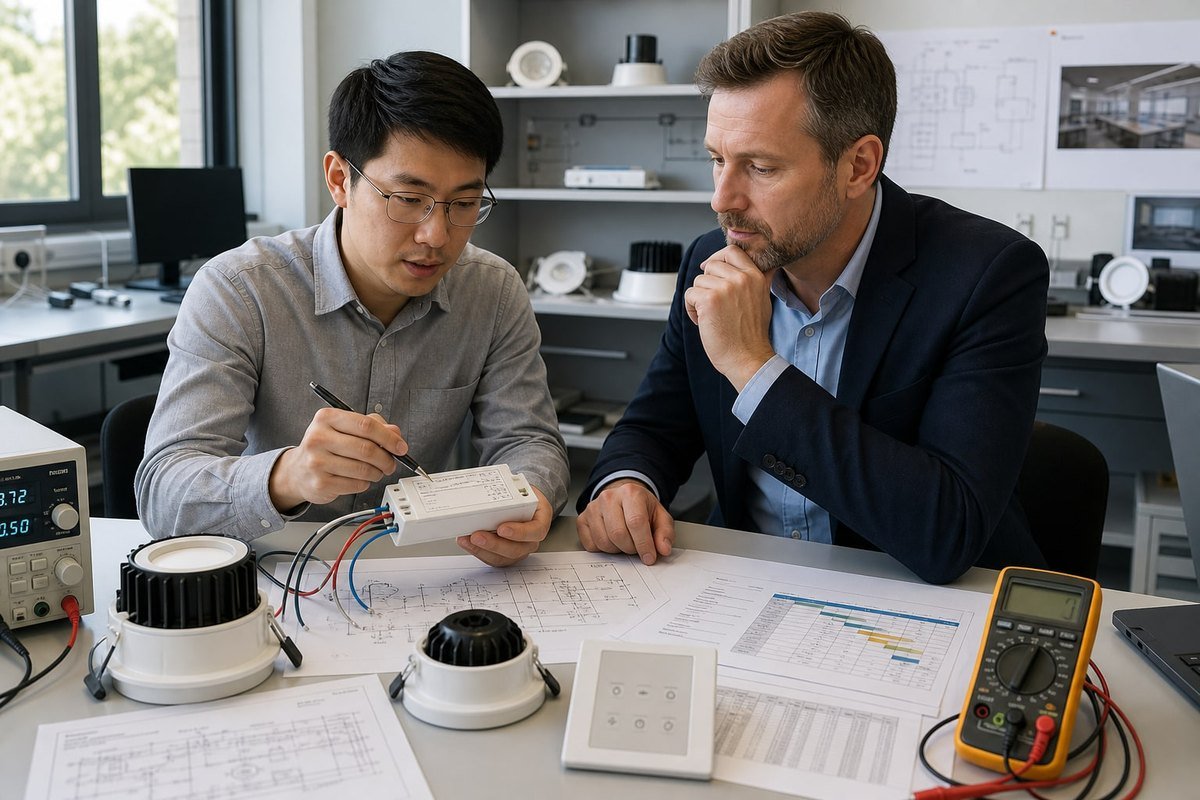
Le coût du driver représente généralement moins de 15% de la nomenclature d'un luminaire. Pourtant, les défaillances du driver sont à l'origine d'une part disproportionnée des dépassements budgétaires des projets. La raison est simple : le driver se situe à la croisée de l'installation électrique, du système de commande et de la charge LED. Une erreur au niveau de ce composant unique se répercute simultanément dans trois directions.
Où se cachent les coûts cachés ?
| Mauvais choix | Symptôme immédiat | Coût en aval |
|---|---|---|
| Intensité nominale trop élevée | Surchauffe des LED | Baisse précoce du flux lumineux, réclamations au titre de la garantie |
| Décalage de la plage de tension | Scintillement, perte de signal à faible intensité lumineuse | Dépannage sur site, main-d'œuvre de remplacement |
| Interface DALI non certifiée | Gérer les échecs | Retards de mise en service, honoraires de l'intégrateur |
| Pas de limitation du courant d'appel | Déclenchement des disjoncteurs à la mise sous tension | Refonte du système électrique, ajout de contacteurs |
| DALI classique au lieu de DALI-2 | Aucune garantie d'interopérabilité | Écosystème verrouillé, coût futur de la mise à niveau |
Les risques liés au calendrier sont plus importants que les risques liés aux coûts
Les dépassements de coûts font mal, mais ce sont les retards qui tuent les projets. C’est lors de la mise en service que les alimentations de mauvaise qualité font perdre le plus de temps. Une alimentation LED DALI-2 réagit correctement à l’adressage IEC 62386 7, l'affectation par groupe et les commandes de scène à partir de n'importe quel contrôleur compatible. Les appareils non certifiés fonctionnent souvent lors des démonstrations, mais tombent en panne sur le réseau réel, et les intégrateurs facturent à la journée pendant qu'ils recherchent la panne. Dans le cadre de nos activités d'ODM, nous intégrons des tests de conformité DALI-2 précisément parce que nos clients grossistes ne peuvent pas se permettre de retards dans le calendrier.
Il y a également une dimension prospective. Les bâtiments intelligents ont de plus en plus besoin de données. Les modules d’éclairage compatibles avec le système de retour d’information D4i transmettent via le bus les données relatives à la consommation d’énergie, aux heures de fonctionnement et à la température. Intégrer cette fonctionnalité dès le départ coûte un peu plus cher par unité. L’installer a posteriori impliquerait de remplacer chaque driver fixé au plafond. Lorsque j’examine le cahier des charges d’un projet avec un client, je m’informe toujours du plan quinquennal, et pas seulement de la date de lancement, car le driver le moins cher au départ est rarement le plus économique sur toute la durée de vie de l’installation.
Conclusion
Le « courant constant » fait référence à la sortie régulée du pilote, et non au bus DALI. Adaptez le courant, la plage de tension et la conformité DALI-2 à vos luminaires, puis effectuez des contrôles qualité concrets. En faisant les choses correctement dès le départ, vous préserverez à la fois les coûts de votre projet, son calendrier et la réputation de votre marque.
Notes de bas de page
1. Source officielle de l'UE expliquant le marquage « CE » mentionné dans les contrôles de la documentation relative au contrôle qualité. ↩︎
2. Définit le mécanisme de défaillance en cause lorsque les LED surchauffent en raison d'un courant excessif. ↩︎
3. Explique la propriété des semi-conducteurs qui sous-tend les concepts liés à la plage de tension directe des LED. ↩︎
4. Présentation de la technique de gradation utilisée à de faibles niveaux de luminosité. ↩︎
5. Fournit des informations techniques sur la diminution du flux lumineux due à la suralimentation des LED. ↩︎
6. Informations générales sur la mesure du scintillement lumineux en rapport avec les essais photométriques mentionnés. ↩︎
7. Fait référence à l'organisme international de normalisation chargé des spécifications du protocole DALI. ↩︎