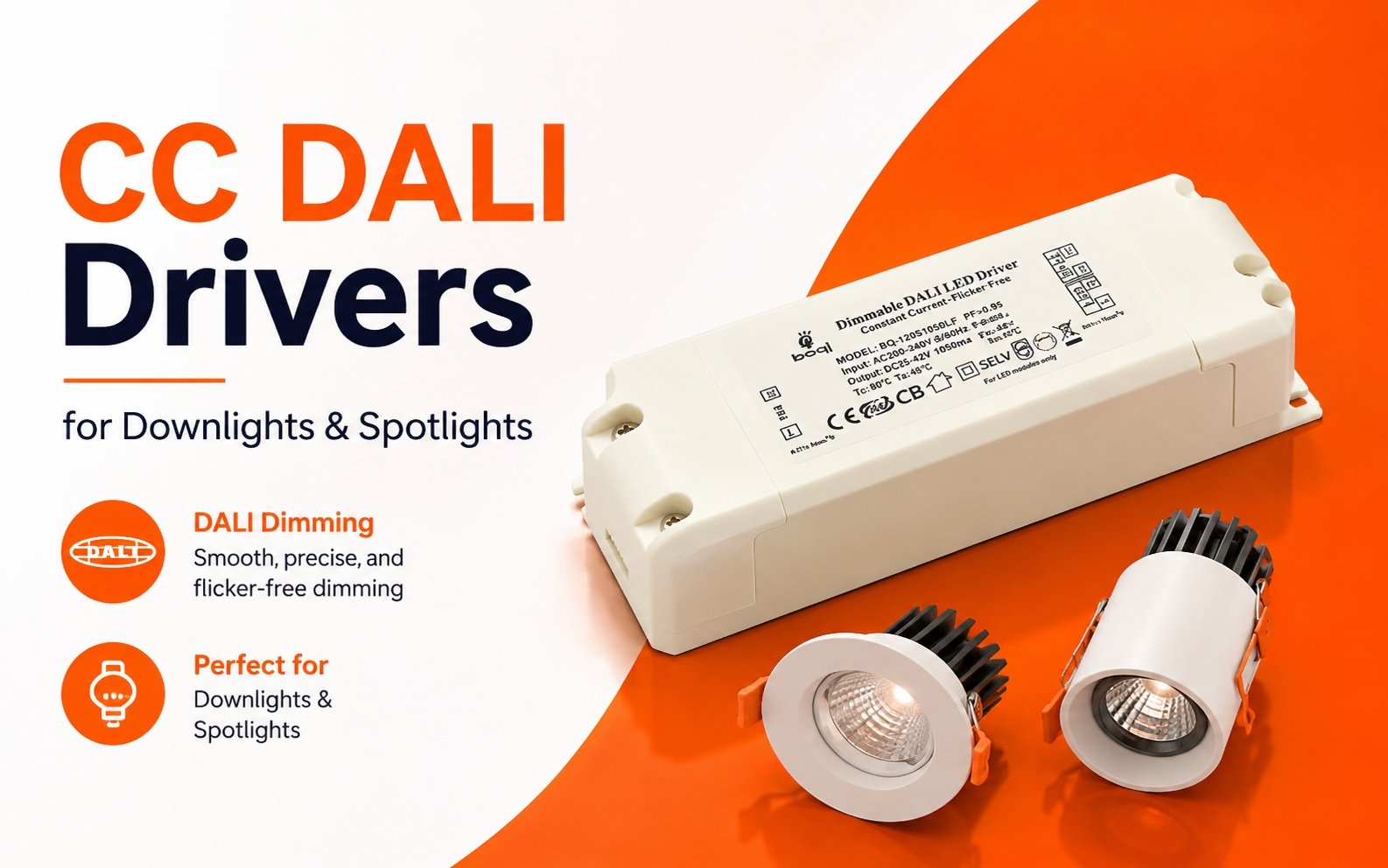














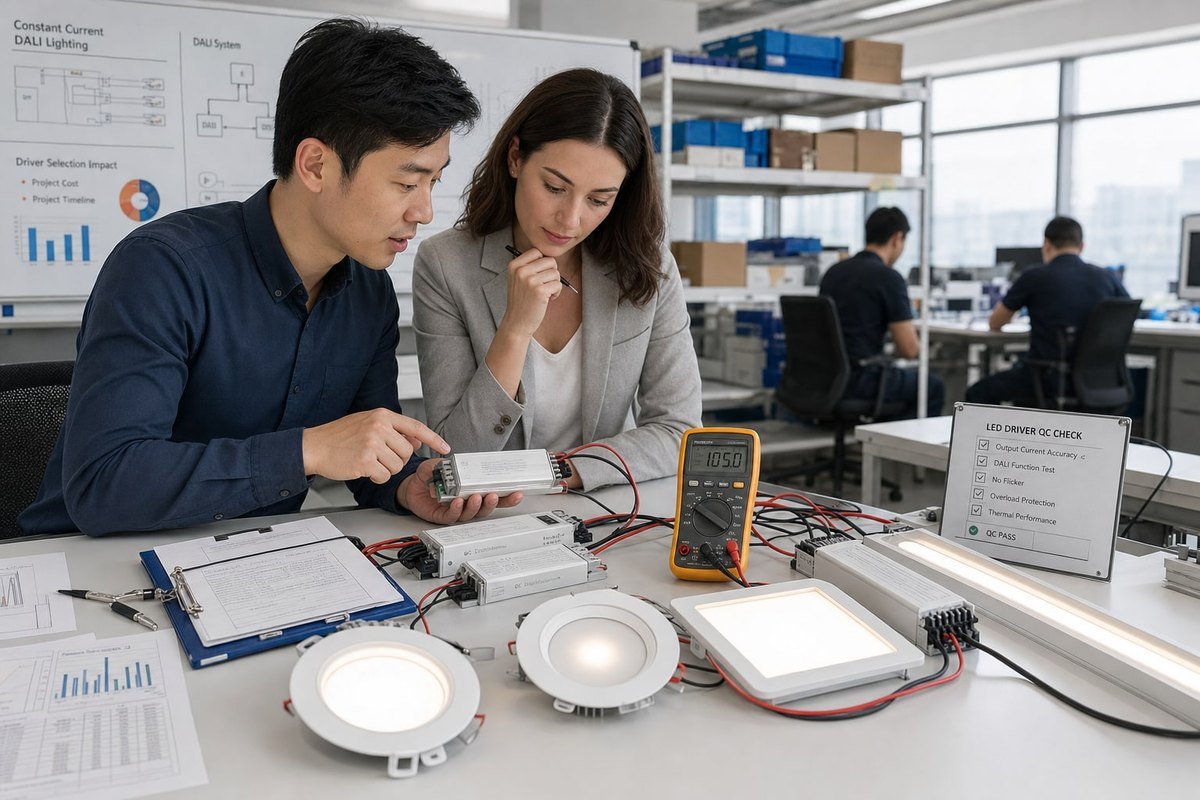
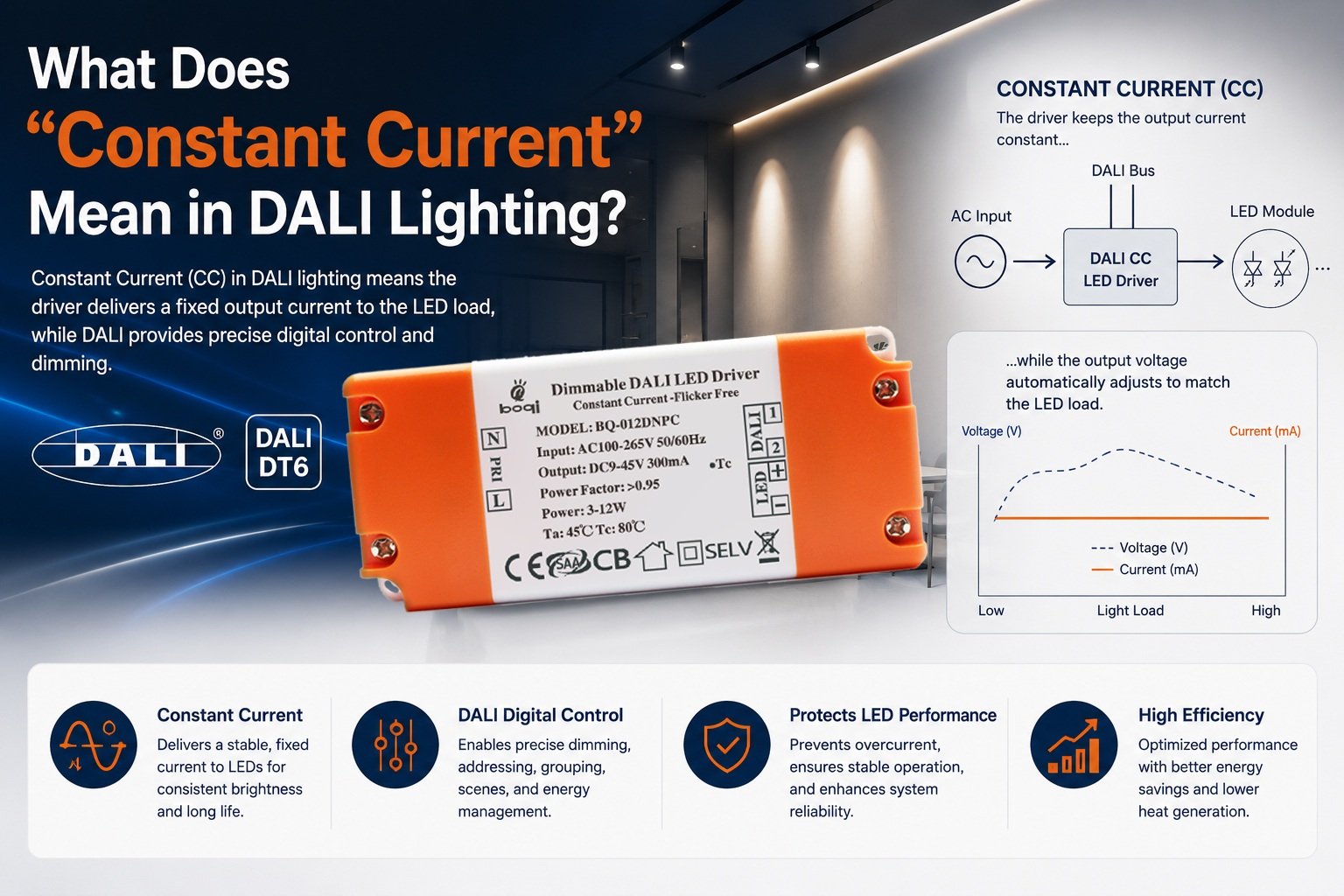
Người mua thường hỏi tôi dòng điện không đổi trong chiếu sáng DALI nghĩa là gì. Sự nhầm lẫn ở đây gây ra driver bị trả lại, đèn nhấp nháy và chậm tiến độ ra mắt. Đội kỹ thuật Thâm Quyến của chúng tôi giải đáp câu hỏi này mỗi ngày.
Dòng điện không đổi trong chiếu sáng DALI có nghĩa là driver LED cung cấp dòng điện đầu ra cố định tính bằng miliampe cho mô-đun LED trong khi điện áp của nó dao động trong dải điện áp thuận. DALI chỉ là giao thức điều chỉnh độ sáng kỹ thuật số; bản thân driver điều chỉnh và ổn định dòng điện.
Định nghĩa đó nghe có vẻ đơn giản. Nhưng chi tiết quyết định đèn của bạn mờ mượt hay hỏng sớm. Hãy để tôi hướng dẫn bạn những điều thực sự quan trọng khi bạn mua hoặc chỉ định các driver này.
Làm sao tôi biết đèn LED của mình có cần driver DALI dòng điện không đổi không?
Mùa xuân năm ngoái, một nhà phân phối ở Ý đã gửi cho chúng tôi một mẫu đèn downlight liên tục bị cháy. Nguyên nhân là do driver điện áp không đổi kết hợp với mô-đun COB điều khiển bằng dòng điện.
Đèn LED của bạn cần driver DALI dòng điện không đổi nếu mô-đun LED ghi dòng điện định mức tính bằng miliampe, chẳng hạn như 350mA hoặc 700mA. COB trần, bộ đèn downlight và mô-đun công suất cao được điều khiển bằng dòng điện; dải LED có điện trở tích hợp thường cần điện áp không đổi.
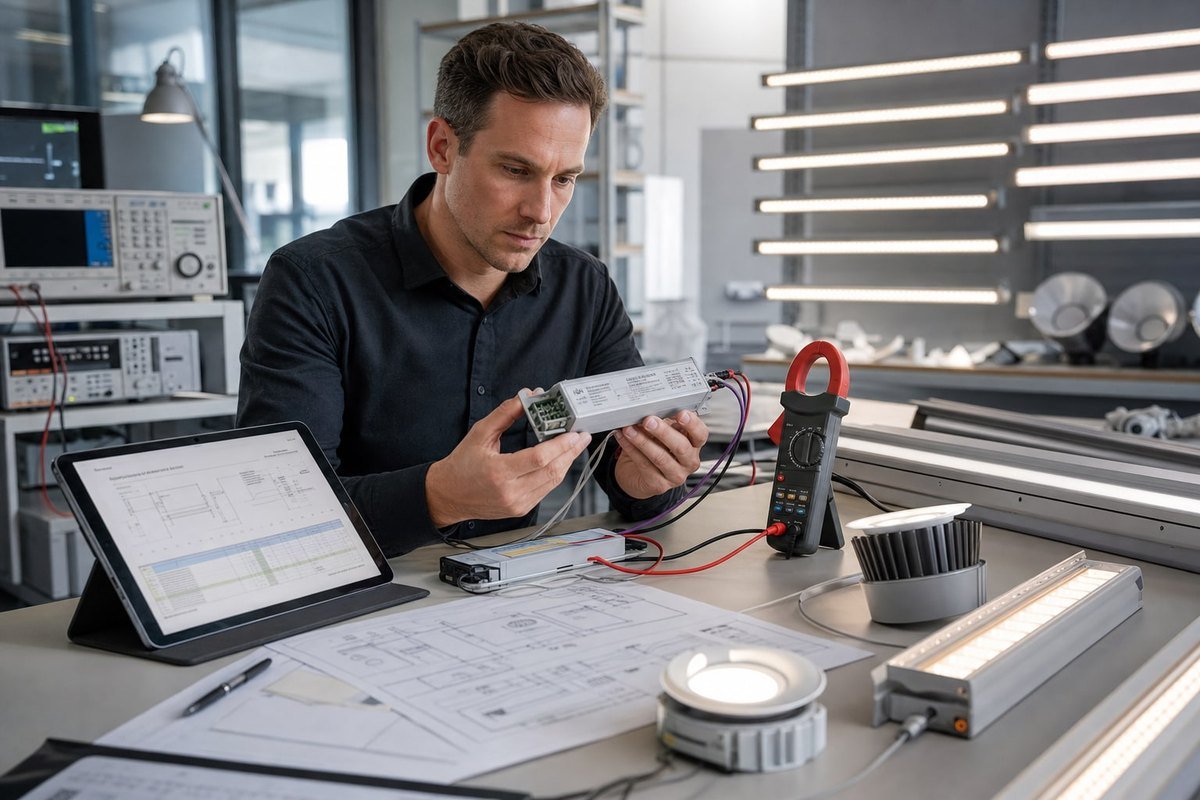
Cách nhanh nhất để quyết định là đọc bảng dữ liệu mô-đun LED. LED là chất bán dẫn điều khiển bằng dòng điện. Cấp quá nhiều dòng điện, nhiệt độ tăng, điện trởgiảm, và LED kéo thêm dòng điện. Phản ứng dây chuyền đó được gọi là 1 drops, and the LED pulls even more current. That chain reaction is called sự chạy trốn nhiệt 2, and it destroys the chip. A constant current driver prevents this by holding the output current milliamps steady while adjusting voltage automatically.
.
Kiểm tra ba điều này trước tiên
First, look at the module rating. If it says “700mA, 24–42V,” that voltage span is the
điện áp thuận 3 range, and you need constant current. Second, look at the wiring. Constant current systems use a series wiring configuration, so the same current flows through every LED in the string. Third, look at your control plan. If the project demands an addressable lighting system with scenes and groups, you need DALI control gear, not analog dimming.
.
Here is the constant voltage comparison our engineers share with new clients:
| Yếu tố | Dòng điện không đổi (CC) | Điện áp không đổi (CV) |
|---|---|---|
| Regulated output | Fixed current (mA) | Fixed voltage (V) |
| Tải điển hình | COBs, downlights, panels, high-bays | LED strips, signage modules |
| Wiring | Series wiring configuration | Parallel |
| Failure risk if mismatched | Overcurrent, thermal runaway | Uneven brightness, hot spots |
| Brightness consistency | Identical across the string | Drops along long runs |
One more point people miss. DALI itself does not make a system constant current. The DALI bus only carries digital commands at roughly 16V DC with a small current budget. The driver output side is a separate circuit, and it can be CC or CV depending on the product.
.
Đúng
.
Sai
.
Tôi nên chỉ định dòng điện đầu ra nào khi tìm nguồn driver DALI dòng điện không đổi cho dự án của mình?
Choosing an output current is a trade-off we weigh with clients constantly: higher milliamps mean more lumens per module, but also more heat and shorter LED life.
Ghi rõ dòng điện đầu ra được nêu trong bảng dữ liệu mô-đun LED của bạn, thường là 350mA, 500mA, 700mA hoặc 1050mA, và xác nhận dải điện áp thuận của driver bao phủ chuỗi LED của bạn. Để linh hoạt giữa các mã SKU, hãy chọn driver đa dòng có thể điều chỉnh qua công tắc DIP hoặc lập trình.
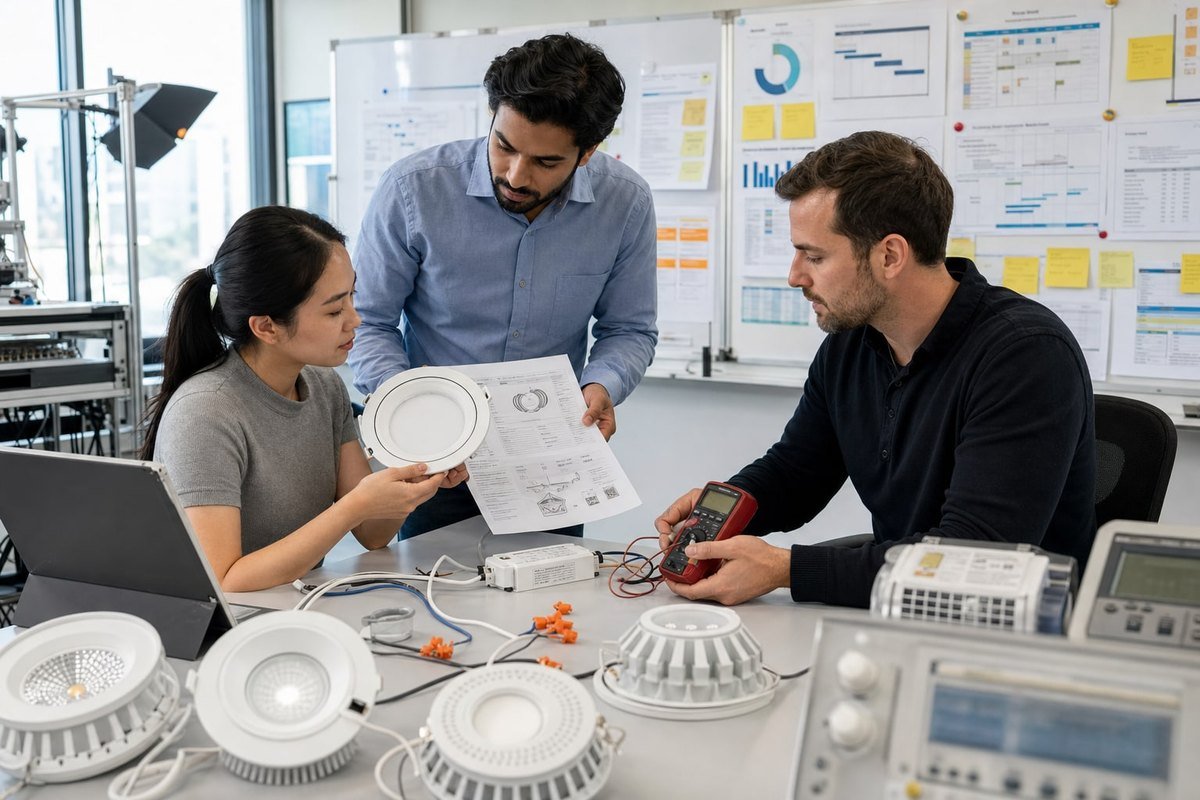
Xác định đúng giá trị dòng điện chỉ là bước một. Bạn cũng cần kiểm tra rằng cửa sổ điện áp của driver khớp với chuỗi LED của bạn. Nếu chuỗi của bạn cần 30–42V ở 700mA, driver định mức 25–40V sẽ bị giới hạn ở mức cao và gây sụt áp hoặc nhấp nháy. Trong các dự án OEM của chúng tôi cho các thương hiệu chiếu sáng châu Âu, sự không khớp điện áp này là lỗi thông số kỹ thuật phổ biến nhất mà chúng tôi phát hiện trong quá trình rà soát thiết kế.
Khớp dòng điện với ứng dụng
Các loại đèn khác nhau tập trung quanh các dòng điện điển hình. Hãy dùng điều này làm điểm khởi đầu, sau đó xác minh với mô-đun thực tế của bạn:
| Đăng kí | Dòng điện đầu ra điển hình | Dải công suất điển hình |
|---|---|---|
| Đèn spotlight nhỏ, đầu ray | 350–500mA | 5–15W |
| Đèn downlight thương mại | 500–700mA | 10–25W |
| Đèn panel, đèn tuyến tính | 700–1050mA | 25–45W |
| Đèn high-bay công nghiệp | 1050mA trở lên | 60W+ |
Cũng quyết định hành vi điều chỉnh độ sáng
Dòng điện không phải là thông số duy nhất trên bảng thông số kỹ thuật. Hãy hỏi cách driver điều chỉnh độ sáng. Thiết kế driver DALI-2 tốt hơn sử dụng phương pháp làm mờ kết hợp: giảm dòng điện liên tục ở độ sáng cao, sau đó sử dụng điều chế độ rộng xung 4 tần số cao ở mức thấp. Sự kết hợp này mang lại khả năng làm mờ mượt mà, không nhấp nháy xuống đến 1% hoặc thậm chí 0,1%. Đồng thời chỉ rõ loại thiết bị. Bộ điều khiển DALI DT6 xử lý làm mờ kênh đơn tiêu chuẩn, trong khi DT8 cân bằng hai kênh dòng điện cho ánh sáng trắng điều chỉnh qua một địa chỉ. Nếu khách hàng của bạn muốn phản hồi năng lượng và nhiệt độ cho hệ thống quản lý tòa nhà, hãy thêm hỗ trợ D4i vào danh sách yêu cầu.
Cuối cùng, yêu cầu khởi động mềm và giới hạn dòng điện khởi động. Khi hàng chục driver khởi động cùng lúc trên một bộ ngắt mạch, driver rẻ tiền sẽ làm ngắt mạch. Driver tốt thì không.
Làm sao tôi có thể xác minh độ chính xác dòng điện không đổi trong quá trình kiểm soát chất lượng cho dòng sản phẩm chiếu sáng nhãn riêng của mình?
Một giám đốc thu mua từ Singapore từng hỏi tôi qua WhatsApp về các bước kiểm soát chất lượng chính xác của chúng tôi trước khi cam kết đơn hàng nhãn riêng. Cuộc trò chuyện đó đã trở thành danh sách kiểm tra tiêu chuẩn của chúng tôi.
Xác minh độ chính xác dòng điện không đổi bằng cách đo dòng điện đầu ra bằng đồng hồ vạn năng hiệu chuẩn hoặc tải điện tử ở độ sáng tối đa và nhiều mức làm mờ DALI, trên điện áp tải tối thiểu và tối đa. Chấp nhận các đơn vị trong phạm vi ±5% dòng điện định mức và xác nhận hiệu suất nhấp nháy bằng máy đo nhấp nháy quang học.
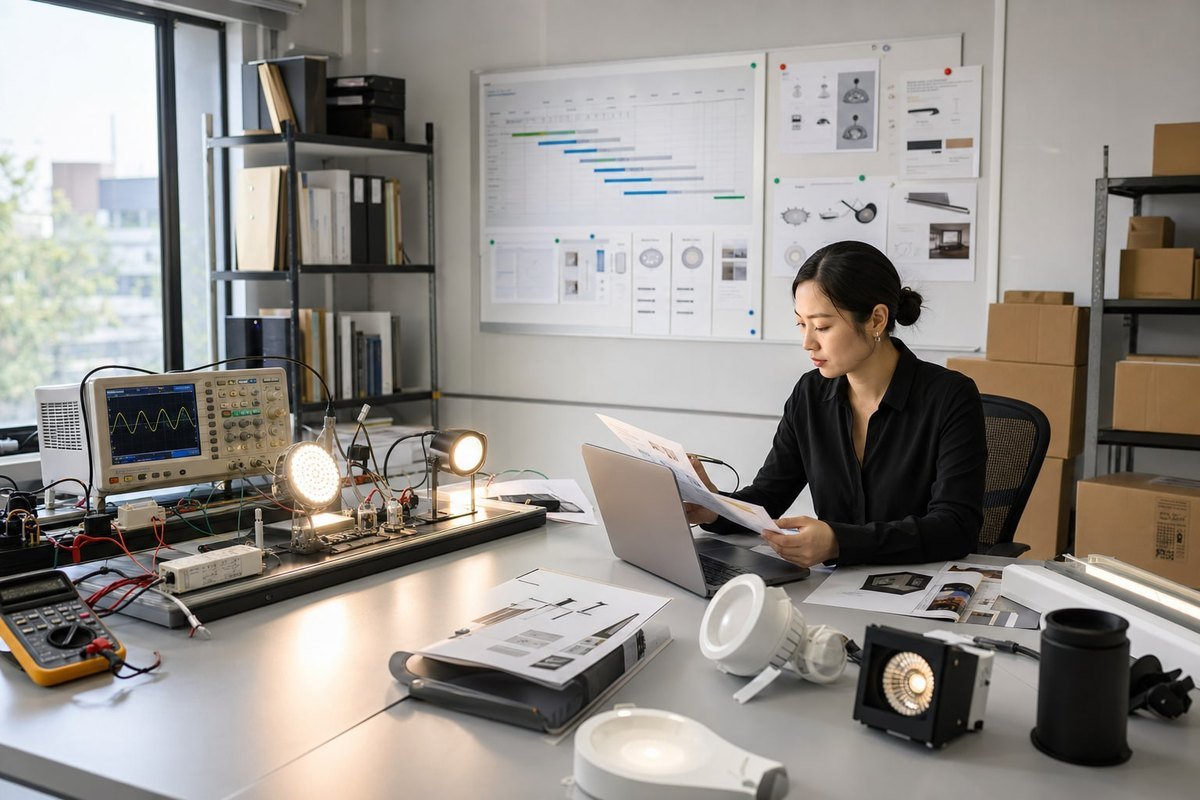
Kiểm soát chất lượng cho driver nhãn riêng không phức tạp, nhưng phải có hệ thống. Trên dây chuyền sản xuất của chúng tôi tại Thâm Quyến, mọi driver đều trải qua kiểm tra tự động trước khi logo được in trên vỏ. Tôi khuyên các chủ thương hiệu nên tái tạo phiên bản thu nhỏ của quy trình này trong quá trình kiểm tra trước khi giao hàng, tự thực hiện hoặc thông qua bên kiểm tra thứ ba.
Quy trình kiểm soát chất lượng năm bước thực tế
- Kiểm tra dòng điện tĩnh. Kết nối driver với tải điện tử được đặt trong dải điện áp thuận định mức. Đo dòng điện đầu ra ở độ sáng 100%. Giá trị phải nằm trong ±5% giá trị ghi trên nhãn.
- Quét tải. Lặp lại phép đo ở điện áp tối thiểu và tối đa của dải driver. Một tầng dòng điện không đổi chất lượng giữ cùng chỉ số milliamp trên toàn bộ dải.
- Độ tuyến tính làm mờ DALI. Gửi lệnh DALI ở 100%, 50%, 10% và 1%. Xác nhận đầu ra ánh sáng tuân theo đường cong làm mờ logarit mượt mà, không có bước nhảy hoặc nhảy vọt. Điều này kiểm tra giao thức làm mờ kỹ thuật số và tầng điều chỉnh dòng điện hoạt động chính xác cùng nhau.
- Đo nhấp nháy. Ở mức làm mờ thấp, driver chuyển sang điều chế độ rộng xung phải chạy ở tần số đủ cao để không thể nhìn thấy. Kiểm tra bằng máy đo nhấp nháy 6 ở 10% và 1%.
- Lấy mẫu thử nghiệm nhiệt và độ bền. Chạy một lô mẫu ở tải đầy đủ trong buồng gia nhiệt để thử nghiệm đốt cháy kéo dài. Dòng điện trôi dưới nhiệt độ sẽ phát hiện các linh kiện yếu trước khi khách hàng của bạn phát hiện.
Tài liệu cần yêu cầu từ nhà cung cấp
Yêu cầu báo cáo thử nghiệm liên kết với số sê-ri, không phải bảng dữ liệu chung. Trong công việc xuất khẩu của chúng tôi đến các thị trường như Đức, Nhật Bản và Úc, chúng tôi nhận thấy khả năng truy xuất nguồn gốc theo lô giúp rút ngắn thời gian giải quyết tranh chấp từ vài tuần xuống vài ngày. Đồng thời xác minh các dấu an toàn in trên vỏ, như ký hiệu CE và SELV, khớp với chứng nhận thực tế. Dấu giả trên vỏ driver vẫn là rủi ro thực sự khi mua từ các nhà máy chưa được kiểm định.
Tại sao việc chọn đúng driver DALI dòng điện không đổi ảnh hưởng đến tổng chi phí dự án và tiến độ của tôi?
Chúng tôi từng giúp một khách hàng Anh cứu dự án khách sạn bị đình trệ. Nhà cung cấp ban đầu giao driver có định mức dòng điện sai, và mọi đèn downlight phải được cấp lại nguồn tại hiện trường.
Driver sai buộc phải làm lại, thay thế và trì hoãn vận hành, nhân chi phí vượt xa giá driver. Driver DALI dòng điện không đổi đúng ngăn ngừa lỗi hiện trường, tăng tốc định địa chỉ và vận hành, giảm tiêu thụ năng lượng thông qua làm mờ chính xác và bảo vệ tuổi thọ LED, giữ ngân sách và tiến độ nguyên vẹn.
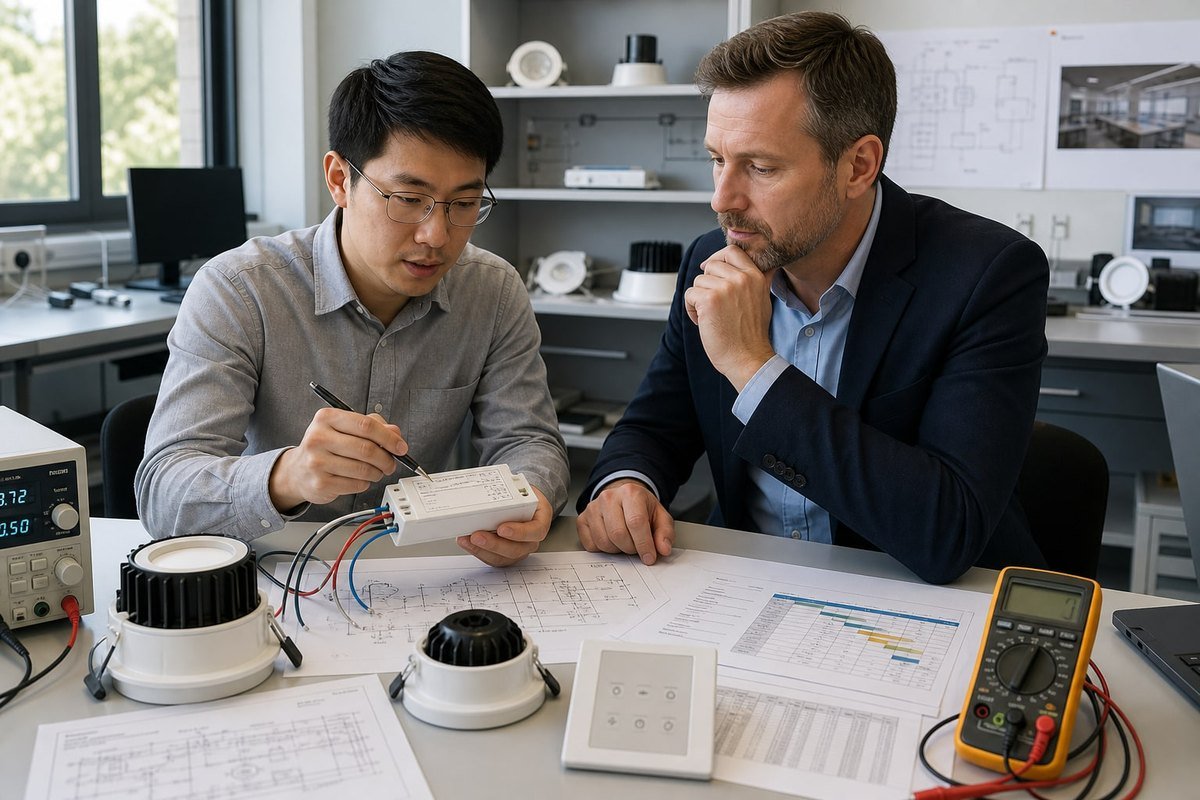
Chi phí driver thường dưới 15% tổng chi phí vật liệu của bộ đèn. Tuy nhiên, sai lầm về driver gây ra tỷ lệ vượt ngân sách không tương xứng. Lý do đơn giản: driver nằm giữa hệ thống điện, hệ thống điều khiển và tải LED. Một lỗi trong thành phần này lan tỏa theo ba hướng cùng lúc.
Nơi chi phí ẩn xuất hiện
| Lựa chọn sai | Triệu chứng ngay lập tức | Chi phí phát sinh |
|---|---|---|
| Định mức dòng điện quá cao | LED quá nhiệt | Suy giảm quang thông sớm, khiếu nại bảo hành |
| Không khớp dải điện áp | Nhấp nháy, sụt áp ở mức làm mờ | Khắc phục tại hiện trường, chi phí nhân công thay thế |
| Giao diện DALI không chứng nhận | Lỗi địa chỉ hóa | Chậm trễ vận hành thử, phí tích hợp |
| Không có giới hạn dòng khởi động | Aptomat nhảy khi cấp nguồn | Thiết kế lại điện, bổ sung contactor |
| DALI cũ thay vì DALI-2 | Không đảm bảo khả năng tương tác | Hệ sinh thái khóa chặt, chi phí nâng cấp trong tương lai |
Rủi ro về tiến độ lớn hơn rủi ro về chi phí
Chi phí vượt ngân sách gây thiệt hại, nhưng trễ tiến độ giết chết dự án. Vận hành thử là nơi driver kém chất lượng làm lãng phí thời gian nhất. Driver LED DALI-2 phản hồi chính xác lệnh địa chỉ hóa IEC 62386 7, gán nhóm và cảnh từ bất kỳ bộ điều khiển tương thích nào. Các thiết bị không chứng nhận thường hoạt động khi demo nhưng lỗi trên bus thực tế, và nhà tích hợp tính phí theo ngày trong khi họ truy tìm lỗi. Trong công việc ODM của chúng tôi, chúng tôi tích hợp kiểm tra tuân thủ DALI-2 chính xác vì khách hàng bán buôn của chúng tôi không thể chấp nhận trượt tiến độ.
Cũng có góc nhìn hướng tới tương lai. Tòa nhà thông minh ngày càng yêu cầu dữ liệu. Driver hỗ trợ phản hồi D4i báo cáo mức tiêu thụ năng lượng, giờ vận hành và nhiệt độ qua bus. Đặc tả khả năng đó ngay bây giờ tốn thêm một chút cho mỗi đơn vị. Nâng cấp sau này nghĩa là thay mọi driver trên trần. Khi tôi xem xét đặc tả dự án với khách hàng, tôi luôn hỏi về kế hoạch năm năm, không chỉ ngày ra mắt, vì driver rẻ nhất ngày đầu hiếm khi là driver rẻ nhất trong suốt vòng đời lắp đặt.
Sự kết luận
Dòng không đổi mô tả đầu ra được điều chỉnh của driver, không phải bus DALI. Khớp dòng điện, dải điện áp và tuân thủ DALI-2 với đèn của bạn, và xác minh bằng QC thực tế. Làm đúng một lần, chi phí dự án, tiến độ và danh tiếng thương hiệu của bạn đều được bảo vệ.
Chú thích
Nguồn EU chính thức giải thích dấu CE được đề cập trong kiểm tra tài liệu QC. ↩︎
Xác định cơ chế lỗi được đề cập khi LED quá nhiệt do dòng điện vượt mức. ↩︎
Giải thích đặc tính bán dẫn làm nền tảng cho khái niệm dải điện áp thuận của LED. ↩︎
Thông tin nền về kỹ thuật điều chỉnh độ sáng dùng ở mức sáng thấp. ↩︎
Cung cấp thông tin kỹ thuật nền về suy giảm quang thông do LED bị quá tải dòng. ↩︎
Thông tin nền về đo nhấp nháy ánh sáng liên quan đến kiểm tra trắc quang được đề cập. ↩︎
Chỉ đến tổ chức tiêu chuẩn quốc tế quản lý đặc tả giao thức DALI. ↩︎