













Every month, buyers message our Shenzhen team about burned-out LED strips fixed DC output voltage 1. The cause is almost always the same: someone misunderstood what constant voltage means in an LED driver.
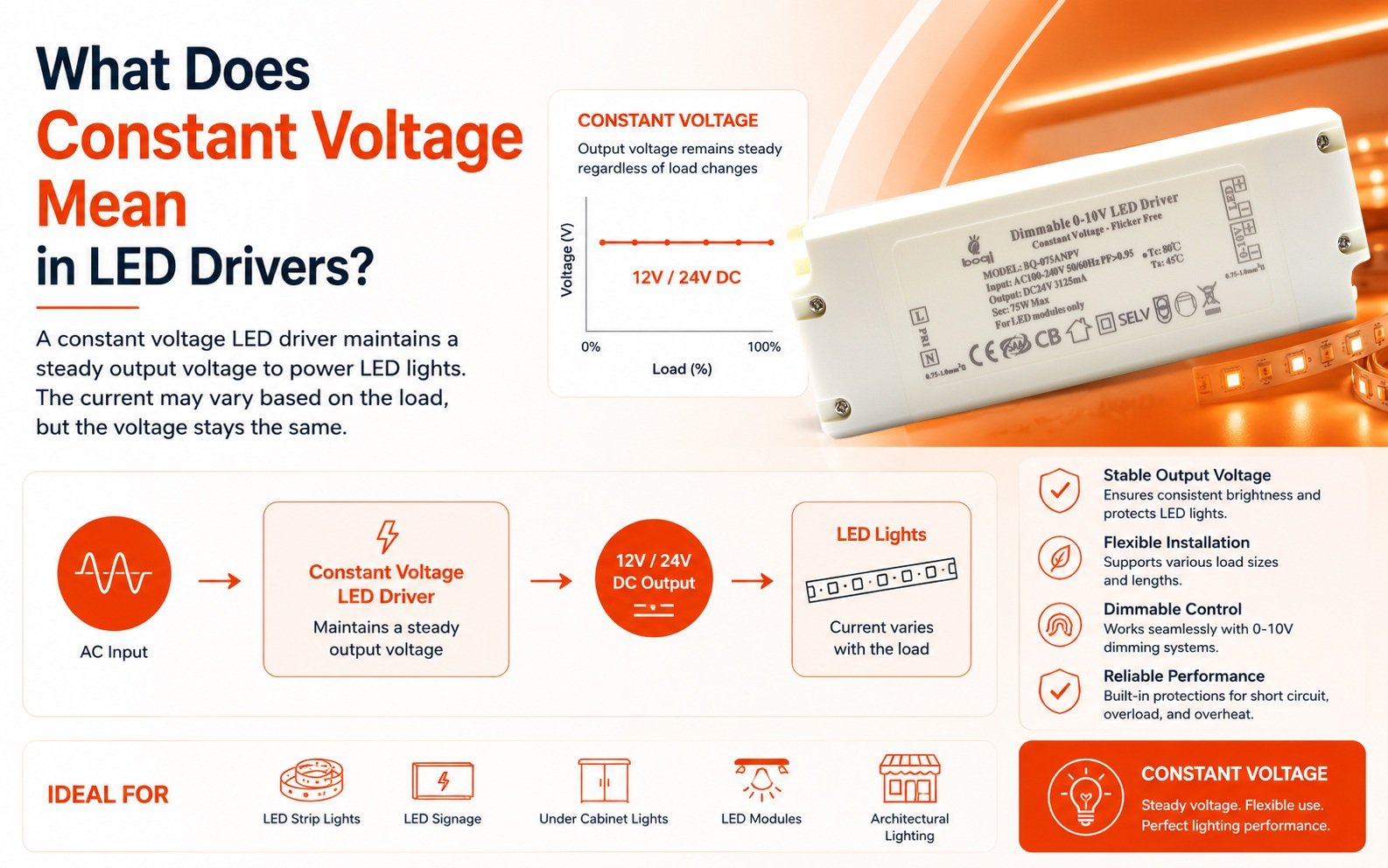
Constant voltage (CV) means an LED driver maintains a fixed DC output voltage, typically 12V or 24V, while the connected LED load determines how much current it draws through its built-in current-limiting circuitry. CV drivers power LED strips, neon flex, RGB/RGBW products, and other fixed-voltage loads.
That definition sounds simple. But the details decide whether your project runs for ten years or fails in ten weeks. Let me walk you through what actually matters, from label reading to sourcing checks.
How do I tell the difference between constant voltage and constant current LED drivers?
Last month, a Singapore distributor sent us a WhatsApp photo of two driver labels, asking which suited her strip project. The answer was printed on the nameplate.
A constant voltage LED driver holds output voltage fixed at 12V or 24V while current varies with the load. A constant current driver does the opposite: it locks the current and lets voltage change to match the LED string. Check the label for output XXV versus output XXmA.
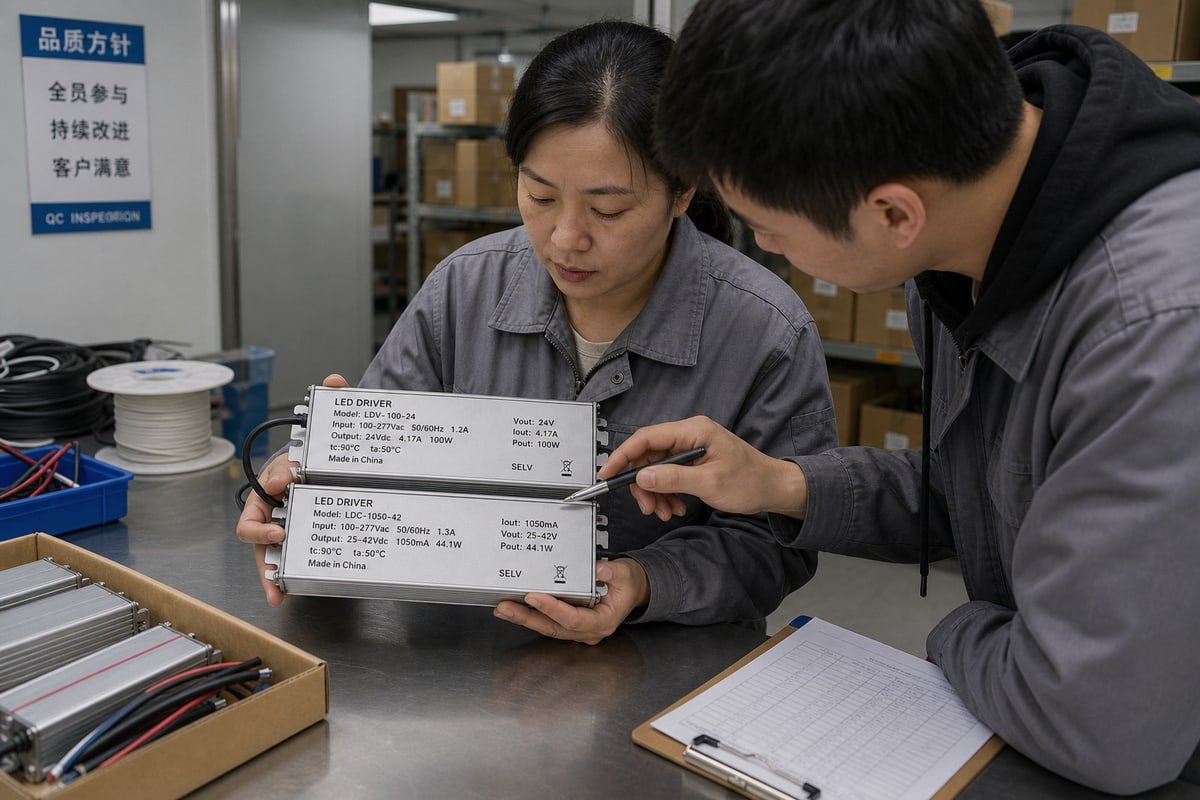
The fastest way to separate the two is a side-by-side view. Here is the comparison table we send to new distribution partners:
| Feature | Constant Voltage (CV) | Constant Current (CC) |
|---|---|---|
| What is regulated | Voltage (e.g., 12V and 24V DC) | Current (e.g., 350mA, 700mA) |
| Label reads | Output: 24V DC, max 8.3A | Output: 700mA, 20–42V |
| Typical loads | LED strips, neon flex, signage modules | Bare LED arrays, downlights, panel lights |
| Wiring style | Parallel branches on one voltage rail | Series LED strings |
| Common dimming | Pulse width modulation dimming on the DC side | Analog or PWM at the driver itself |
Read the label first
Both types are switching power supply designs internally. Both convert AC mains into DC. The difference is what the feedback loop watches. A CV driver watches voltage and corrects it. Constant current drivers watch current and let voltage float across a stated range. If the nameplate lists one fixed voltage, it is CV. If it lists one fixed current and a voltage window, it is CC.
The industry-insider distinction
Here is the framing I use in every technical training: CV drivers control the voltage; the LED load’s own circuitry controls the current. That is why you generally cannot connect a bare high-power LED directly to a 24V CV driver and expect safe operation. A bare LED does not regulate its own current. A 24V strip, by contrast, is designed around that supply and carries current-limiting components onboard. One newer trend worth noting: constant power drivers now regulate both voltage and current, but for fixed-voltage loads, CV remains the standard.
Which LED products should I match with a constant voltage driver?
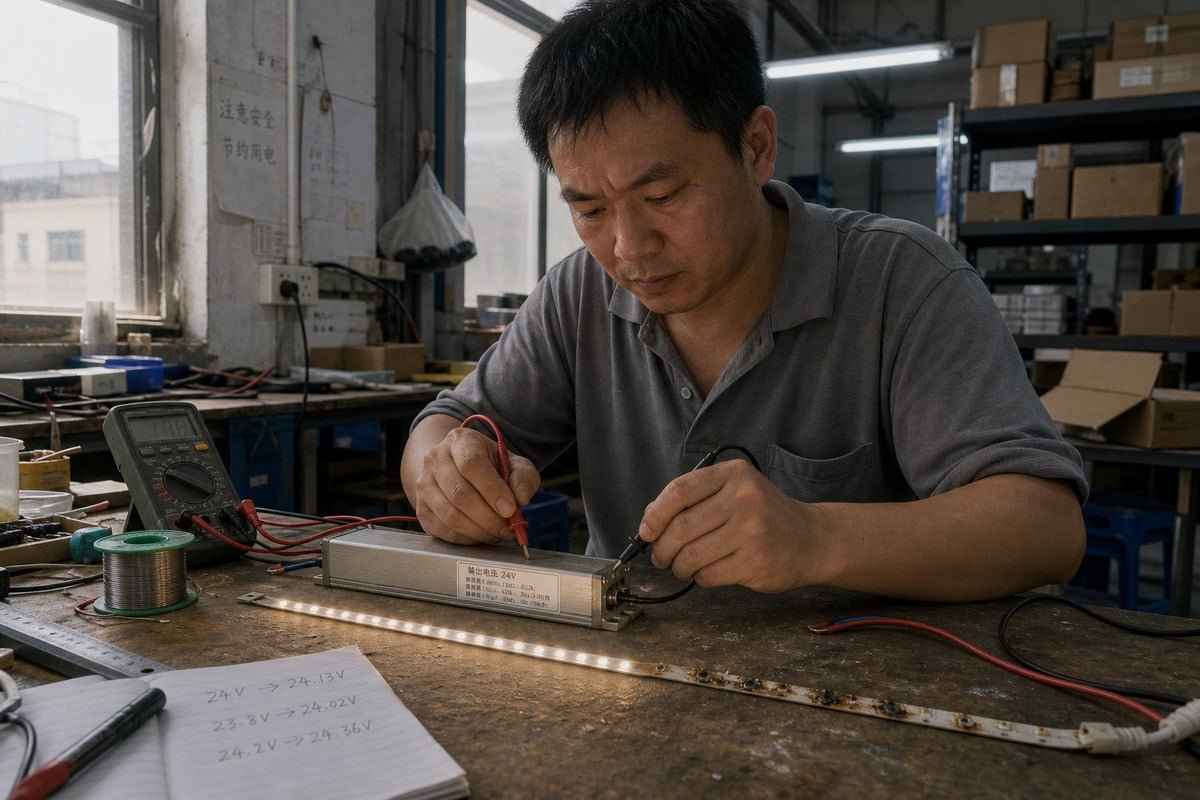
During a recent burn-in run at our Shenzhen facility, we paired sample drivers with 24V tape, neon flex, and signage modules to confirm real-world compatibility before an OEM shipment.
Match constant voltage drivers with LED products designed for a fixed DC input: LED strips, neon flex, RGB/RGBW tape, signage modules, and under-cabinet linear lighting. These products contain current limiting resistors or ICs onboard, so they only need a stable 12V or 24V supply.
The rule is architecture, not brightness. A product qualifies for a CV driver when the current management already lives inside the product itself. Here is how the common categories break down:
| LED product | Rated voltage | Onboard current control | CV driver fit |
|---|---|---|---|
| Flexible LED strip | 12V or 24V | Current limiting resistors per segment | Excellent |
| Neon flex | 24V typical | Resistors inside the extrusion | Excellent |
| RGB/RGBW tape | 12V or 24V | Resistors plus controller ICs | Excellent |
| Signage modules | 12V typical | Resistors or small regulator ICs | Excellent |
| Under-cabinet linear lighting | 24V typical | Onboard regulation | Excellent |
| Bare COB or high-power LED | Varies by chip | None | Not suitable |
Why parallel wiring makes CV so popular
A parallel wiring configuration is the natural partner of a fixed voltage rail. Every branch sees the same 24V, and each branch draws its own current. That is why an LED strip power supply can feed several runs at once, and why installers can add or remove sections freely, as long as the total load stays inside the driver’s current limit. This scalability is exactly what makes CV the default for linear lighting applications 2 and signage.
Where dimming fits in
Most CV systems dim through pulse width modulation dimming. The driver keeps its stable voltage rail, and a PWM dimmer switches the output on and off thousands of times per second. This is why CV supplies pair so cleanly with strip dimmers. In our ODM projects, we always test the driver and the customer’s chosen dimmer together, because power regulation and light control are two separate jobs that must cooperate.
How do I choose the right voltage output for my private-label lighting project?
Every driver spec we quote involves a trade-off between headroom and cost. Oversize the unit and the BOM climbs; undersize it and field failures follow within months.
Match the driver voltage exactly to the LED product’s rated voltage, then size capacity from total wattage. Choose 24V for longer runs to reduce voltage drop, 12V for short accent runs, and add at least 20 percent power margin above the calculated continuous load.
Start with the arithmetic, then question it. Suppose your private-label strip is 24V at 10 W/m and the project needs 20 metres. The total wattage load is 10 × 20 = 200W. The current requirement is 200 ÷ 24 ≈ 8.33A. But I would never let a client buy a 200W driver just because the arithmetic matches. Continuous-load margin, ambient temperature, enclosure ventilation, cable losses, and inrush behavior all eat into nominal capacity. We also ask whether the strip’s power rating was measured under real operating conditions or on an open bench.
12V or 24V: which rail wins?
| Factor | 12V DC | 24V DC |
|---|---|---|
| Voltage drop over distance | Higher relative loss | Half the current, far less drop |
| Maximum practical run length | Shorter | Longer |
| Typical use | Short accent runs, automotive-style projects | Architectural runs, linear lighting applications |
| Cable cost for same wattage | Thicker copper needed | Thinner cable acceptable |
The hidden problem: voltage drop
Here is the point most spec sheets skip. Correct voltage does not automatically mean correct sizing. On long runs, a proper voltage drop calculation matters more than the driver’s nominal wattage. A correctly sized 24V driver can still produce visibly uneven brightness if the distribution wiring is undersized or the strip is fed from only one end. Feed long strips from both ends where possible. Many professional-grade CV drivers also include an adjustable output screw, often marked Vadj, which lets an installer nudge the output up slightly to compensate for wire losses. We specify that feature on most of our dimmable driver lines for exactly this reason.
What quality checks should I request when sourcing constant voltage drivers from a Chinese manufacturer?
A hard lesson from our early export years: a spec sheet is a promise, not proof. We now build every QC requirement into the purchase order itself.
Request full-load burn-in testing, output voltage regulation tolerance reports, inrush current data, temperature derating curves, safety certification copies such as UL Class 2 or CE/ENEC, ripple measurements, and an agreed AQL inspection standard before shipment. Verify each report matches your actual production batch.

After a decade of shipping dimmable drivers to buyers across Singapore, Japan, Germany, and Australia, this is the seven-step verification sequence we recommend procurement managers write into every order:
- Confirm the safety file for your market. Ask which standard applies: UL Class 2 certification for low-voltage installations in North America, CE and ENEC documentation for Europe, or the relevant marks for Southeast Asia and Oceania. Request the certificate number, not just a logo on a datasheet.
- Check output voltage regulation. Ask for the tolerance across the full load range, from minimum load to maximum. A quality CV driver holds its rail tight; a poor one sags under load and causes color shift on RGB tape.
- Demand full-load burn-in. We run extended burn-in at rated load and elevated ambient temperature before packing. Ask your supplier for the burn-in duration, temperature, and failure log.
- Review inrush current data. CV systems can see switch-on spikes reported at up to 50 times the rated current while bulk capacitors charge. Confirm the design includes NTC thermistor protection or equivalent, or your client’s breakers and relays will suffer.
- Get the temperature derating curve. A 200W label at 25°C may mean far less inside a hot ceiling void. The curve tells you the honest capacity.
- Test dimming compatibility. If the project uses PWM dimming 3, ask the factory to test your exact dimmer model with the driver. We do this as standard in our OEM development process because paper compatibility often fails in practice.
- Agree on pre-shipment inspection. Set an AQL sampling level in writing, and confirm the ripple and hi-pot test records travel with the batch. For private-label orders, add label, logo, and packaging checks to the same inspection.
One more tip from our collaborative development work: send the factory your actual LED product, not just its datasheet. Real-load testing catches mismatches that documents never reveal.
Conclusion
Constant voltage means the driver holds 12V or 24V steady while your LED product manages current. Match voltage, size wattage with margin, and verify quality before shipment.
Footnotes
1. Authoritative overview of power supply units and their function in maintaining fixed output voltages for electronic loads. ↩︎
2. Official DOE resource for LED technology and applications, replacing the broken EERE link. ↩︎
3. Technical explanation of Pulse Width Modulation used for controlling power and dimming in LED lighting systems. ↩︎