















As fitas LED TRIAC que se recusam a desligar completamente quase nos custaram um relacionamento com um grande distribuidor na Alemanha no ano passado — e essa reclamação ensinou uma lição crítica à nossa equipe de engenharia.
As fitas LED TRIAC não desligam completamente porque uma pequena corrente de fuga flui através do dimmer mesmo no seu estado desligado. Essa tensão residual energiza parcialmente o driver LED dimerizável e, como os LEDs precisam de muito pouca energia para emitir luz, a fita produz um brilho fraco ou um flash periódico.
A causa raiz quase nunca é a própria fita LED. É a interação entre o dimmer, o Controlador LED 1, e a carga conectada. Abaixo, detalho exatamente por que isso acontece e o que você pode fazer a respeito.
O que faz com que minhas fitas LED TRIAC permaneçam fracamente iluminadas mesmo depois de eu desligá-las?
Durante uma auditoria de fábrica no último trimestre, conectamos a mesma fita LED a três dimmers TRIAC diferentes em nossa bancada de testes — e obtivemos três resultados completamente diferentes no estado desligado.
A principal causa é a corrente de fuga do dimmer. Os semicondutores TRIAC nunca alcançam um circuito aberto perfeito, então 1–5 mA de corrente podem passar mesmo quando o dimmer está desligado. Essa corrente minúscula é invisível para lâmpadas incandescentes, mas suficiente para fazer as fitas LED brilharem.

Por que os LEDs reagem a microcorrentes
Lâmpadas incandescentes precisam de corrente substancial para aquecer um filamento. Os LEDs não. Uma corrente que seria completamente invisível em uma lâmpada halógena de 60 W pode produzir um efeito de ghosting perceptível em uma fita LED classificada em apenas alguns watts. Isso não é um defeito. É uma consequência direta da eficiência do LED. A junção semicondutora 2 dentro de cada LED pode emitir fótons em níveis de microampères. Essa sensibilidade é o que torna os LEDs energeticamente eficientes — e também o que os torna vulneráveis a cada miliampère perdido no circuito.
As cinco causas raiz
Classifiquei as causas pela frequência com que as encontramos em retornos reais de campo:
| Causa | O que acontece | Quão comum |
|---|---|---|
| Dimmer corrente de fuga 3 | 1–5 mA passa através do TRIAC mesmo quando desligado | Muito comum |
| Requisito de carga mínima não atendido | O dimmer não consegue operar corretamente abaixo de sua carga LED nominal | Comum |
| Acoplamento capacitivo na fiação | Fios energizados adjacentes induzem tensão fantasma no ramal comutado | Moderado |
| Energia armazenada nos capacitores do driver | Capacitores eletrolíticos descarregam lentamente através dos LEDs | Moderado |
| Piso de tensão do firmware do dimmer | Dimmers digitais definem uma saída mínima acima do zero real de volts | Menos comum |
Há também uma corrente de retenção 4 questão que vale a pena entender. Um TRIAC permanece travado — conduzindo — até que a corrente através dele caia abaixo de um limiar chamado corrente de retenção em cada cruzamento de zero da CA. Com cargas LED muito pequenas, a corrente pode oscilar próxima a esse limiar. O TRIAC pode não se redefinir completamente ao seu estado não condutivo em cada ciclo. O resultado é imprevisível: às vezes a fita desliga, às vezes não.
Comportamento Leading Edge vs. Trailing Edge
Um dimmer leading edge corta a frente de cada semiciclo de CA. Um dimmer trailing edge corta a parte de trás. Ambos os tipos de dimerização por corte de fase 5 podem vazar corrente, mas se comportam de maneira diferente na extremidade inferior da faixa de dimerização.
Nos nossos testes, os dimmers de corte de fase descendente geralmente produzem uma dimerização mais suave na faixa baixa. Mas “mais suave” nem sempre significa “zero verdadeiro”. Ambos os tipos podem permitir que a tensão residual chegue ao driver se a rede snubber interna do dimmer criar um caminho de bypass. Esse snubber — um circuito RC projetado para proteger o TRIAC contra picos de tensão — é um caminho CA permanente entre a linha e a carga. Ele existe em quase todos os dispositivos de dimerização por corte de fase.
O ciclo de carregamento que causa o flashing
Às vezes a fita não brilha continuamente. Em vez disso, ela pisca a cada poucos segundos. Isso acontece porque a corrente de fuga carrega lentamente os capacitores de entrada dentro do driver LED. Quando energia suficiente se acumula, o driver inicia brevemente, entrega um pulso de energia aos LEDs, e os capacitores se descarregam. Então o ciclo se repete:
Corrente de fuga → capacitor carrega → driver inicia brevemente → LEDs piscam → capacitor descarrega → ciclo se repete
Esse flashing periódico é mais alarmante para os usuários finais do que um brilho tênue, mas a causa raiz é a mesma: corrente residual do dimmer alcançando um driver que precisa de muito pouca energia para despertar.
Como posso corrigir o problema de brilho residual ao usar dimmers TRIAC com fitas LED?
O trade-off que avaliamos em cada projeto é direto: você deve tratar o sintoma no lado da carga, ou resolver o problema no nível dimmer-driver?
Você pode corrigir o brilho residual adicionando um resistor de carga fictícia ou capacitor de bypass de LED na saída, substituindo o dimmer por um classificado para cargas de LED baixas ou — de forma mais confiável — usando um driver de LED dimerizável e dimmer combinados e testados juntos como um sistema completo.

Correções rápidas vs. soluções adequadas
Nem toda correção carrega o mesmo risco ou custo. Aqui está uma comparação classificada do mais simples ao mais confiável:
| Correção | Como Funciona | Prós | Contras |
|---|---|---|---|
| Resistor de carga fictícia | Adiciona uma carga resistiva para elevar a potência total acima do requisito de carga mínima do dimmer | Barato, rápido de instalar | Desperdiça energia, pode superaquecer se mal dimensionado |
| Capacitor de bypass LED | Absorve a corrente de fuga e impede que ela chegue ao driver | Pequeno, barato | Deve ser corretamente especificado; valor errado pode causar cintilação ou risco de segurança |
| Substituir o dimmer | Use um dimmer com carga mínima mais baixa e classificação LED adequada | Resolve a causa raiz no interruptor | Custo mais alto, requer religação |
| Sistema dimmer-driver combinado | Use um driver e dimmer testados juntos para compatibilidade de faixa completa | Melhor confiabilidade em todas as condições de dimerização | Requer fornecimento de um único ecossistema testado |
| Desconexão física baseada em relé | Um relé abre fisicamente o circuito quando o dimmer atinge zero | Isolamento galvânico verdadeiro, corrente zero garantida | Adiciona complexidade, custo e um componente adicional |
Por que componentes aleatórios são perigosos
Um dos maiores erros que vejo em campo é um instalador adicionando um resistor ou capacitor aleatório para eliminar o efeito de ghosting. Se o componente for subdimensionado, ele superaquece. Se for sobredimensionado, interfere no desempenho da dimerização. E se não for classificado para tensão de rede, torna-se um risco de incêndio.
Nossa equipe de engenharia testou dezenas de componentes de “correção” de pós-venda. Os resultados são inconsistentes. Alguns funcionam com um dimmer e falham com outro. Alguns funcionam à temperatura ambiente, mas falham quando o invólucro do driver aquece durante a operação de verão. A deriva térmica da sensibilidade do gate do TRIAC piora a corrente de fuga à medida que as temperaturas sobem, então uma correção que funciona em um laboratório frio pode falhar em um vazio de teto a 45 °C.
Eu aconselho fortemente contra adicionar componentes não especificados sem consultar o fabricante do driver. A correção mais barata nem sempre é a mais segura.
A abordagem em nível de sistema
O caminho mais confiável é tratar o dimmer, o driver e a carga LED como um sistema integrado. Quando desenvolvemos nossos drivers LED TRIAC de tensão constante Boqi, nós os testamos contra uma lista de modelos compatíveis de dimmer de corte de fase ascendente e dimmer de corte de fase descendente. Esse teste de compatibilidade cobre comportamento de inicialização, faixa de dimerização, cintilação e — criticamente — comportamento de desligamento.
Um sistema adequadamente combinado elimina a necessidade de componentes de bypass completamente. Também melhora a estabilidade da dimerização, o desempenho na faixa baixa e a confiabilidade na inicialização. É por isso que sempre recomendamos que nossos distribuidores e fabricantes de iluminação especifiquem o dimmer e o driver juntos, não como itens de linha separados.
A mesma fita LED pode desligar perfeitamente com o Dimmer A, brilhar fracamente com o Dimmer B e cintilar com o Dimmer C. Os dimmers TRIAC não são eletricamente idênticos, mesmo quando todos são comercializados como “compatíveis com LED”. Esse é o problema central, e a correspondência em nível de sistema é a solução central.
Quais drivers de LED devo especificar para evitar desligamento incompleto em meus projetos de dimerização TRIAC?
Uma gerente de compras em Singapura uma vez me disse que testou quatro drivers diferentes “compatíveis com TRIAC” de quatro fornecedores — e apenas um desligou completamente com o dimmer do seu projeto.
Especifique um driver LED dimerizável que apresente uma tabela de compatibilidade de dimmers testada, suporte dimerização por corte de fase leading edge e trailing edge, tenha baixo consumo de energia em standby e atenda ao requisito de carga mínima do dimmer escolhido. Drivers sem dados de compatibilidade publicados são um risco.

O que procurar em um datasheet de driver
Nem toda folha de dados lhe diz o que você precisa saber. Aqui estão as especificações que mais importam para prevenir o desligamento incompleto:
| Especificação | Por Que Importa | O Que Observar |
|---|---|---|
| Tipo de dimerização | Confirma compatibilidade com dimerização por corte de fase | “TRIAC / corte de fase ascendente / corte de fase descendente” claramente indicado |
| Nível mínimo de dimerização | Mostra quão baixo o driver pode dimerizar | 1% ou menor é ideal; 5% ou acima pode não atingir o desligamento verdadeiro com alguns dimmers |
| Potência em standby | Energia consumida quando o dimmer está no mínimo | Abaixo de 0,5 W reduz a tensão residual e o risco de ghosting |
| Lista de dimmers testados | Comprova a compatibilidade no mundo real | Modelos de dimmer nomeados com resultados de desempenho confirmados |
| Faixa de tensão de saída | Deve corresponder à sua fita LED | Tensão constante: 12 V ou 24 V DC |
| Potência nominal vs. carga mínima do dimmer | O driver deve consumir corrente suficiente para o dimmer operar | Verifique se a potência de entrada do driver excede a carga mínima LED declarada pelo dimmer |
Tensão constante vs. corrente constante
Para aplicações com fita LED, você quase sempre precisa de um driver de tensão constante. A própria fita contém resistores integrados que regulam a corrente para cada cluster de LED. Um driver de corrente constante é projetado para diferentes tipos de luminária — painéis de luz, downlights e produtos similares onde os LEDs são ligados em série.
Quando projetamos nossos drivers LED TRIAC de tensão constante Boqi, o estágio de entrada é otimizado para sinais de dimming por corte de fase. Isso significa que o correção do fator de potência 6 circuito e o filtro EMI são ajustados para que os capacitores Y do filtro não criem caminhos de fuga excessivos. A fuga do capacitor Y do filtro EMI é uma das causas menos óbvias do brilho fantasma. O próprio filtro pode vazar correntes mínimas para o terra do chassi, e se a fita LED estiver montada em um canal de alumínio aterrado, forma-se um circuito fantasma que contorna completamente o caminho de energia pretendido.
Por que “Compatível com LED” Não É Suficiente
Muitos dimmers são comercializados como “compatíveis com LED”, mas esse rótulo não tem nenhum padrão universal por trás. Significa simplesmente que o dimmer foi projetado pensando em cargas LED. Isso não garante operação limpa com o seu driver específico.
O mesmo vale para o lado do driver. Um driver rotulado como “TRIAC dimmable” confirma que ele pode aceitar uma entrada AC com corte de fase. Isso não confirma dimming suave, partida confiável ou desligamento completo com todos os dimmers TRIAC do mercado.
É exatamente por isso que publicamos listas de compatibilidade de dimmers testadas com nossos drivers Boqi. Nossa equipe em Shenzhen testa cada modelo de driver com uma bateria de dimmers dos mercados para os quais exportamos — incluindo modelos comuns no Reino Unido, Alemanha, Austrália e Sudeste Asiático. Esse processo leva tempo, mas poupa nossos distribuidores de falhas custosas em campo e reclamações de garantia.
A verdadeira pergunta que um responsável de compras deveria fazer não é “Este driver é TRIAC dimmable?” mas “Este driver foi testado com o dimmer específico que meu projeto utiliza?” Se o fornecedor não puder responder a essa pergunta com dados, o risco fica com você.
Como faço para testar a compatibilidade com TRIAC antes de confirmar um pedido em grande quantidade com meu fornecedor?
Uma lição que aprendemos cedo em nosso negócio de exportação: nunca aprove um pedido em volume com base em um único teste de bancada à temperatura ambiente com fios curtos.
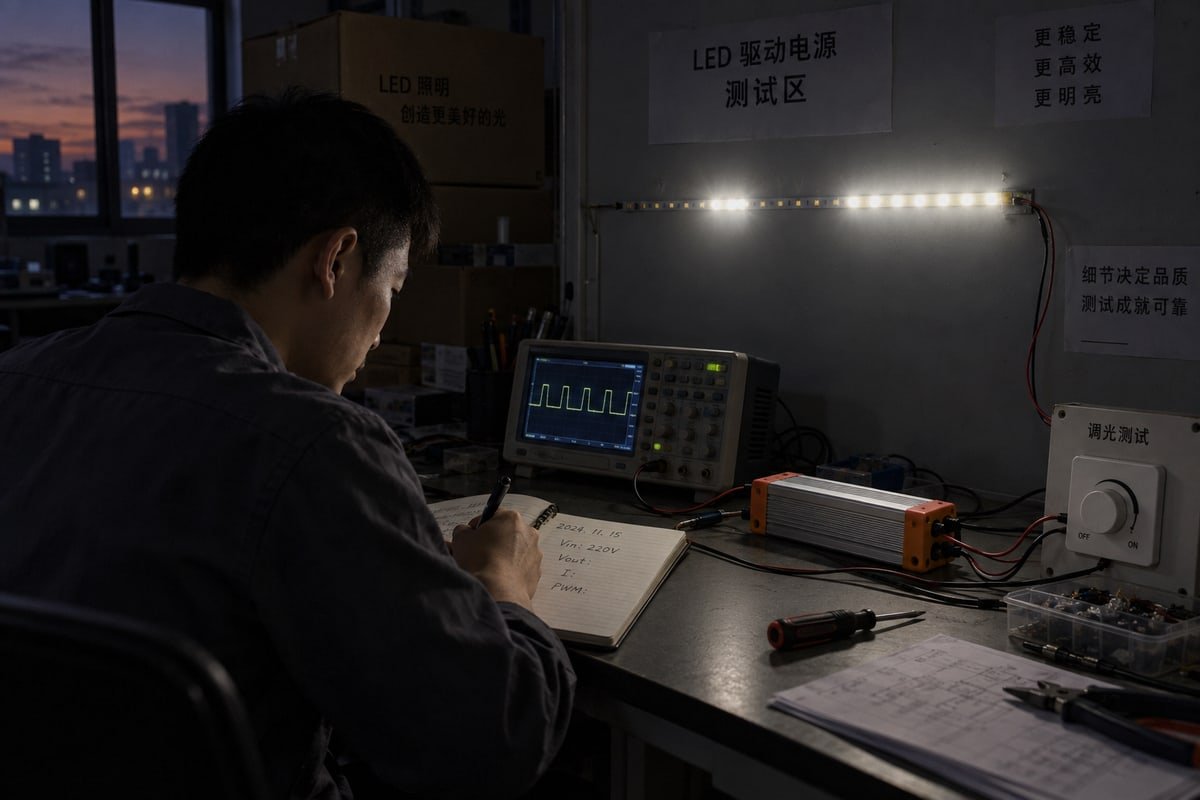
Teste a compatibilidade com TRIAC executando o driver de LED e o dimmer juntos através de um protocolo estruturado que verifica a inicialização, a dimerização em faixa completa, a estabilidade no limite inferior, a cintilação e o desligamento completo — depois repita em temperatura elevada e com comprimento máximo de fio para simular condições reais de campo.
Um protocolo prático de testes em sete etapas
Aqui está o protocolo que usamos internamente antes de aprovar um par dimmer-driver para envio de produção:
- Teste de partida a frio. Ligue o dimmer a partir de zero. A fita LED deve acender suavemente sem acender de repente em um nível de brilho aleatório.
- Varredura de faixa completa. Dimme lentamente de 100% até o mínimo. Observe flicker, stepping ou saltos bruscos de brilho.
- Manutenção no nível baixo. Ajuste o dimmer para seu nível visível mais baixo e deixe por 10 minutos. A saída deve permanecer estável sem flicker visível.
- Teste de desligamento. Desligue o dimmer. A fita deve apagar completamente em até 2 segundos sem brilho residual e sem piscadas periódicas.
- Teste térmico. Enclausure o driver em um espaço que simule um vão de teto ou cavidade de móvel. Opere por 2 horas em nível de dimming baixo, depois repita o teste de desligamento. A deriva térmica da sensibilidade do gate do TRIAC aumenta a corrente de fuga quando o dispositivo está quente.
- Teste de comprimento de fio. Adicione o percurso máximo de cabo que você espera na instalação real. Fios mais longos aumentam o acoplamento capacitivo, o que pode introduzir tensão fantasma no circuito LED.
- Teste com múltiplas unidades. Conecte o número de drivers que você planeja instalar em um único circuito de dimmer. Múltiplos drivers alteram a carga total e podem empurrar o sistema para fora da janela de operação do dimmer.
Como as falhas se manifestam
Cada padrão de falha aponta para uma causa raiz diferente. Use esta tabela para diagnosticar o que você observa durante os testes:
| Sintoma Durante o Teste | Causa Provável | Ação Recomendada |
|---|---|---|
| A fita acende de repente em 30% em vez de 0% | Piso de tensão do firmware do dimmer ajustado muito alto | Tente um dimmer diferente ou solicite ajuste de firmware |
| A fita apresenta flicker em níveis baixos | O sinal de corte de fase está instável em ângulo de condução baixo | Troque de dimmer leading edge para dimmer trailing edge |
| Brilho fraco quando desligado | Corrente de fuga ou bypass da rede snubber | Confirme a compatibilidade dimmer-driver ou use um sistema combinado |
| Flash periódico a cada 3–5 segundos | Ciclo de carga-descarga do capacitor por tensão residual | Adicione um capacitor de bypass LED testado ou troque para um dimmer compatível |
| Funciona à temperatura ambiente mas brilha quando quente | A deriva térmica aumenta a corrente de fuga do TRIAC | Use um dimmer com especificação de corrente de fuga mais baixa |
Quantas amostras testar
Recomendo testar pelo menos 3 amostras de cada componente. As tolerâncias de fabrico significam que uma amostra pode passar enquanto outra falha no limite. Se 1 em cada 3 amostras falhar o teste de desligamento, isso é um sinal de alerta para a fiabilidade em campo. Aplicamos esta regra à nossa própria produção — cada lote de drivers LED TRIAC Boqi passa por verificações pontuais de compatibilidade com dimmers antes de aprovarmos o envio.
Quando solicitar amostras antes de encomendar
Se o seu fornecedor não conseguir fornecer uma lista de compatibilidade com dimmers testada, peça amostras e execute o protocolo acima você mesmo. O custo de 5 drivers de amostra e uma semana de testes é muito inferior ao custo de um recall em campo de milhares de unidades. Este é o conselho que dou a cada novo distribuidor que nos contacta através do nosso website ou em feiras comerciais.
Um sistema de dimerização TRIAC deve ser sempre avaliado como um sistema completo. A questão importante não é “Isto é um dimmer TRIAC?” A questão é “Este dimmer foi testado e comprovado compatível com este driver LED específico?” Utilizar uma combinação testada — como drivers LED TRIAC de tensão constante Boqi emparelhados com dimmers de corte inicial e corte final Boqi compatíveis — proporciona aos instaladores e fabricantes de iluminação um desempenho mais previsível no arranque, gama de dimerização, controlo de cintilação e comportamento de desligamento.
Essa é a verdadeira diferença entre um sistema que dimeriza com sucesso durante um teste rápido de bancada e um que opera de forma fiável numa instalação real durante anos.
Conclusão
As fitas LED TRIAC que não desligam são um problema de sistema, não um defeito da fita. Combine o seu dimmer, driver LED dimerizável e carga como um sistema testado para eliminar o brilho residual de vez.
Interessado em adquirir os produtos mencionados neste artigo? Veja detalhes e solicite um orçamento aqui:
Notas de Rodapé
Fornece uma visão geral técnica dos drivers LED e o seu papel fundamental nos circuitos de iluminação. ↩︎
Explicação autorizada de como as junções semicondutoras LED operam e a sua eficiência energética inerente. ↩︎
Definição científica e contexto de engenharia para corrente de fuga em circuitos eletrónicos e semicondutores. ↩︎
Explica o funcionamento do semicondutor TRIAC e o conceito de corrente de retenção referido no artigo. ↩︎
Normas industriais para compatibilidade de dimerização entre iluminação de estado sólido e sistemas de dimerização por corte de fase. ↩︎
Explica o conceito elétrico de correção do fator de potência utilizado em sistemas de iluminação de alta eficiência. ↩︎